🏹 Bow Spine Calculator
Find the correct AMO arrow spine rating for your bow setup — compound, recurve, longbow & traditional
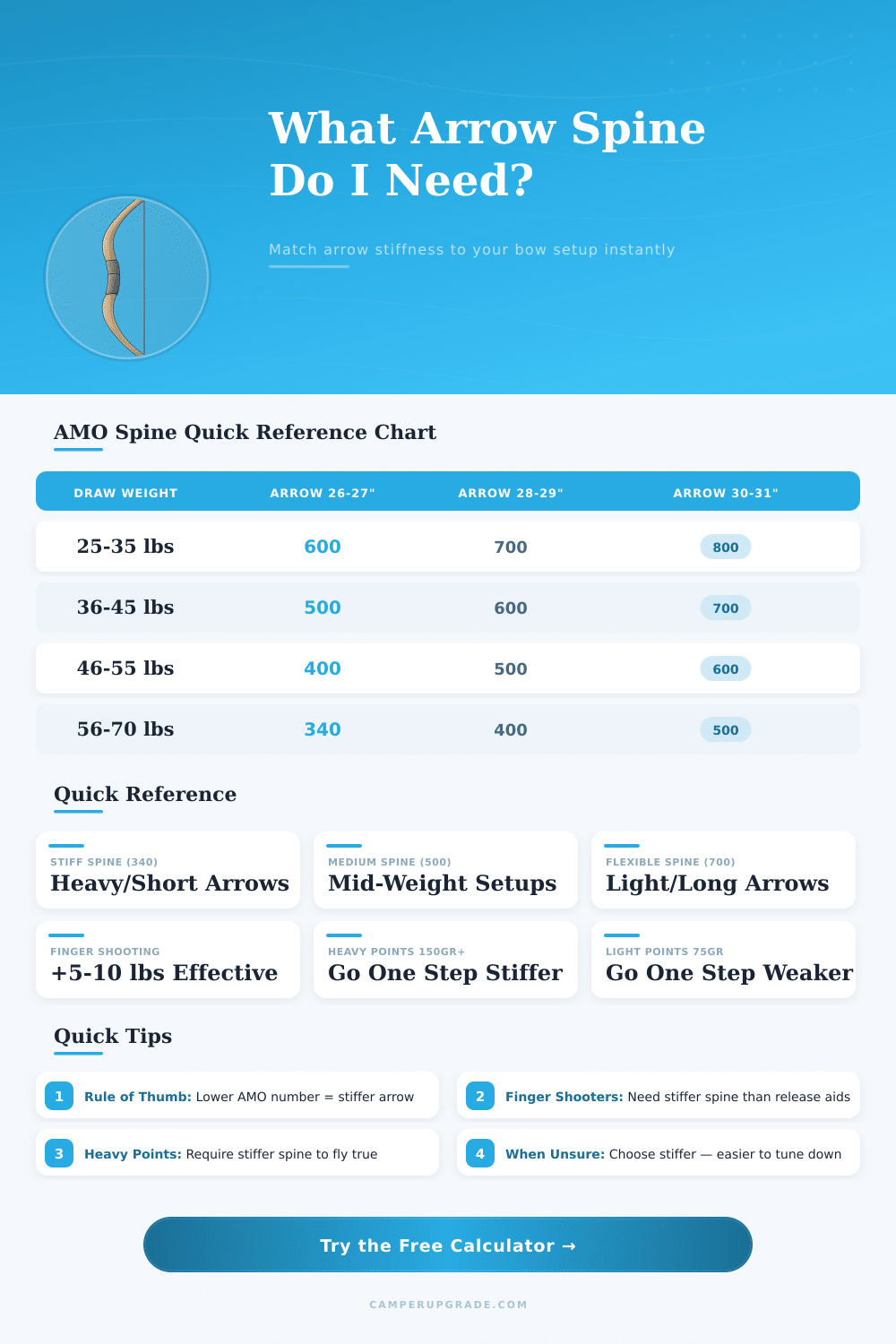
| Effective Draw Weight | Arrow 25-26" | Arrow 27-28" | Arrow 29-30" | Arrow 31-32" |
|---|---|---|---|---|
| 20-25 lbs | 700 | 800 | 900 | 1000 |
| 26-30 lbs | 600 | 700 | 800 | 900 |
| 31-35 lbs | 500 | 600 | 700 | 800 |
| 36-40 lbs | 500 | 500 | 600 | 700 |
| 41-45 lbs | 400 | 500 | 500 | 600 |
| 46-50 lbs | 400 | 400 | 500 | 500 |
| 51-55 lbs | 350 | 400 | 400 | 500 |
| 56-60 lbs | 340 | 350 | 400 | 400 |
| 61-65 lbs | 300 | 340 | 350 | 400 |
| 66-70 lbs | 260 | 300 | 340 | 350 |
| 71-80 lbs | 250 | 260 | 300 | 340 |
| AMO Spine # | Deflection (in) | Stiffness | Typical Use |
|---|---|---|---|
| 250 | 0.250" | Very Stiff | Heavy bows 70-100 lbs |
| 260 | 0.260" | Very Stiff | Heavy hunting 65-75 lbs |
| 300 | 0.300" | Stiff | 60-70 lb compound/recurve |
| 340 | 0.340" | Stiff | 55-65 lb compound standard |
| 350 | 0.350" | Medium-Stiff | 50-60 lbs, hunting |
| 400 | 0.400" | Medium | 45-55 lbs, most compounds |
| 500 | 0.500" | Medium-Flex | 35-50 lbs, recurve/compound |
| 600 | 0.600" | Flexible | 30-40 lbs, recurve |
| 700 | 0.700" | Very Flexible | 25-35 lbs, light recurve |
| 800 | 0.800" | Extra Flex | 20-30 lbs, youth/beginner |
| 900 | 0.900" | Ultra Flex | Under 25 lbs, children |
| 1000 | 1.000" | Max Flex | Very light, practice only |
| Point Weight | vs 100gr Baseline | Spine Adjustment | Effect |
|---|---|---|---|
| 75 gr | -25 gr | One step weaker | Lighter tip needs weaker spine |
| 100 gr | Baseline | No adjustment | Standard reference point |
| 125 gr | +25 gr | One step stiffer | Heavier tip needs stiffer spine |
| 150 gr | +50 gr | Two steps stiffer | Heavier tip needs stiffer spine |
| 200 gr | +100 gr | Three steps stiffer | Very heavy tip, much stiffer |
Find the right arrow spine for your bow seems simple until you actually start to research the theme. Basically, arrow spine is only a measure of the flex of the arrow. When the string pushes the arrow forward it bends, and that flex must match with your particular bow setup.
Some factors affect the calculation of that spine needed: draw weight, arrow length and the weight of the point all matter. Most spine charts ask for those three pieces of information to give you an answer. With a compound bow, things are quite easy, you simply use the draw weight that the bow represents.
How to Find the Right Arrow Spine for Your Bow
Gold Tip offers a tool for choosing spine that removes the guessing for matching arrows to your rig. Their chart maybe suggests an arrow with 500-spine for your setup if you shoot a 100-grain point. But if you extend the arrow to 30 inches, suddenly your bow reqiures something more rigid, for instance 400-spine.
If you increase the draw weight to 60 pounds and keep the arrow at 27 inches, the chart still asks for 400-spine. Different variables, but occasionally the same answer.
Then we have the dynamic spine, where things become real. That is how the arrow actually acts when it leaves the bow. It moves based on the draw weight, arrow length, weight of the point and the type of bow that you use.
Even changing your draw length affects how the arrow reacts. Static spine never adjusts, but dynamic spine permanently moves based on your setup.
The following information does not come from the calculator.
Here maker charts commonly fail, they do not explain how your bow is cut or what rest setup you use. Bow cut “dead center” against one cut “center-shot” could require different dynamic spines, even if the weight and length stay the same. The dynamic spine calculator of 3Rivers seems to be nearer to the reality than most maker advice.
Other problematic spot is that spine numbers base on weight rather than actual measure of deflection. If everything were presented by deflection, matching arrows to your bow would be much more simple. Old 50-pound recurve could draw 500-spine arrows, while modern 50-pound recurve maybe need 300s, entirely different tools.
Traditional recurve shooters usually use spine charts created for center-shot bows, finger release and points around 100 to 125 grains. You can alter the result by changing the point weight or altering the plunger and rest. Shooting bare shafts and trying various spines are better than only trusting the figures.
Arrows that are too rigid group outside, for right-handers, that usually means shooting to the left. Spine matters, although some bows are more forgiving thanothers.