🏹 Bow Let-Off Calculator
Calculate your holding weight at full draw and optimize your compound bow setup
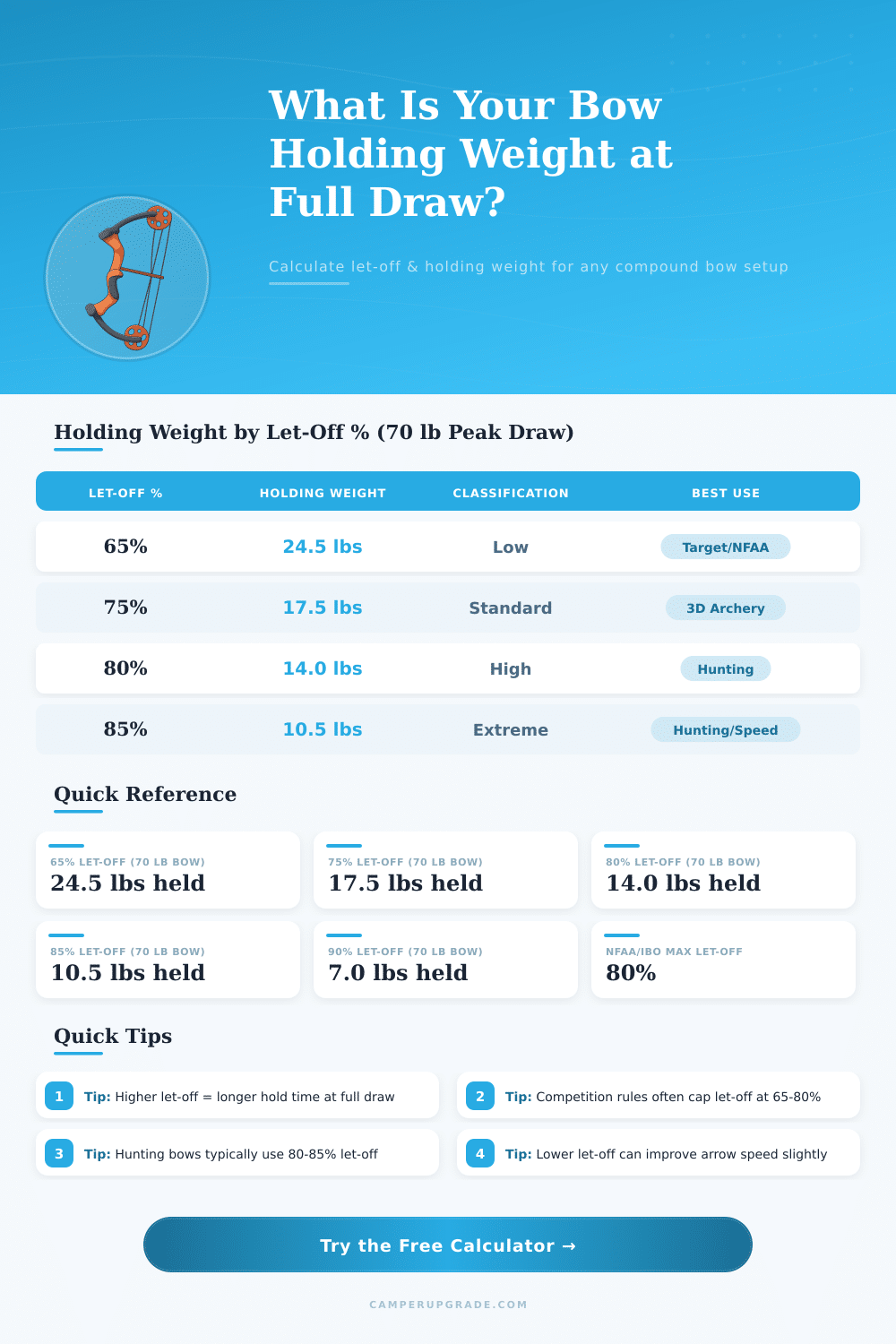
| Let-Off % | Hold at 60 lbs | Hold at 70 lbs | Hold at 80 lbs | Classification |
|---|
| Application | Recommended Let-Off | Pros | Cons |
|---|---|---|---|
| Hunting | 80-85% | Long hold, less fatigue | May reduce speed |
| 3D Archery | 75-80% | Balanced hold/speed | Check tournament rules |
| NFAA Target | 65-80% | Competition legal | More hold effort |
| IBO/ASA Competition | Up to 80% | Regulation compliant | Check class rules |
| Speed Shooting | 90% | Max stored energy | Often not comp-legal |
| Youth/Beginner | 80% | Easier to hold | Slightly less speed |
Letoff is genuinely one of the most important factors about compound bows. Here what it means: when you reach the full draw, part of that maximum weight simply disappears. For instance, if you use 60-pound bows with 80% letoff…
At the anchor, you keep only around 12 pounds instead of the full force. Even so, you yet must draw back the whole 60 pounds to reach that The magic of letoff happen only after you reach the highest spot of the draw.
What is let-off in a compound bow
When compound bows first appeared, the letoff were around 30 to 40 percent. Later things changed, 50% became the standard, and later 65% started to be popular. Fast to today, and you can find bows with 80% or even more on the market.
Some maker even bids 99% letoff, yet keep his bows fast and forgiving. There are even special models with 100% letoff, although that is very niche and require almost perfect form to be precise.
The design of the cam is what does this difference. Those early compound bows had eccentric wheels, that usually gave around 50% letoff. Modern cams.
Those elliptical or bean-shaped, give much more letoff than the old round designs evre could.
Here why letoff is so important in compound shooting. It allows hunters use higher weights, yet keep good accuracy and control. Higher letoff means that you can keep the full draw without tiring your body, what is very useful during a hunt.
Imagine that: you hunt deer, you draw back and suddenly the creature moves. That extra time at full draw without your arms trembling? That entirely alters the game.
Target shooters however see things differently. Most of them prefer lower letoff because it forces you stay active, you always pull against the wall, what improves your form. More muscles stay active when you keep heavier weight, and that leads to more stable shooting.
Moreover, bows with less letoff are a bit faster, what gives some feet advantage on the second shot.
Change the letoff is not difficult if you know what you do. You can exchange different modules, move the stops, or change the position of the module regarding the stop, move it shorter usually increase the valley and reduce the holding weight. Build the stops themselves also can lower the letoff.
Even the twist of the string technically alter the actual letoff compared with what the cam specs say.
Here where it becomes legal problem: some states have rules about how much letoff you can use during hunting. Some places limited it at 65%, later at 80%, and now they say there is no limit for hand-held bows. But not every state follows that.
Some guards check the percentage written on your modules, and if you are above the limit, you will receive a ticket. Someguards control the percentage written on your modules, and if you are above the limit, you will receive a ticket.