🏹 Bow Draw Weight Calculator
Find the right draw weight for your age, build, and archery goals
| Age Group | Gender | Build | Recommended Range | Notes |
|---|---|---|---|---|
| Youth (<12) | Any | Slight | 10–20 lb | Form & fun first |
| Youth (<12) | Any | Average | 15–25 lb | Build gradually |
| Teen (13–17) | Male | Average | 25–40 lb | Room to grow |
| Teen (13–17) | Male | Athletic/Strong | 35–50 lb | Check draw length |
| Teen (13–17) | Female | Average | 20–35 lb | Form over weight |
| Adult (18–50) | Male | Slight | 30–45 lb | Fine for target/3D |
| Adult (18–50) | Male | Average | 45–65 lb | Most common range |
| Adult (18–50) | Male | Athletic | 55–70 lb | Elk hunting capable |
| Adult (18–50) | Male | Strong | 60–80 lb | Max compound typical |
| Adult (18–50) | Female | Slight | 20–35 lb | Target ideal |
| Adult (18–50) | Female | Average | 25–45 lb | Deer hunting capable |
| Adult (18–50) | Female | Athletic/Strong | 40–55 lb | Versatile range |
| Senior (50+) | Male | Average | 35–55 lb | Joint health priority |
| Senior (50+) | Female | Average | 25–40 lb | Comfort key |
Compound bow estimate: ±2.5% of rated weight per inch from 28" standard. Actual values vary by bow model.
| Game Animal | Minimum (lb) | Recommended | Notes |
|---|---|---|---|
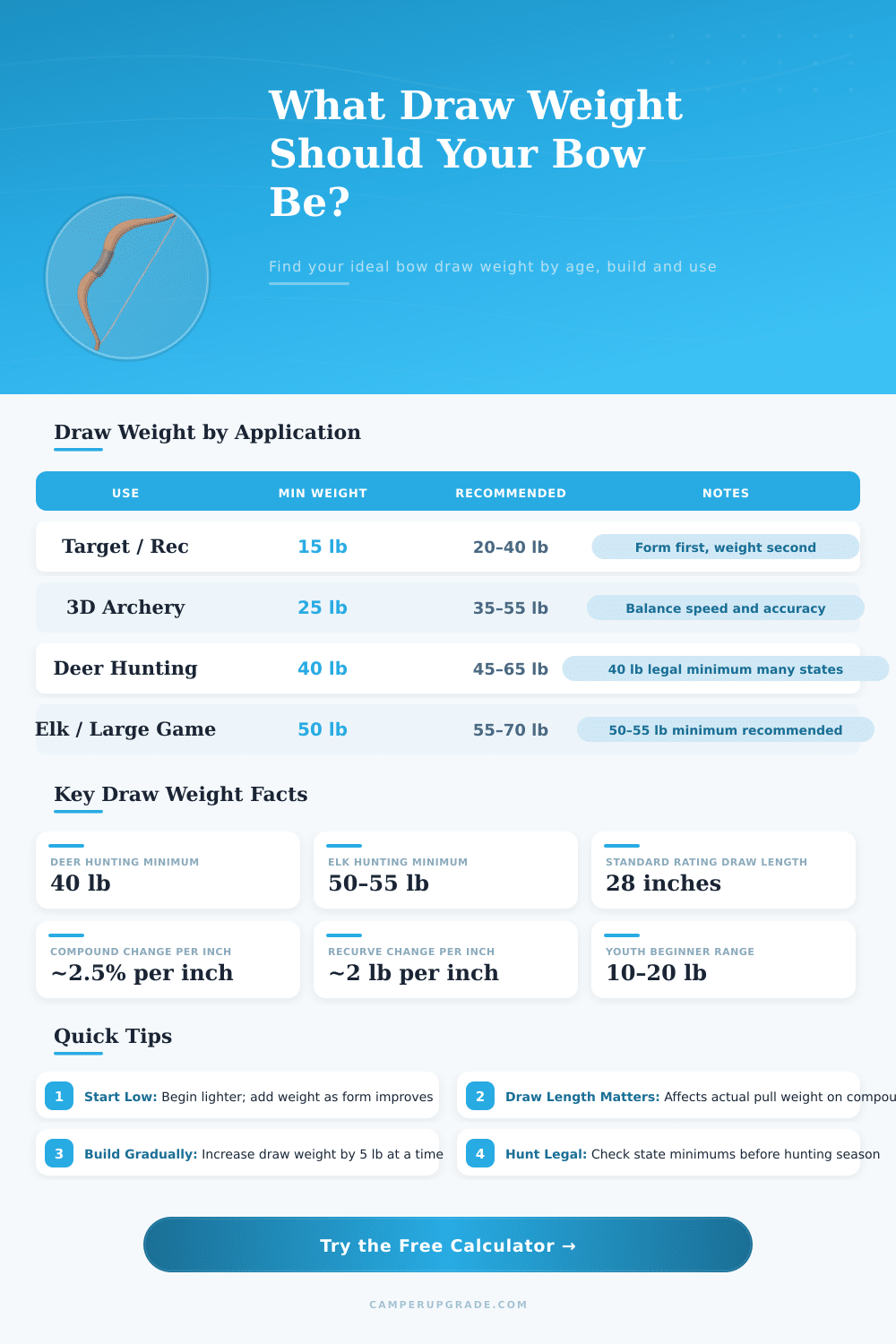
| Deer (whitetail, mule) | 40 lb | 45–65 lb | Most states require 40 lb minimum; some allow 35 lb |
| Elk | 50 lb | 60–70 lb | 50–55 lb typically required; higher recommended |
| Bear | 50 lb | 60–80 lb | Dense hide; higher weight aids penetration |
| Wild Boar | 40 lb | 50–70 lb | Tough hide; penetration important |
| Small Game / Turkey | 30 lb | 35–50 lb | Lighter weight acceptable; accuracy matters more |
⚠️ Always verify your state or province regulations before hunting season. Minimum draw weight laws vary by jurisdiction.
| Bow Type | Typical Range | Adjustability | Characteristics |
|---|---|---|---|
| Compound | 40–80 lb | Adjustable (±10 lb range typical) | Let-off reduces holding weight 65–90%; rated at 28" |
| Recurve | 20–60 lb | Fixed (by limb selection) | Rated at archer's draw length; ±2 lb per inch change |
| Longbow | 30–80 lb | Fixed | Rated at specific draw length; weight climbs with draw |
| Crossbow | 75–200 lb | Fixed | High draw weight; mechanical advantage makes it manageable |
Draw weight is the force needed to pull the bowstring back to full draw. It is measured in pounds. It is very important to find the right weight, mainly when you start to learn.
If you choose a bow too heavy that can cause real problems
How to Choose the Right Draw Weight for Your Bow
On most bows, the written draw weight is measured at a length of 28 inches. That is the standard in the world of archery to compare different models. Still, if your draw length is shorter or longer than 28 inches, the actual weight changes.
For every inch above 28, you add about 2 to 3 pounds to the draw. For instance, a bow of 30 pounds drawn to only 27 inches will feel closer to 28 pounds.
When you pull the bowstring back, energy gathers in the arms of the bow. This energy transfers to the arrow when you release it. Higher draw weight gives faster arrow speed and deeper penetration.
But it also requires more strength and the skill to draw correctly.
New archers commonly make a mistake and choose too heavy draw weight. Beginners should not go past 30 pounds, and most should indeed start under 25 pounds. Some even suggest 15 to 20 pounds as a good starting point.
The problem is that beginers can physically pull heavy weights, but the muscles used for archery are not the same as those in everyday life or other sports. Adults usually should consider the range of 18 to 22 pounds.
For men, the initial range can be 20 to 45 pounds, depending on the physical build and strength. Women commonly start around 20 pounds. It is a smart move to look at the physical build of a person before giving them a bow.
Compound bows are a bit different because of the “let-off“. At 80 percent let-off, most shooters feel only about 18 pounds or less at full draw. Hence, starting at 40 to 50 pounds for an adult man on a compound bow is reasonable, and around 60 pounds for hunting.
If you hunt with a recurve bow, 40 pounds is usually the minimum draw weight. Some states have their own rules, so it is important to check the local laws before going out. For instance, Alaska requires 45 pounds for hunting with a bow.
For target shooting beyond 60 yards, a minimum of 35 pounds is a good starting point.
A good test is whether you can hold the bow at full draw for 5 to 10 seconds comfortably. Shooting more often with the current weight before increasing the pounds helps to avoid injuries and improve the form. Drawing a bow is not a natural motion, so too fast an increase of the weight can cause problems.
If something feels uncomfortable, using a bow with lower weight can help get things back on track. Budget bows commonly have a bigger range of adjustment, going from around 15 to 70 pounds.