🏹 Archery Angle Calculator
Find your true shooting distance when hunting uphill or downhill. Enter your slant range and angle — the Rifleman’s Rule is applied automatically.
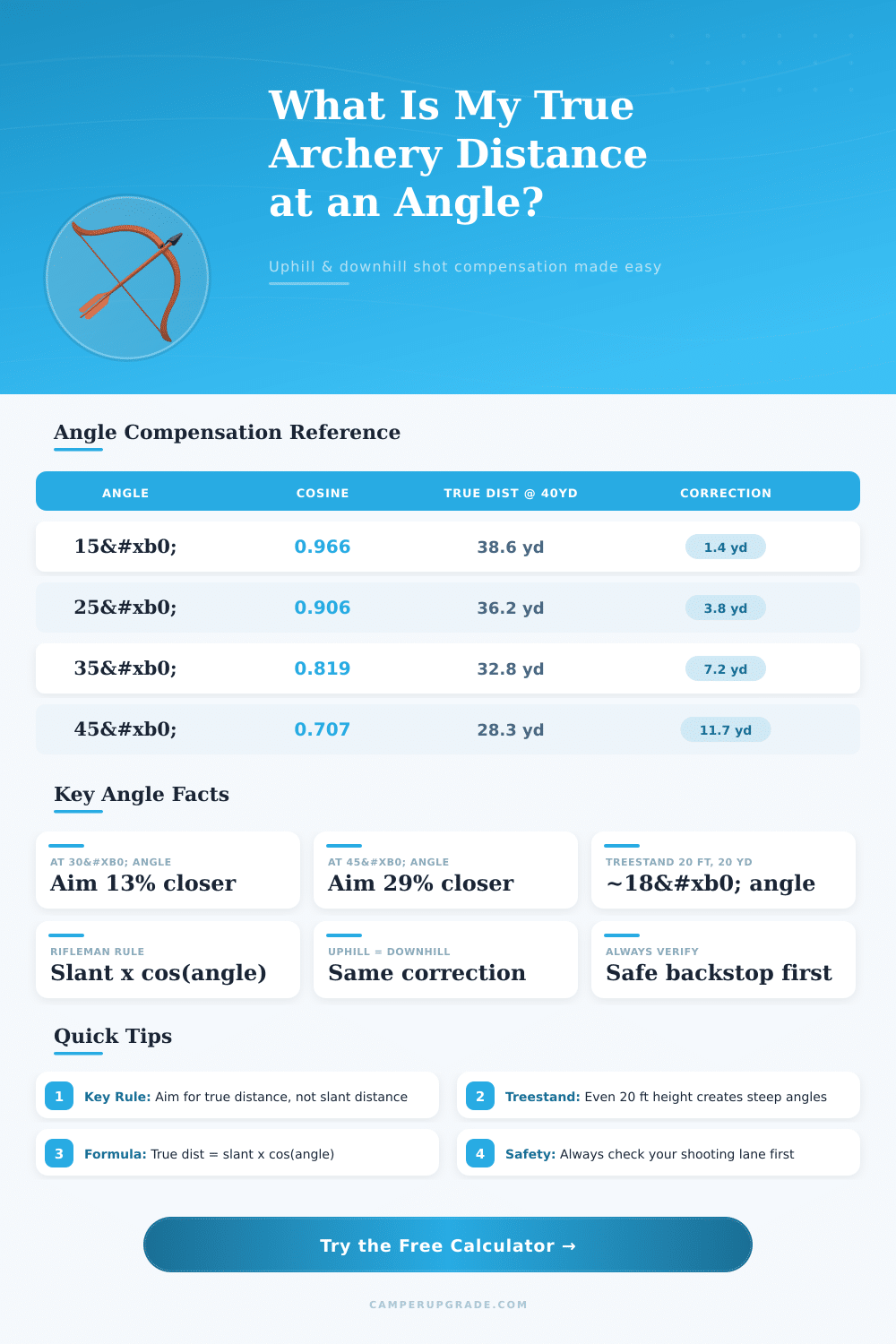
| Angle | Cosine | % Correction | True @ 30 yd | True @ 40 yd | True @ 50 yd |
|---|---|---|---|---|---|
| 0° | 1.000 | 0% | 30.0 yd | 40.0 yd | 50.0 yd |
| 5° | 0.996 | 0.4% | 29.9 yd | 39.8 yd | 49.8 yd |
| 10° | 0.985 | 1.5% | 29.5 yd | 39.4 yd | 49.2 yd |
| 15° | 0.966 | 3.4% | 29.0 yd | 38.6 yd | 48.3 yd |
| 20° | 0.940 | 6.0% | 28.2 yd | 37.6 yd | 47.0 yd |
| 25° | 0.906 | 9.4% | 27.2 yd | 36.2 yd | 45.3 yd |
| 30° | 0.866 | 13.4% | 26.0 yd | 34.6 yd | 43.3 yd |
| 35° | 0.819 | 18.1% | 24.6 yd | 32.8 yd | 41.0 yd |
| 40° | 0.766 | 23.4% | 23.0 yd | 30.6 yd | 38.3 yd |
| 45° | 0.707 | 29.3% | 21.2 yd | 28.3 yd | 35.4 yd |
| 50° | 0.643 | 35.7% | 19.3 yd | 25.7 yd | 32.1 yd |
| 55° | 0.574 | 42.6% | 17.2 yd | 23.0 yd | 28.7 yd |
| 60° | 0.500 | 50.0% | 15.0 yd | 20.0 yd | 25.0 yd |
| Slant Distance | At 15° | At 25° | At 35° | At 45° |
|---|---|---|---|---|
| 20 yards | 19.3 yd | 18.1 yd | 16.4 yd | 14.1 yd |
| 30 yards | 29.0 yd | 27.2 yd | 24.6 yd | 21.2 yd |
| 40 yards | 38.6 yd | 36.2 yd | 32.8 yd | 28.3 yd |
| 50 yards | 48.3 yd | 45.3 yd | 41.0 yd | 35.4 yd |
| Stand Height | Angle at 20 yd | Angle at 30 yd | Angle at 40 yd |
|---|---|---|---|
| 10 feet | 9.5° | 6.3° | 4.8° |
| 15 feet | 14.0° | 9.5° | 7.1° |
| 20 feet | 18.4° | 12.5° | 9.5° |
| 25 feet | 22.6° | 15.5° | 11.8° |
| 30 feet | 26.6° | 18.4° | 14.0° |
| 35 feet | 30.3° | 21.3° | 16.3° |
Within typical archery ranges (under 60 yards), the simplified formula (slant × cosθ) and full parabolic ballistic calculations differ by less than one yard in virtually all hunting scenarios. The simplified rule is reliable for bowhunting use.
Flat and level ground is perfect for archery but safely causes no always operate like this. When you shoot upward or down, the angles play important role about where your arrow indeed will fall. There are several ways to settle this problem, and when you understand how angles affect your shots, you will shoot more confident.
Here is what genuinely happens. When you aim with angle, your arrow does not travel the full distance you see on your rangefinder. What genuinely matters is the horizontal distance between you and the target, and that always is shorter on inclined ground.
How to Aim When Shooting Uphill or Downhill
The sharper the angle, the more you must compensate. For most archers, that becomes problem only at long-range shots or when one hunts from high platforms, where the difference of height is big.
The math for counting angle compensation requires the reverse tangent of the height difference divided by the horizontal distance. But be honest, none wants to do math when one is in the woods and deer is right here. The simplest solution is use rangefinder with angle compensation.
Some models have that already entered, though occasionally they err about one or two yards, maybe three in some ocasions. If you do not want to spend more for such device, you can use regular measure and conversion chart. Carrying full chart is not very practical, but you could note some common angles and distances and stick them on the case of your rangefinder.
Let me show some actual numbers. Assume that you are 40 yards away upward at 30-degree angle… You indeed would aim for around 35 yards.
That is because multiplying your line-of-sight by means of the cosine of that angle, you receive the real distance. Here is another sample: if your target sits 90 yards away at between 45 and 50 degrees, you would shoot as if it were in 60 yards. Even short distances feel this change.
Shot of 20 yards on 30-degree slope? You genuinely aim more near 17 yards.
Your technique is even more important on sharp angles. Draw your bow to level using the same solid method that you practice usually. Set your anchor spot before anything another happens, and only then search your target.
Many archers reverse this sequence and start drawing upward or down without setting their form first. Most folks forget to bend the waist. If you omit that step, your whole draw and anchor moves, what immediately destroys your form.
When the angle becomes gross, forget about perfect T-form, because that entirely throws your balance. Only keep your form as pure as possible while you standfirm.
If your string slips at too sharp angle, your arrow could shoot almost directly upward or travel away from your mark. That is dangerous, because the arrow returns down with almost the same pace it went upward.