🧗 Climbing Calculator
Convert climbing grades, calculate fall factor, analyze anchor loads, and check rope lengths — all in one tool.
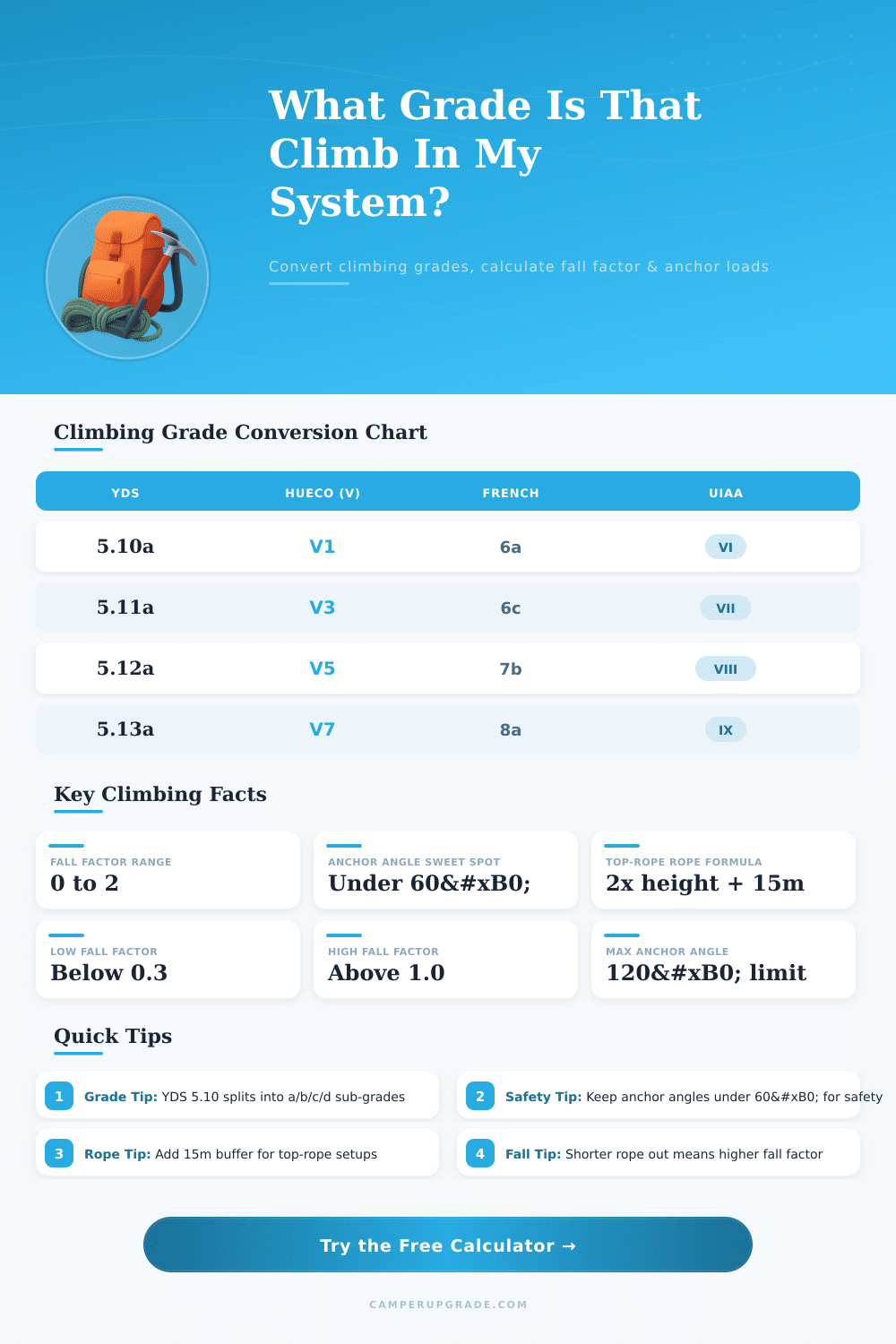
| YDS | Hueco (V) | French | UIAA | Australian | British Tech |
|---|---|---|---|---|---|
| 5.8 | V0 easy | 5a | V | 17 | VD |
| 5.9 | V0 | 5b | VI- | 18 | HVD |
| 5.10a | V1 | 6a | VI | 19 | VS 4c |
| 5.10b | V1 | 6a+ | VI | 20 | VS 4c |
| 5.10c | V2 | 6b | VI+ | 21 | HVS 5a |
| 5.10d | V2 | 6b+ | VII- | 21 | HVS 5a |
| 5.11a | V3 | 6c | VII | 22 | E1 5b |
| 5.11b | V3 | 6c+ | VII | 23 | E2 5b |
| 5.11c | V4 | 7a | VII+ | 24 | E3 5c |
| 5.11d | V4 | 7a+ | VIII- | 24 | E3 5c |
| 5.12a | V5 | 7b | VIII | 25 | E4 6a |
| 5.12b | V5 | 7b+ | VIII | 26 | E4 6a |
| 5.12c | V6 | 7c | VIII+ | 27 | E5 6b |
| 5.12d | V6 | 7c+ | IX- | 28 | E5 6b |
| 5.13a | V7 | 8a | IX | 29 | E6 6c |
| 5.13b | V8 | 8a+ | IX | 30 | E6 6c |
| Fall Factor | Risk Level | Typical Scenario | Impact on Rope System |
|---|---|---|---|
| 0.0 – 0.1 | Very Low | Fell below last piece, lots of rope out | Minimal — barely felt |
| 0.1 – 0.3 | Low | Short fall above last piece, deep on pitch | Low — rope absorbs well |
| 0.3 – 0.7 | Moderate | Mid-pitch lead fall | Significant — check rope condition |
| 0.7 – 1.0 | High | Fell above last piece, not much rope out | High — inspect rope and gear |
| 1.0 – 1.5 | Very High | Short rope, long fall — near anchor | Very high — retire rope if repeated |
| 1.5 – 2.0 | Extreme | Factor-2: fell from above anchor | Extreme — highest possible force |
| Angle Between Arms | Force Multiplier (per arm) | % of Load per Arm | Recommendation |
|---|---|---|---|
| 0° | 0.50x | 50% | Ideal — arms parallel |
| 30° | 0.52x | 52% | Excellent |
| 60° | 0.58x | 58% | Good — standard practice |
| 90° | 0.71x | 71% | Acceptable limit |
| 120° | 1.00x | 100% | Maximum — do not exceed |
| 150° | 1.93x | 193% | Dangerous — avoid |
| Route Height | Top-Rope Rope Needed | Lead Rope Needed | Rappel Reach |
|---|---|---|---|
| 15m (50ft) | 45m | 25m | 25m (50m rope) |
| 20m (65ft) | 55m | 30m | 30m (60m rope) |
| 25m (80ft) | 65m | 35m | 30m (60m rope) |
| 30m (100ft) | 75m | 40m | 35m (70m rope) |
| 35m (115ft) | 85m | 45m | 40m (80m rope) |
| 40m (130ft) | 95m | 50m | 40m (80m rope) |
A climbing calculator is a useful tool to count various things related to climbing. There are several types and each serves different goals depending on what climbing style is used
For cycling fans, a climbing calculator can show the pace and power needed to beat your own record. One only enters the body weight, the climb profile and the target time, and the tool counts the needed speed and watts per kilo. Another version counts the climb impact based on the weight of the person and the bike, along with the length and height of the way.
Climbing calculators and how they help
Some prefer a calculator where one enters the distance, height and average watts to receive the approximate time to end the climb. Pages like bikecalculator.com help to plan efforts on various mountainous ways. Also exist models based on physics that count the power produciton during climbing.
One interesting cycling calculator helps to find the steepest hill that one can climb without increasing the effort. First one determines the total weight, which for a traveler means the body plus the bike, gear, food and water. Typical touring bikes weigh between 12 and 17 kilos.
Camping gear, clothes and spare parts usually add another 15 to 20 kilos.
Then we have calculators for rock climbing. A program called Darth Grader counts the grade of the way by summing several sections and boulder parts separated by rests. This way one can define the grade of the last climbed way.
The route description must go from the ground to the anchor. For instance, if a way starts with a pumpy 7c section to a big pot with good footholds, followed by a 7A boulder section, the description will be 7c G 7A. One can add sections as needed, but each climbing part must be separated by a rest.
Also exist calculators for finger strength. One determines the force needed for different grades, using data that helps avoid injuries and prepare for levels: medium as V5-V10, hard as V10-V14 and elite as V14-V17. Another calculator converts between various edge depths using an algorithm, although there is a bit of uncertainty.
Hang times of 7 seconds give the best accuracy. Beginners however should use 10- or even 15-second hangs.
A fall force calculator is another useful tool. It counts the fall factor and the impact force on the climber. The fall factor is the ratio between the fall distance and the length of the rope.
The highest possible factor is 2, which gives maximum tension to the rope. A factor of 1 is considered moderate.
Finally, exist Critical Force Calculator that helps to determine the aerobic endurance of the forearms. If a sport or trad climber feels “pumped” before reaching the most difficult part (the crux), the endurance of the forearms probably requires more work. Even so, no calculator can entirely predict the climbing grade by themselves.