🧗 Climbing Strength Calculator
Measure your finger strength ratio, pull-up score, and estimated climbing grade based on your stats.
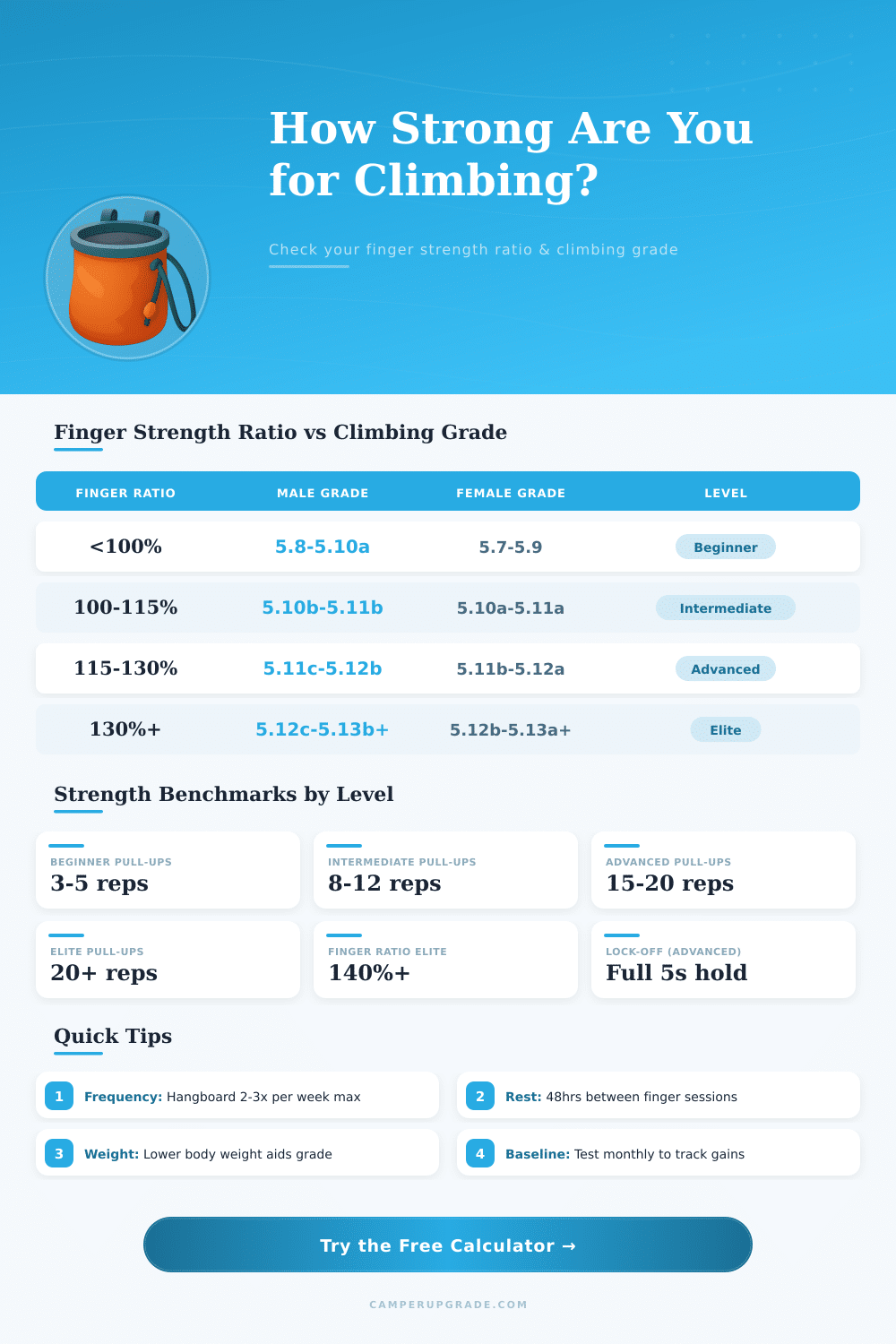
| Finger Strength Ratio | Male Grade | Female Grade | Level |
|---|---|---|---|
| Below 100% | 5.8 - 5.10a | 5.7 - 5.9 | Beginner |
| 100% - 115% | 5.10b - 5.11b | 5.10a - 5.11a | Intermediate |
| 115% - 130% | 5.11c - 5.12b | 5.11b - 5.12a | Advanced |
| 130% - 145% | 5.12c - 5.13b | 5.12b - 5.13a | Expert |
| 145% and above | 5.13c+ | 5.13b+ | Elite |
| Grade Range | Pull-Ups (reps) | Max Hang (20mm) | Lock-Off Ability |
|---|---|---|---|
| 5.8 - 5.10a | 3 - 5 | Bodyweight only | Can't lock off |
| 5.10b - 5.11b | 8 - 12 | BW + 10-20% | 90° for 3s |
| 5.11c - 5.12b | 13 - 18 | BW + 20-35% | 90° for 10s |
| 5.12c - 5.13b | 18 - 22 | BW + 35-50% | Full lock 5s |
| 5.13c+ | 22+ | BW + 50%+ | Full lock 10s+ |
Build strength for climbing does not mean to simply have big arms. It involves almost all main muscles of the body, where the lower part and the core play a key role. They help to steady and strengthen the body for climbing.
Quadriceps and calves are very important although upper body strength also cannot be skipped.
How to Build Strength for Climbing
It is possible to understand strength in climbing as a fuel tank. The more powerful one is, the more moves it is possible to do and the harder they can be. Even so, so that strength truly be useful on the wall, climbing skills need to be trained too.
For newcomers, climbing only three times weekly already builds a lot of specific sporting strength. Climbing until tiredness truly changes things, and after a month the progress shows clearly. Also technique is key.
While one starts, one should stress laying wait on the feet instead of pulling yourself upward by means of arms. The arms serve mainly to keep the body near the wall and stop falling. Climb, reach the next hold, move feet upward and repeat.
Women usually learn climbing technique more quickly, because they tend to focus on footwork and balance than push by means of raw strength through every step. Great climbers always show impressive muscular focus, but the main qualities, that climbing builds, is balance and skill.
At higher levels on the other hand, arms and fingers need truly solid strength. Handles become smaller and hard to keep, especially in hanging sections. Climbing here becomes much more intense.
Power, body awareness, balance, technique and mental readiness all matter, but none of them is enough alone. Sloping paths with long reaches benefit from both pull power and pull endurance. Who manages to do one-arm lock-off, that probably has no more limit of strength beyond certain grades.
By means of regular and steady strong training, muscles and tendons can make more power and handle bigger training loads. Then those tissues nicely adapt to the needs of climbing. Horizontal pulls are useful for climbing on hanging walls, while pushing flat strengthens muscles for pressing moves.
Climbers do well, if they include weight in exercises for legs, back and core, and progress to single-leg movements like pistol-squats. Campus boards are great for finger endurance, hold-power, core, shoulders and feet. Upper warmup, gradual increase of amount and rest all are needed to safely buildstrength.
Training of finger strength by means of hangboard method and maximum suspension is another popular way. Climbing strengthens forearms, fingers, hands, shoulders, upper back, core and legs, while tendons adapt to the used climbing style.
Sometimes pure raw power simply eases everything. Better endurance, safe footwork and even fast clip of quickdraws become more natural, when the body is strong enough to fully trust hands and feet.