🧗 Climbing Shoe Calculator
Answer a few questions to find your ideal climbing shoe profile, downturn, closure, and fit tightness.
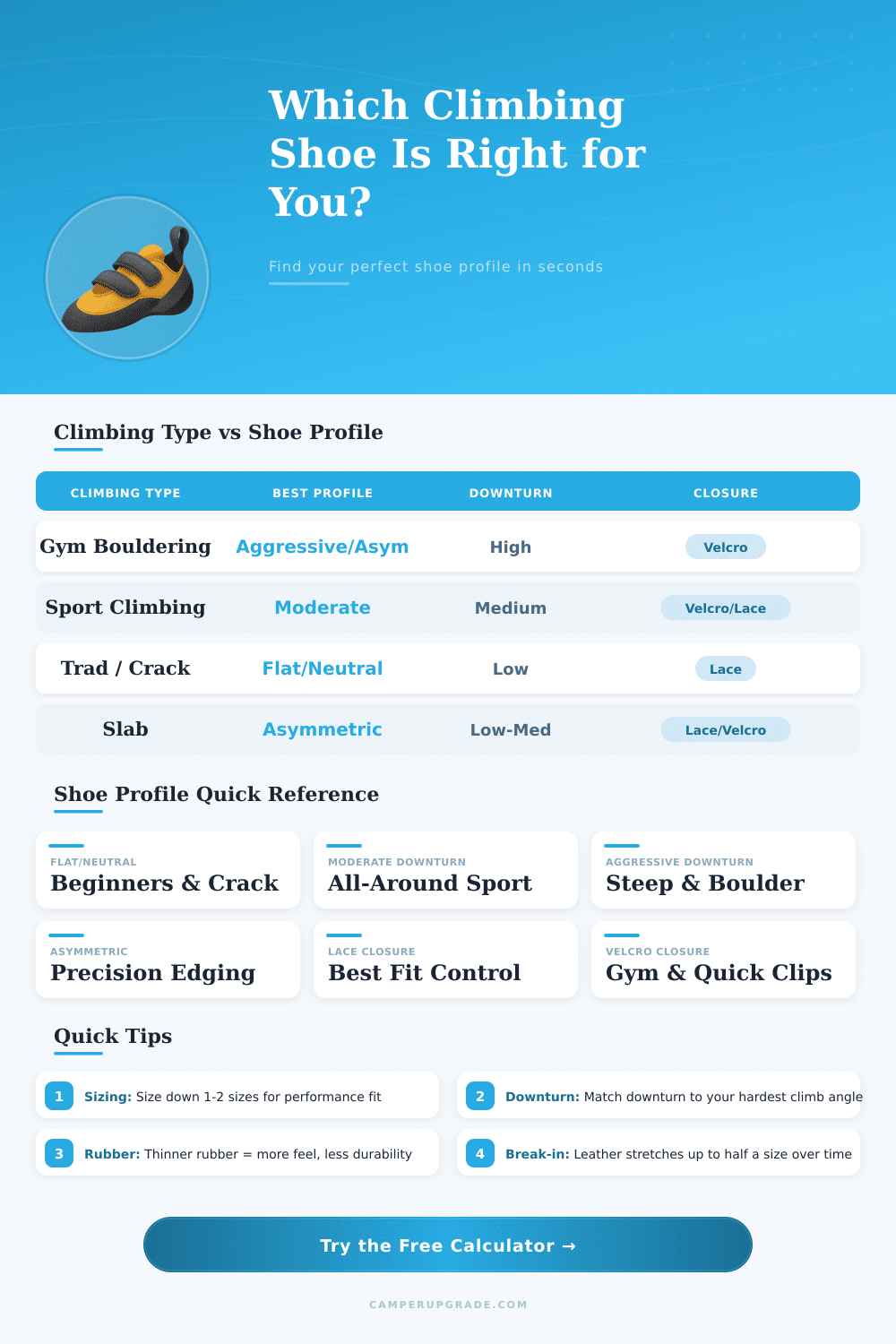
| Climbing Type | Best Profile | Downturn | Rubber Thickness | Notes |
|---|---|---|---|---|
| Gym Bouldering | Aggressive / Asymmetric | High | Thin (3-4mm) | Maximum sensitivity and precision |
| Sport Climbing | Moderate Downturn | Medium | Medium (4-5mm) | Versatile for diverse route types |
| Traditional / Trad | Flat / Neutral | Low | Thick (4-5mm) | Comfort for long multi-pitch days |
| Crack Climbing | Flat / Neutral | Flat | Thick (5mm+) | Rand wrap for hand/foot jams |
| Slab | Asymmetric | Low-Medium | Thin-Medium | Feel and smearing ability key |
| Overhang / Steep | Aggressive Downturn | High | Thin (3-4mm) | Heel hooking and toe hooking |
| Closure | Best For | Pros | Cons |
|---|---|---|---|
| Lace | Trad, crack, all-day, wide/narrow feet | Best fit customization, even pressure | Slower on/off, laces can fray |
| Single Velcro | Gym, sport, beginners | Easy on/off, consistent fit | Less fit adjustability than lace |
| Double Velcro | Gym bouldering, competition | Quick, secure, good for odd foot shapes | Heavier, velcro wears over time |
| Slipper (No Closure) | Advanced gym, warm-up shoe | Lightweight, sensitive, fast | Fit depends on stretch, less heel security |
A climbing shoe is made up of special parts, created mainly for rock climbing. What sets them apart from average shoes? They have a typical curved form, that is uneven, and sticky rubber under the sole.
The rubber covers also the heel and the toes, what gives climbers better hold especially there, where it most matters.
How to Choose the Right Climbing Shoes
A climbing shoe comes in quite a wide range. There are aggressive models, middle variants and neutral types; everything depends on the kind of climbing, that you practice. Whether you do bouldering, sport climbing, traditional, self-protected climbing, fast or competitive climbing, for each of those types there is a fitting shoe.
Some models fill a double role as reliable everyday tools, while others focus sharply on one particular climbing style.
Here is the main point: the fit beats almost everything else. A climbing shoe should feel great, without pressure, and with no wasted space inside. Many climbers fall into the idea, that pressure of the feet in small shoes helps on more difficult routes.
But actually it does not work like this. The form of the foot matters more than one thinks. A person with a long big toe differs from one with a broad foot, so they need entirely different shoes.
For instance, Five Ten shoes tend to be broader, while European makers like La Sportiva and Scarpa offer narrower ones with snug heels. Today you can even choose low-volume versions from some makers, fittnig for climbers with narrow heels and whole foot shape in the small range.
If you recently start, cheaper shoes make full sense. The more expensive or specialized choices truly matter only for expert climbers, that learnt to use features like toe hooking well. The La Sportiva Tarantulace works as a good entry-level option.
Most climbers benefit from better shoes, when they reach around V5 in bouldering or 5.12-level on ropes.
Some shoes arrive with shaped rubber soles instead of one solid layer. That method ensures stronger grip, bigger range and better overall comfort. So you have only a small break-in time, what means use right from the box.
The rubber itself varies a lot, more hard types last more long, while softer ones stick more well too smooth walls. More sticky rubbers need less heat than those, that are meant for long use.
The Scarpa Instinct VS is built for steep routes thanks to its flex and feel. The Unparallel UpMocc works as a good budget choice, that you can fit well for cracks or turn to bouldering. The Arpia V is built with a precise pointed toe for narrow cracks, a form that accepts broader feet and padded insole.
And honestly, it doeswell on harder climbs also.
The right shoe creates real difference, but no miracle. It will not raise you a whole grade alone, but it surely helps. Flat shoes barely work on steep walls, where aggressive shoes shine.
Nights of shoe demos in climbing gyms let you test different brands before spending money on a pair. Online calculators and fit tools are worth checking to find the right fit also.