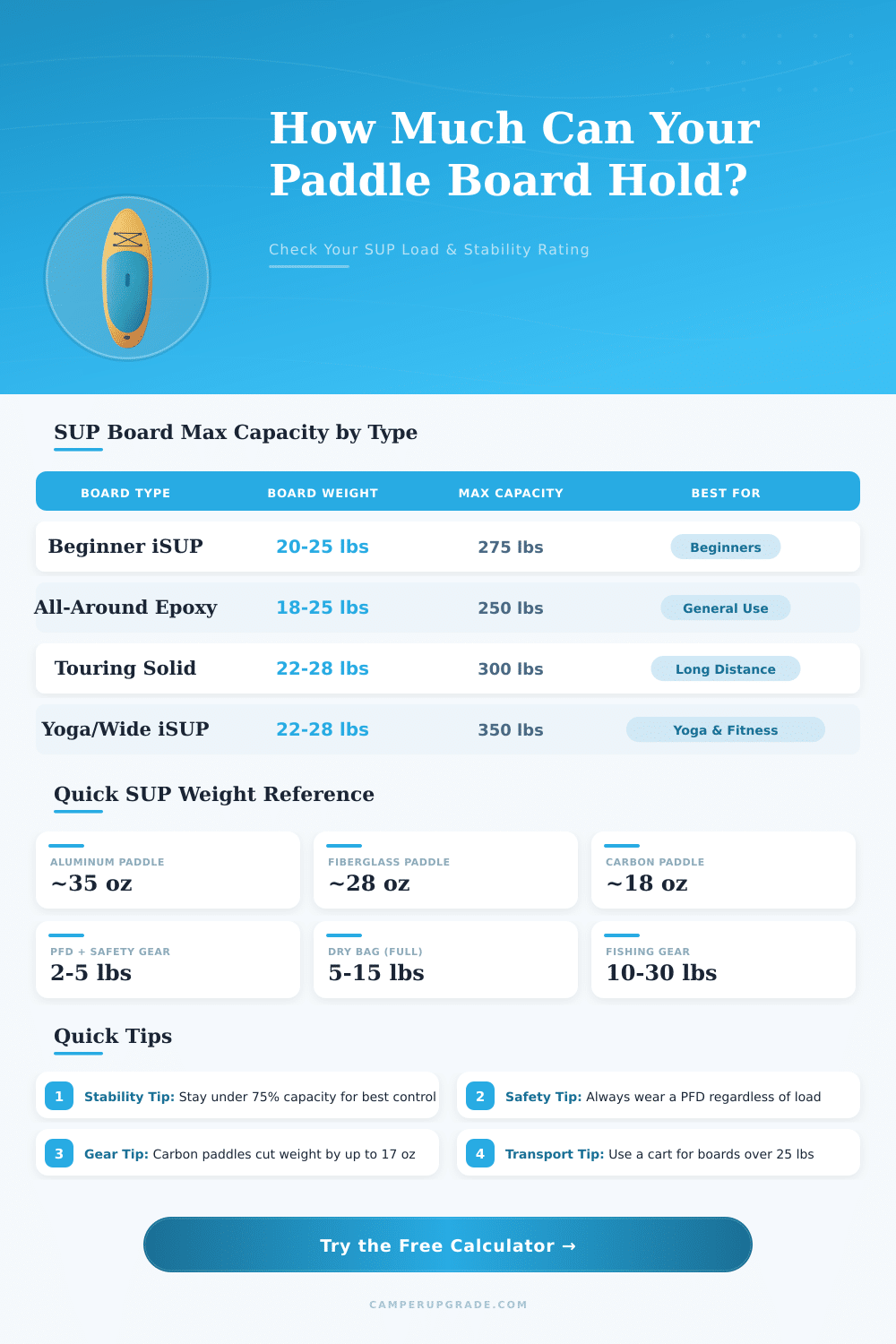
🏄 Paddle Board Weight Calculator
Check your SUP load percentage, remaining capacity, and stability rating before you paddle.
| Material | Typical Weight | Durability | Best Use |
|---|---|---|---|
| Inflatable PVC (iSUP) | 20-28 lbs | High | Travel, beginners, yoga |
| Solid Epoxy / Fiberglass | 18-25 lbs | Medium | All-around, touring |
| Carbon Fiber | 14-20 lbs | Low-Medium | Racing, performance |
| Soft-Top Foam | 22-30 lbs | Very High | Beginners, kids |
| Wood / Bamboo Veneer | 24-32 lbs | Medium | Aesthetics, recreation |
| Use Case | Board Type | Ideal Payload | Max Recommended |
|---|---|---|---|
| Casual Day Paddle | Beginner iSUP | 140-180 lbs | 200 lbs |
| Yoga & Fitness | Yoga / Wide iSUP | 120-200 lbs | 260 lbs |
| Fishing Trip | Fishing SUP | 180-300 lbs | 350 lbs |
| Touring / Multi-Day | Touring Solid | 170-240 lbs | 265 lbs |
| Racing / Sprint | Racing Solid | 140-180 lbs | 195 lbs |
| Family / Tandem | Yoga/Wide or Fishing | 250-320 lbs | 350 lbs |
The weight of a paddle board matters much more than many folks think. Boards weigh somewhere between 15 pounds for the most lightweight and 40 to 50 pounds for the heavy. Usually more lightweight boards cost more and can be a bit less solid.
Boards made from fiberglass, epoxy, or carbon fiber commonly have weight between 25 and 35 pounds. They give more firmness but carrying them is quite a lot harder. Special heavy boards, for instance for fishing or big ones for several people, pass 40 pounds.
Paddle Board Weight and How to Pick the Right One
A board at around 60 pounds is too heavy and could make it hard or even dangerous to carry.
Lightweight boards handle more easily, but truly lightweight ones easily get pushed by wind and waves. So one must think about that balance.
The weight of the board itself forms only one part of the whole. Equally important is the capacity for weight. Paddle boards can bear an average of 200 to 300 pounds, even so models for 500 pounds or more widely exist.
The most many inflatable paddle boards last between 285 and 480 puonds, while bigger ones reach up to 500 pounds. Makers mark the boards in pounds or in volumes. The maximum weight directly depends on the volume, because volume ties to floating.
With bigger volume the board can bear bigger load.
Volume decides the length of the board, its width and thickness. Length runs from the knows to the tail. Width counts from side to side.
Thickness shows as the space between upper and lower surface of the board. To choose the right size, one must match these measures with the body build.
For newcomers it helps to multiply your own weight in pounds by 1.1 to 1.4, to get the right volume for the first board. For instance a person at 175 pounds with 10 pounds of gear reaches a total of 185 pounds. That person would need a board with at least 185 to 258 liters of volume.
Overloading the weight limit of the board causes troubles. The board will sit more below in water, soak, and become hard to paddle. This hurts the stability, the speed, and the overall feel.
Nobody wants such experience, so choosing a board with high capacity is the better idea. Always count the heaviest paddler, possible extra passengers like babies or dogs, and all gear when checking the capacity. Capacity means the whole load; body weight plus water bottles, coolers, life jackets, fishing gear, and everything else on the deck.
Inflatable boards roll together in a pack that fits in a car trunk or even plane luggage. Rigid boards need roof racks and straps. Thatportability forms a big reason why inflatable boards are popular between newcomers.