🏄 Paddle Board Volume Calculator
Find the right SUP volume for your weight & skill level, or calculate volume from board dimensions
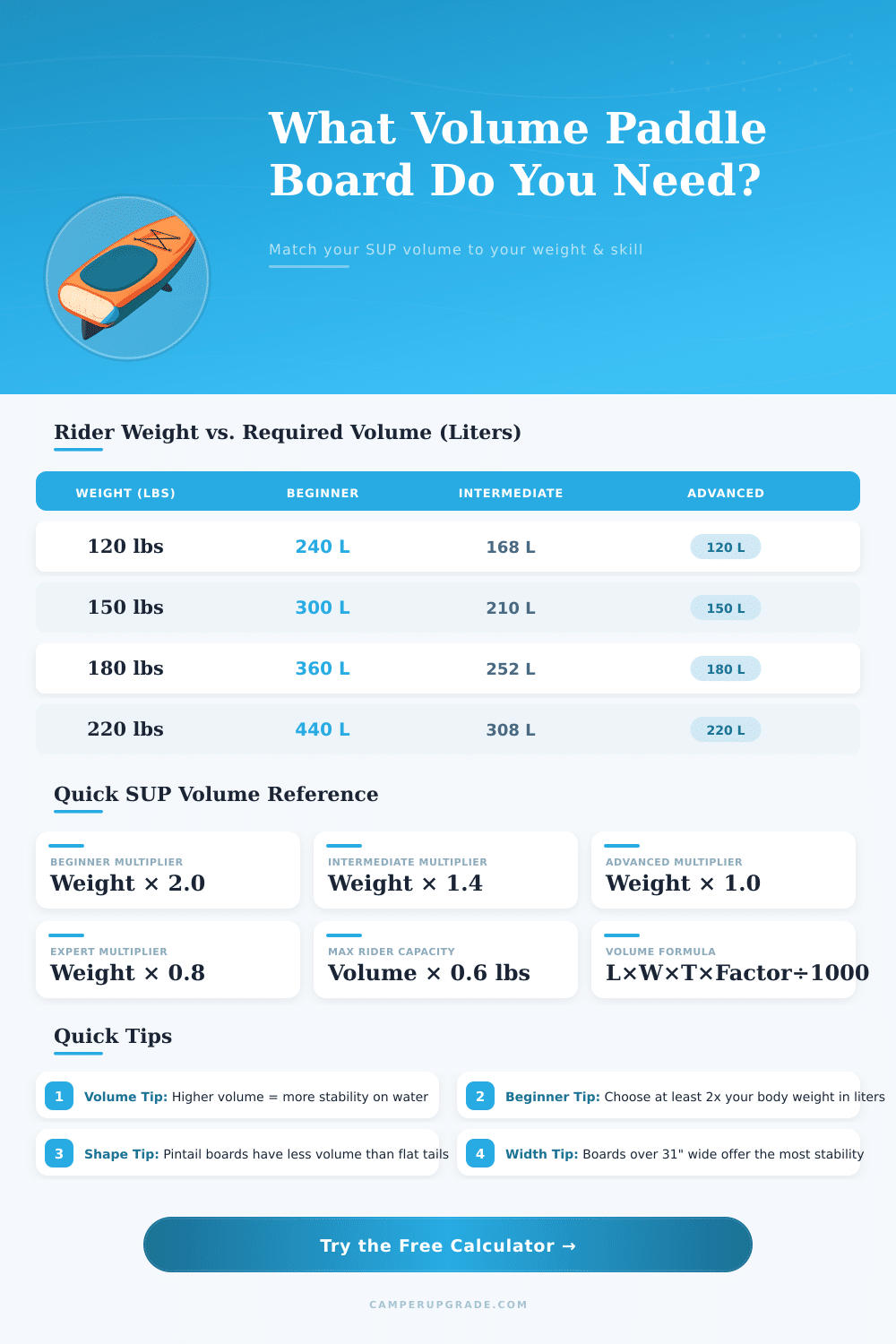
| Weight (lbs) | Weight (kg) | Beginner | Intermediate | Advanced | Expert |
|---|---|---|---|---|---|
| 100 lbs | 45 kg | 200 L | 140 L | 100 L | 80 L |
| 120 lbs | 54 kg | 240 L | 168 L | 120 L | 96 L |
| 140 lbs | 64 kg | 280 L | 196 L | 140 L | 112 L |
| 160 lbs | 73 kg | 320 L | 224 L | 160 L | 128 L |
| 180 lbs | 82 kg | 360 L | 252 L | 180 L | 144 L |
| 200 lbs | 91 kg | 400 L | 280 L | 200 L | 160 L |
| 220 lbs | 100 kg | 440 L | 308 L | 220 L | 176 L |
| 250 lbs | 113 kg | 500 L | 350 L | 250 L | 200 L |
| Board Type | Length | Width | Thickness | Approx. Volume |
|---|---|---|---|---|
| All-Around iSUP | 10'6" | 32" | 4.75" | ~254 L |
| All-Around Hardboard | 10'6" | 32" | 4.5" | ~170 L |
| Touring | 12'6" | 28" | 4.5" | ~181 L |
| Surf SUP | 9'0" | 30" | 4" | ~118 L |
| Yoga / Fitness | 11'0" | 34" | 6" | ~324 L |
| Race Board | 14'0" | 24" | 4" | ~141 L |
| Beginner Wide | 10'0" | 35" | 5" | ~300 L |
| Kids SUP | 8'0" | 28" | 4" | ~105 L |
When you buy your first paddle board, the volume really is one of the main things that you must consider. Think about it like this: volume simply shows how much space your board takes up, and one measures it in liters. It works the same as with surfboards.
The bigger the volume the more well your board will float you, so it will carry you more easily than something with less volume.
Choose the Right Paddle Board Volume
The most common paddle boards that you find for everyday use have a length between 10 and 12 feet, and they usually are wide at around 32 to 34 inches. Here is the main trade-off: wider boards give a firm feeling under your feet, but narrow ones move through the water more quickly. Short boards commonly work for surfing or for children that are learning.
If you start and want mainly stability, choose something in the range of 10 to 11 feet… Combine that with a width of 31 to 35 inches, and you will have a forgiving, reliable base. For more safety, aim for 33 or 34 inches wide.
The volume really decides if the board can carry you. The maximum weight limit shows the whole load that the board lasts before it loses buoyancy, becomes unstable and starts sniking. For casual paddlers in North America and Europe, something between 180 and 250 liters commonly works well.
In Australia and New Zealand, where the water conditions are a bit more harsh, boards usually have 130 to 210 liters.
Do not let yourself be fooled only by the length. You could have an 11-foot board with 38 inches wide and enough volume, or another 11-foot one with only 24 inches wide, that barely will float you. Simply looking at the length could lead you to something totally wrong for your needs.
Here are some simple rules that help to find the ideal level. Beginners commonly succeed aiming at around 1.8 times their body weight in kilos for the volume. Middle level paddlers aim at about 1.5 times their weight, while experts can use something close to 1.3 times.
Another way? Take your weight in kilos, add the weight of the board and of the paddle, and expand by 20 percent, that gives an approximate number. For most folks, you probably need between 185 and 258 liters.
Long boards slip through calm water more smoothly and keep speed more well during long trips, which is useful for long sessions. The downside is that they turn more hardly. When you improve in paddling, you can try narrow, low volume boards, that feel more quick.
Even so, volume is not the whole story. Things like the thickness, the shape of the nose, the width of the tail and the general shape all affect how the board works. Floating and paddling is notthe same.
For river paddling, you will want something lightweight and quick. Boards for white water must be thicker to handle rough waves. If you still are not sure what style to choose, an all-around board is really your most reliable choice.