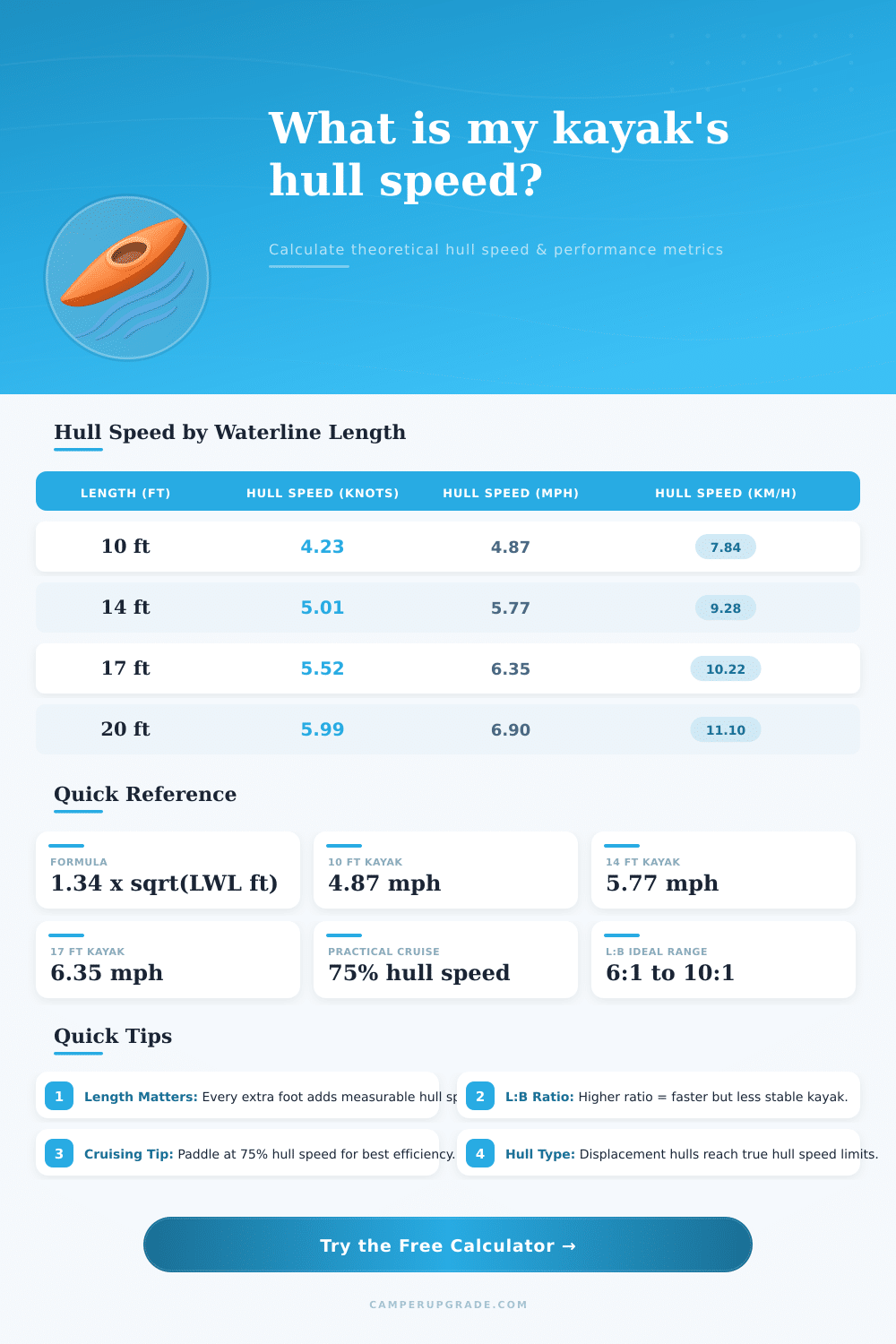
🛶 Kayak Hull Speed Calculator
Calculate theoretical hull speed, length-to-beam ratio, and practical performance metrics for any kayak.
| Length (ft) | Hull Speed (knots) | Hull Speed (mph) | Hull Speed (km/h) | 75% Cruise (mph) |
|---|---|---|---|---|
| 8 ft | 3.79 | 4.36 | 7.02 | 3.27 |
| 10 ft | 4.24 | 4.87 | 7.85 | 3.65 |
| 12 ft | 4.64 | 5.34 | 8.60 | 4.01 |
| 14 ft | 5.01 | 5.77 | 9.28 | 4.33 |
| 15 ft | 5.19 | 5.97 | 9.61 | 4.48 |
| 16 ft | 5.36 | 6.17 | 9.93 | 4.63 |
| 17 ft | 5.52 | 6.35 | 10.22 | 4.76 |
| 18 ft | 5.68 | 6.54 | 10.52 | 4.91 |
| 19 ft | 5.84 | 6.72 | 10.82 | 5.04 |
| 20 ft | 5.99 | 6.90 | 11.10 | 5.17 |
| Kayak Type | Typical L:B Ratio | Speed Characteristic | Stability |
|---|---|---|---|
| Whitewater / Short Rec. | 3:1 – 5:1 | Slow | Very High |
| Recreational Sit-on-Top | 5:1 – 7:1 | Moderate | High |
| Day Touring | 7:1 – 9:1 | Good | Moderate |
| Sea / Expedition | 9:1 – 11:1 | Fast | Low-Moderate |
| Racing / Surf Ski | 11:1 – 14:1 | Very Fast | Low |
The hull speed is simply the limit, where the kayak meets a wall of resistance. It marks the moment when the flow of the river and the strong waves line up to reduce the resistance. When the paddler tries to pass this speed, the boat jumps upward very fast.
Think of it as a natural ceiling that physics sets.
What Is Kayak Hull Speed
The formula for counting the hull speed is fairly easy. One takes the square root from the length of the waterline of the kayak, measured in feet, and then multiplies it by 1.34. This way one gets the value in knots.
For instance, for a 14-foot ship the hull speed reaches around 5.01 knots. An 18.5-foot model would reach about 5.76 knots, what matches to around 6.63 miles each hour.
Long ships have bigger hull speed. Here is the main rule. The speed connects with the length, so bigger kayaks beat the smaller ones, at least with moving bodies.
Kayaks belong to that type, more like a huge oil tanker than a speed boat. They push through the water rather than slip above it.
hull speed points the phase, where the length of the waves behind the ship matches with the whole length of the wake. After that the resistance of waves grows strongly. Even so long and narrow ships, as kayaks, make little wake.
Rowing kayaks already reached more then 9 knots in short runs, what doubles the theoretical hull speed. A similarly long moving sailboat never would manage to reach 6 knots.
Most paddlers are not Olympic athletes, though. In most cases the real speed depends on the resistance, that the form of the kayak creates, and on the force, that the paddler manages to deliver. The average kayak goes at around 5 to 7 kilometers each hour, and at most to 10 km/h, when one pushes them strongly.
In most 17-foot kayaks the cruising hull speed sits between 4 and 5 knots.
Also the form of the body plays a big role. Flat, round, V-shaped and pontoon-style bodies all act differently. A narrow and long kayak with V-shaped body usually goes more quickly and tracks more well.
Pontoon-style bodies give strong stability, but cost speed and need more work to turn. A smooth ship slips more well and slows itself less between strokes, so that the next stroke needs less force to restore the motion. A thick 13-foot ship can reach 4 knots, but always will feel heavy under the paddle.
Some paddlers believe, that a longer kayak would solve the problem of bigger speed. There truly is some truth in that, but shorter models simply deliver more speed in high values. A narrow 13-foot kayak with good shape claims, that it easily paddles at speeds under 4.5 miles each hour.
All the computers in the world still couldnot push a moving kayak to 27 miles each hour.