🛶 Kayak Size Calculator
Find the ideal kayak length, width & volume for your body type and paddling style.
Easy & stable
Versatile
Speed & storage
Agile & tough
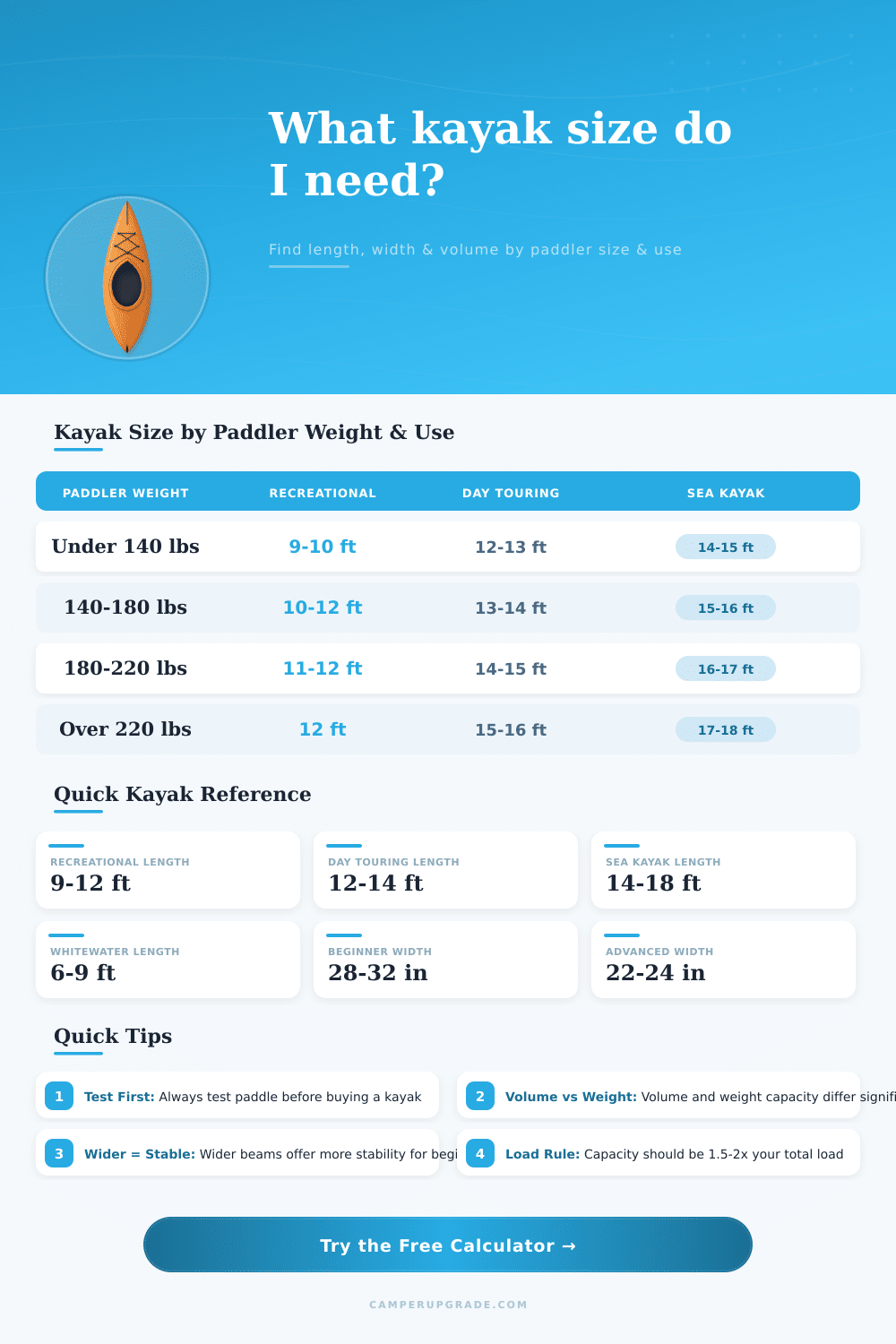
| Paddler Weight | Recreational | Day Touring | Sea Kayak | Whitewater |
|---|---|---|---|---|
| Under 120 lbs (<54 kg) | 9-10 ft | 12 ft | 14-15 ft | 6-7 ft |
| 120-160 lbs (54-73 kg) | 10-11 ft | 12-13 ft | 15-16 ft | 7-8 ft |
| 160-200 lbs (73-91 kg) | 11-12 ft | 13-14 ft | 15-17 ft | 8 ft |
| 200-240 lbs (91-109 kg) | 12 ft | 14-15 ft | 16-17 ft | 8-9 ft |
| Over 240 lbs (>109 kg) | 12+ ft | 15-16 ft | 17-18 ft | 9 ft |
| Feature | Sit-In Kayak | Sit-On-Top Kayak |
|---|---|---|
| Primary Stability | Moderate | High |
| Secondary Stability | High | Moderate |
| Storage Space | Hatches, bow & stern | Open deck, bungee |
| Best For | Touring, sea kayaking, cold water | Fishing, warm water, beginners |
| Self-Rescue | Requires skill (roll/re-entry) | Easy to remount |
| Weather Protection | Better (spray skirt option) | Less (open deck) |
| Typical Length | 10-18 ft | 9-14 ft |
Count, as far as big kayak you truly need, is not easy, do not exist magic answer that works for all. Your choice depends mostly on the place where you plan to paddle, how you want to store it and how much money you plan to spend. In fast rivers one prefers shorter boats, on the other hand for sea paddling you need something much more long.
Fun kayaks usually have short and broad form, what makes them good for beginners or for whoever paddles in calm waters without big waves. The most common models measure around 10 feet and are about 28 inches wide. For children between 8 and 12 years, aim in the range of 6 to 8 feet.
How to Choose the Right Kayak Size
Whitewater kayak paddling splits into several kinds according to your activity. River runners design for crossing rapids and measure between 7 and 9 feet, they commonly are the fastes options. Play boats are the smallest, under 6 feet, and their compact size allows great movement in the water.
For fishing kayaks, unless space for storage or transportation limits you, choose 12 feet or longer is widely correct. Boats more than 12 feet long also work more well on rivers like that in Kansas, where you need something that keeps the line against the flow and does not let itself push by the wind. Even so many folks paddle well with 10-foot kayaks on rivers without real troubles.
What truly decides the write size of kayak in particular is your own body weight. Keeping the whole load around 30 percent under the maximum limit of the factory helps to escape overload. Many fun kayaks have maximum between 250 and 300 pounds, so mind your weight.
Heavier paddlers must search enough space in the cockpit, enough leg room and seating that truly fits. Sit-on-top models give more stability for heavy people, although they fit less well and need more force to move through water. If you are on the heavy side, escape those too short seat faces.
A 14-footer stays very easy to steer and can serve as minimum for short camping trips during two or three days. Long boats give more place for gear and better speed for covering distance. A 10-foot kayak well handles small brooks and rivers, especially in tight parts full of rocks.
The same 14-footer would seem clumsy in such narrow places. Sea kayak paddling brings an entirely other matter; low-volume form for a small paddler can reach 16 feet long, but stays only 21 inches broad.
The best step before spending money on a kayak is to visit a real kayak store by the water itself. Talk with the folks there, explain what activities you plan and try to paddlevarious sizes. Your intended use must be the base for everything else.