🏃 Trail Running Calorie Calculator
Calculate calories burned trail running by terrain, weight, distance & elevation gain
Please enter valid weight, distance, and at least 1 minute of running time.
🏆 Your Trail Run Results
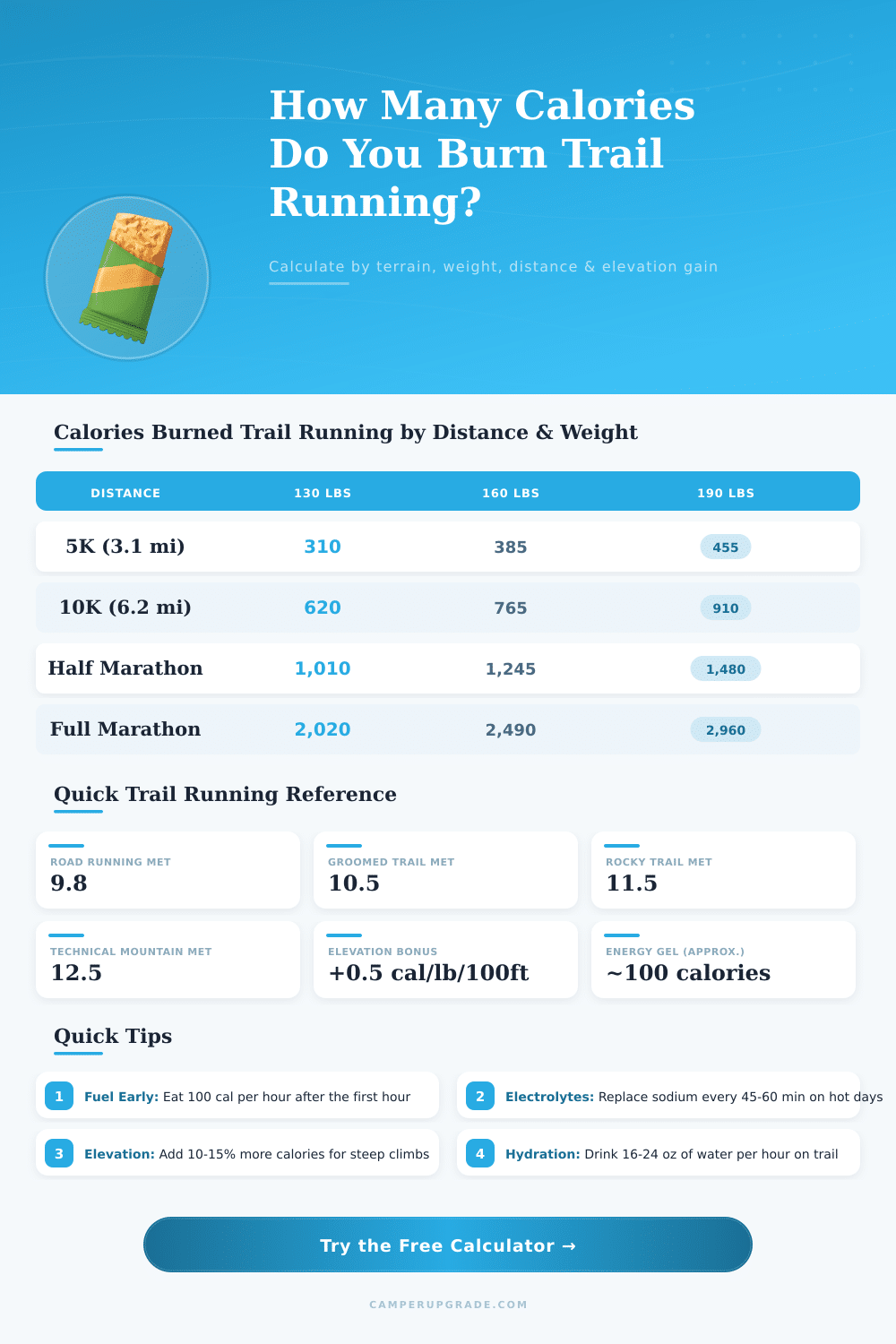
| Distance | 130 lbs (59 kg) | 155 lbs (70 kg) | 180 lbs (82 kg) | 210 lbs (95 kg) |
|---|---|---|---|---|
| 5K (3.1 mi) | 310 | 370 | 430 | 500 |
| 10K (6.2 mi) | 620 | 740 | 860 | 1,000 |
| Half Marathon (13.1 mi) | 1,010 | 1,205 | 1,400 | 1,630 |
| Marathon (26.2 mi) | 2,020 | 2,410 | 2,800 | 3,260 |
| 50K (31 mi) | 2,390 | 2,855 | 3,315 | 3,860 |
| Distance | Road Running | Groomed Trail | Rocky Trail | Technical Mountain |
|---|---|---|---|---|
| 3 miles | 330 | 355 | 385 | 420 |
| 6 miles | 660 | 705 | 775 | 840 |
| 10 miles | 1,100 | 1,175 | 1,290 | 1,400 |
| Half Marathon | 1,310 | 1,400 | 1,535 | 1,665 |
| Marathon | 2,615 | 2,800 | 3,065 | 3,335 |
Way-run projects as one of the most efficient modes to burn calories outside, that you can choose. The inequality of the soil, the slopes the slime and the obstacles force your body to work much more than on flat paving. That extra tension results in around 10 percent more burned calories than during run on average ways.
A person weighing about 150 pounds will burn average 120 calories each mile when they run on the ways outside. There is a simple calculation for finding the calorie expense if you want to do that. For hiking outside it is around 0.42 calories each pound each mile, while for run on flat terrain it reaches around 0.72.
Calories Burned and Eating on Trail Runs
So folks weighing 100 pounds spend about 42 calories per mile during hiking or 72 during run. But trail running raises those figures thanks to the various conditions of the soil.
Here the truth about trail running: it does not limit to heart exercise. It requires muscle strength, endurance and even a bit of planning. Your whole body gets in action.
Changes in height and surface, like stones or roots, use more muscle groups, what explains the extra burned calories.
Electronic trackers and watches estimate the calorie expense mainly according to your heart rhythm and its change during the movement. The kind of activity, that you mark on the device, does not matter two much. On the other hand, those tools rely on statistical models, and the more you work out, the more the ratings can differ from reality.
So take the calorie numbers on your watch screen with doubt.
On time nutrition during trail running truly matters. For run under one hour you normally do not need to add calories. But when you pass the one-hour limit, mid-run fuel becomes something worth thinking about.
A good start is around 200 to 400 calories each hour on the way. It splits into maybe 65 to 130 calories each 20 minutes or so. For run under two hours the needs stay quite low, commonly around 200 to 300 calories each hour, best as simple sugar foods, so that your body can digest and absorb them quickly.
Those numbers range according to your physical size, the running distance and the trouble of the terrain.
Your body has around 2,000 calories of glycogen in store and burns average 100 calories each mile. Every food during run simply covers the difference between your available energy and what you spend. For a half marathon you commonly do not need to add food.
Appetite can grow when you start raising your training. Some runners eat more than 3,000 calories a day, when the mileage rises. For newcomers on the other hand it is easy to err and eat more than what the run truly burns, so stay with your usual diet and only add the run is a wiseway, until your weekly distance gets bigger.