🏃 Trail Run Pace Calculator
Adjust your road pace for terrain & elevation — get your Graded Adjusted Pace for any trail
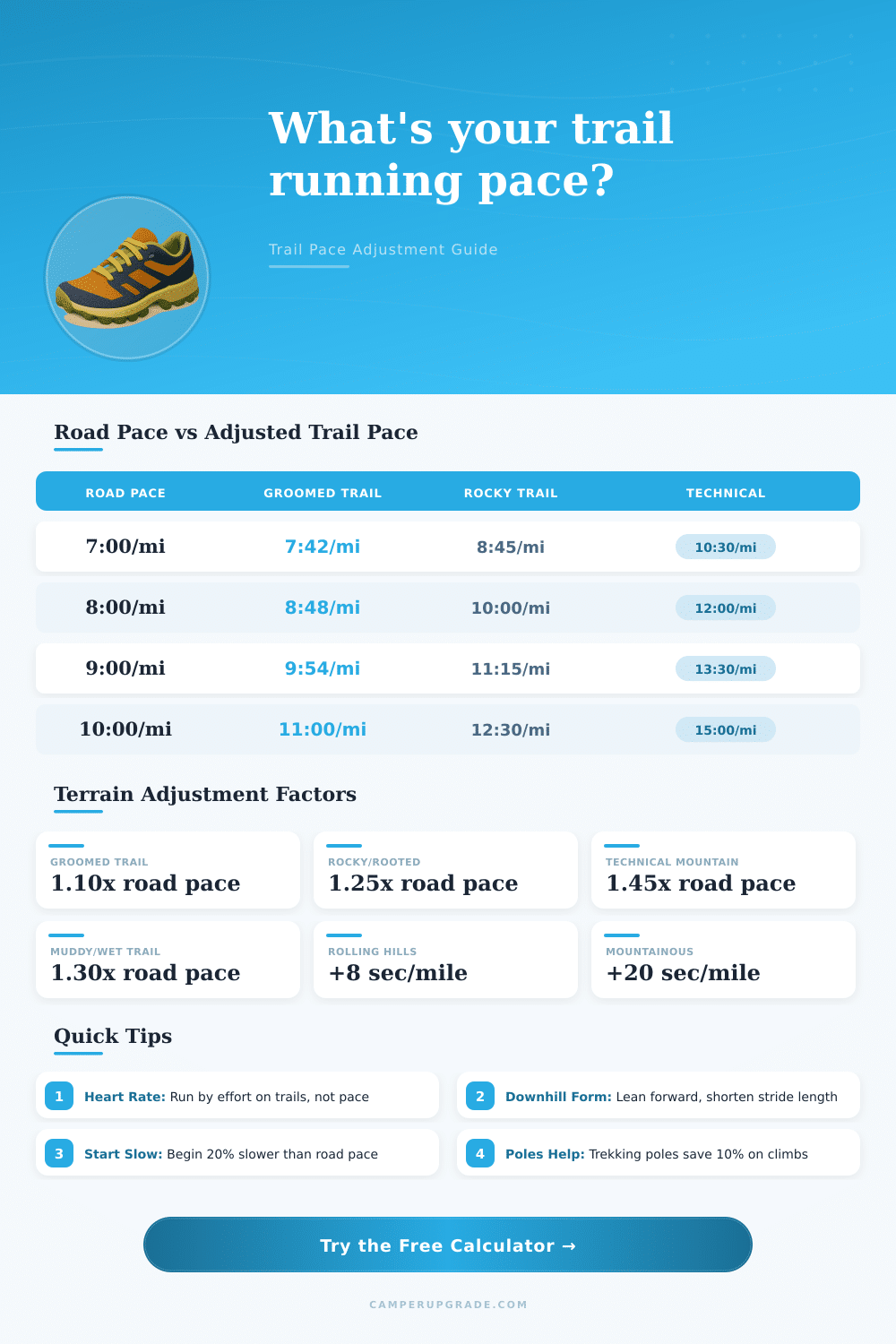
| Road Pace (min/mi) | Groomed Trail | Rocky / Rooted | Technical Mtn | Muddy / Wet |
|---|---|---|---|---|
| 7:00 /mi | 7:42 /mi | 8:45 /mi | 10:09 /mi | 9:06 /mi |
| 8:00 /mi | 8:48 /mi | 10:00 /mi | 11:36 /mi | 10:24 /mi |
| 9:00 /mi | 9:54 /mi | 11:15 /mi | 13:03 /mi | 11:42 /mi |
| 10:00 /mi | 11:00 /mi | 12:30 /mi | 14:30 /mi | 13:00 /mi |
| 11:00 /mi | 12:06 /mi | 13:45 /mi | 15:57 /mi | 14:18 /mi |
| 12:00 /mi | 13:12 /mi | 15:00 /mi | 17:24 /mi | 15:36 /mi |
| Race Distance | Beginner | Intermediate | Advanced | Elite |
|---|---|---|---|---|
| 5K Trail | 40–55 min | 30–40 min | 22–30 min | Under 18 min |
| 10K Trail | 1:20–1:50 | 1:00–1:20 | 45–60 min | Under 38 min |
| Half Marathon (21K) | 3:00–4:00 | 2:15–3:00 | 1:45–2:15 | Under 1:25 |
| Marathon (42K) | 6:00–8:00 | 4:30–6:00 | 3:30–4:30 | Under 2:55 |
| 50K Ultra | 8:00–12:00 | 6:00–8:00 | 4:30–6:00 | Under 3:45 |
| 50-Mile Ultra | 14:00–20:00 | 10:00–14:00 | 7:00–10:00 | Under 6:30 |
Run on trail run have pace that is entirely different than that of run on roads, and that really turns your head around. Runner, that walks forward in 5:10 for kilometer on asphalt, will find his pace quite a lot difficult for control, after they reach the mud. Consider some, that runs 9-miles on road…
On trails they take around 13 until 15 minutes for mile, sometimes even more slowly, depending on how difficult the soil becomes or how severe the hills are.
Trail Running Is Slower Than Road Running
Most runners notice, that their pace drops flat in 10 until 20 percent compared to what happens on roads. So, if you are used to reaching 10-minute miles on pavements, the trails will humble you quickly. That difference only expands, when the soil becomes more loose and more rough.
The change is really big. On flat bits can a runner reach 7 minutes for mile, but when hills start to rise? They take 30 or even 40 minutes for mile, if it is quite a lot steep.
Runner, that comfortably does 8 until 9 minutes for mile on roads or gentler trails, can average around 15 minutes for mile, when they face big heights, thousands of feet climb during the way. Those vertical gains usually mean longer distance, so the slowdown feels even more marked.
Are heavy experience those numbers on your clock. 13:37 for mile pace on snowy trail with 850 feet of rise above 4.5 miles strikes different. Some runners actually get scared and escape more difficult trails entirely, only since they do not want too see those slow times rise, although one should ignore that.
But here the spot: on more steep parts walking is directly more efficient than running. Trail slopes commonly pass those of roads. Mighty rise on narrow trail commonly beats than trying to run it, and down?
Too much roots and stones wait to drop you, except that the corner is too steep for safe run. It simply feels right to walk.
The wiser way is dump the pace entirely and focus on the felt effort instead. Mind, how hard your body really works, instead of obsessing about that, what the clock shows. Trails throw so many things at you, that the pace becomes almost poor as measure.
The only times, when pace matters on trails, are if you have flat, smooth trail, and that is quite a lot rare here.
Even special trail apps struggle with data from trails. They use standard run profile, that gives wrong pace, so your readiness score, what means that one must remove it from calculations. Run on trails, when you went from pavements with enough ground variety, that natural steps differ from smooth run on road.
Think about bark, sand, forest trails, everything from that. The jump from roads totrails is rough, but add hills and rough soil in the mix and the whole work is hard.