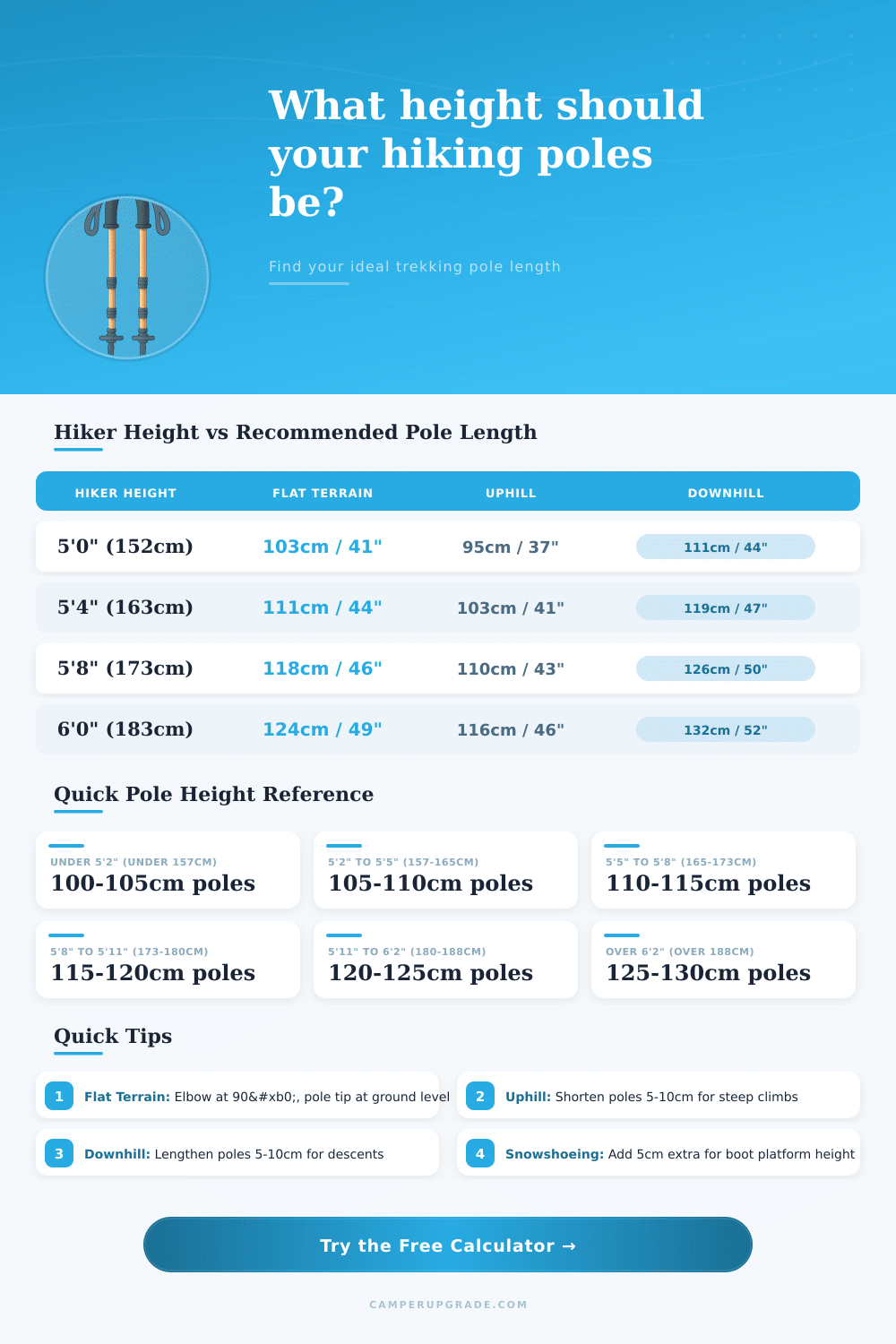
🦶 Hiking Poles Height Calculator
Find your ideal trekking pole length based on your height and terrain type
| Hiker Height | Height (cm) | Flat Terrain | Uphill (−8cm) | Downhill (+8cm) |
|---|---|---|---|---|
| 5'0" | 152cm | 103cm / 41" | 95cm / 37" | 111cm / 44" |
| 5'2" | 157cm | 107cm / 42" | 99cm / 39" | 115cm / 45" |
| 5'4" | 163cm | 111cm / 44" | 103cm / 41" | 119cm / 47" |
| 5'6" | 168cm | 114cm / 45" | 106cm / 42" | 122cm / 48" |
| 5'8" | 173cm | 118cm / 46" | 110cm / 43" | 126cm / 50" |
| 5'10" | 178cm | 121cm / 48" | 113cm / 44" | 129cm / 51" |
| 6'0" | 183cm | 124cm / 49" | 116cm / 46" | 132cm / 52" |
| 6'2" | 188cm | 128cm / 50" | 120cm / 47" | 136cm / 54" |
| 6'4" | 193cm | 131cm / 52" | 123cm / 48" | 139cm / 55" |
| Terrain Type | Adjustment | Why It Helps | Use Case |
|---|---|---|---|
| Flat Trail | No adjustment (baseline) | Elbow at 90° for optimal push | Day hikes, walking paths |
| Uphill (moderate) | Shorten 5cm | Keeps arm angle efficient | Rolling hills, moderate climbs |
| Uphill (steep) | Shorten 8–10cm | Reduces shoulder strain on ascent | Mountain climbing, switchbacks |
| Downhill (moderate) | Lengthen 5cm | Provides forward braking support | Gradual descents, trails |
| Downhill (steep) | Lengthen 8–10cm | Protects knees, improves balance | Steep descents, rocky terrain |
| Mixed Terrain | +2cm from flat baseline | Compromise for varied ground | General backpacking, day trips |
| Snowshoeing | +5cm from flat baseline | Accounts for raised boot platform | Winter trails, snowpack |
| Trail Running | −5cm from flat baseline | Shorter poles for quicker cadence | Fast-paced trail runs |
Get the right length for Hiking Poles matters more than many folks believe. On flat ground the pole reach should allow the arm to bend at 90 degrees. The handle of the pole rests on the ground, while the elbow stays at the right angle.
The upper part of the handle sits at the level of the waist or the hip, when the arm rests beside the body with the forearm bent at 90 degrees.
How to Find the Right Length for Hiking Poles
A simple math rule can help. Take your Height in centimetres and multiply it by 0.68. This way you find the ideal length for the pole in centimetres.
For instance, a folk of 180 cm Height would have around 122 cm as best pole length. Someone around 171 cm tall would reach 115 cm or 120 cm for flat ground.
Some brands offer poles with fixed length in standard sizes, like 100 cm, 110 cm, 120 cm and 130 cm. One famous guide about sizes points 100 cm for folks under 154 cm, 110 cm for those between 154 and 171 cm, 120 cm for floks between 172 and 182 cm, and 130 cm for any above 183 cm. A hiker of 180 cm (5 feet 11 inches) found, that 120 cm poles perfectly work at 90 degrees on flat ground.
Adjustable poles really ease the task, because one can change the length according too the terrain. The adjustment range usually goes from around 60 to 140 cm. During climbing, shorter poles help more.
During descent, long poles give better support. Adjustable Hiking Poles are ideal for general hikes thanks to that flexibility. Some folks set them once outside and leave them unchanged until the tent.
Even so, the Height is not the only factor. Some hikers choose the length by trial and mistake, which differs from the usual advice. One folk noticed, that the standard length caused pain in the arms and then used poles between 115 and 120 cm.
Others like poles a bit longer than the 90-degree standard, placing the handle between elbow and shoulder, similar to the style of cross-country skiing.
The best way to find the right pole length on the trail is to use an adjustable model at your Height and walk with it a bit of time. Then adjust it until it feels comfortable and stay with that. Because in heavy hiking, like river trails, the pole or stick should be around three quarters of the whole Height and a lot stronger.
A taller hiker of 193 cm (6 feet 4 inches) maybe will ask, whether a pole up to 135 cm is enough, which shows, that thesize can become hard at extremes.