🏔 Hiking Difficulty Calculator
Rate any trail using the Shenandoah formula & REI scale — plan safer, smarter hikes
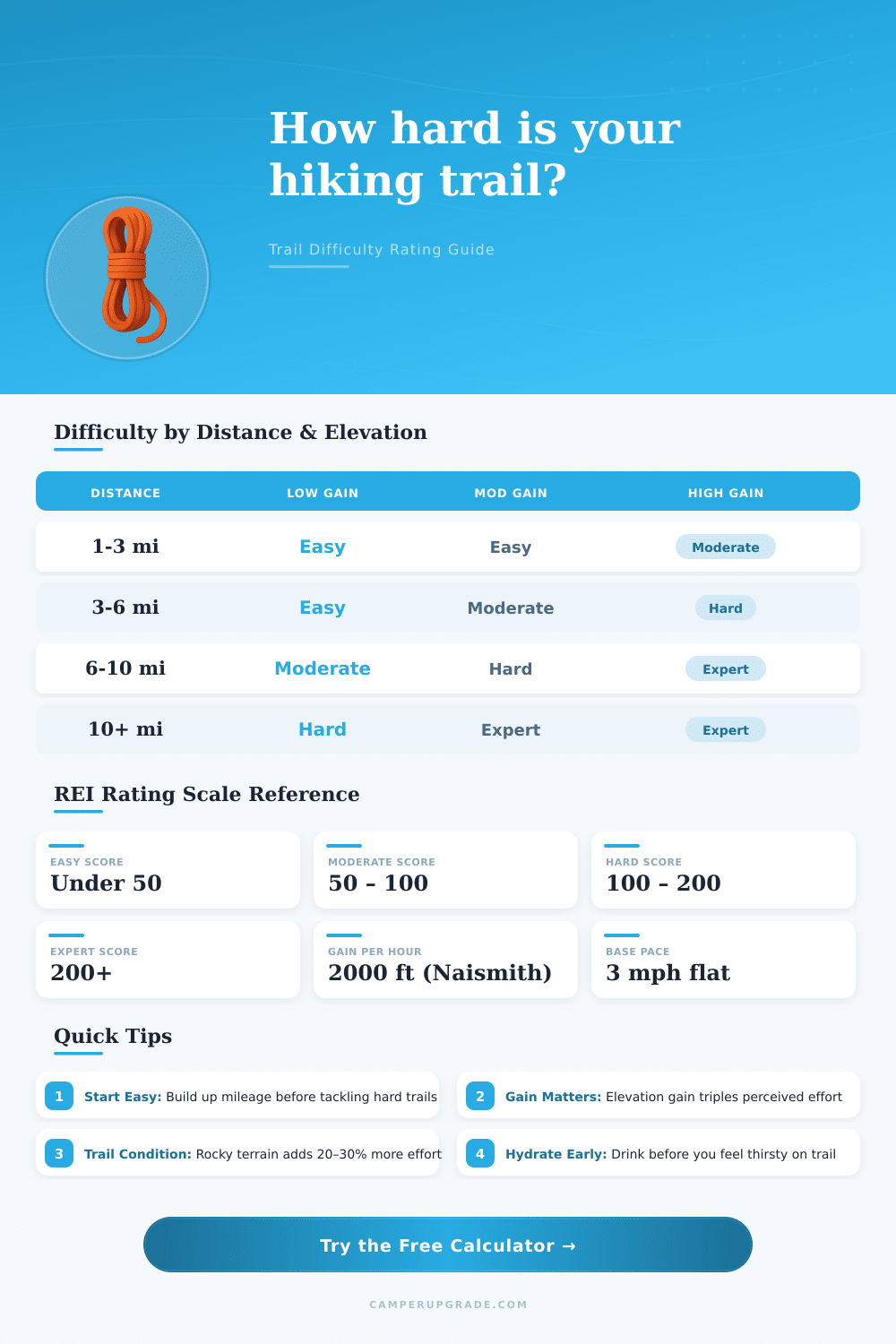
| Distance | Low Gain (<500 ft) | Moderate (500–1500 ft) | High (1500–3000 ft) | Extreme (>3000 ft) |
|---|---|---|---|---|
| 1–3 miles | Easy | Easy | Moderate | Hard |
| 3–6 miles | Easy | Moderate | Hard | Expert |
| 6–10 miles | Moderate | Hard | Expert | Expert |
| 10–15 miles | Hard | Expert | Expert | Expert |
| 15+ miles | Hard | Expert | Expert | Expert |
| Trail | Distance (mi) | Elev. Gain (ft) | Score | Rating |
|---|---|---|---|---|
| Easy Nature Walk | 1.5 | 150 | 21 | Easy |
| Appalachian Day Hike | 8.0 | 1,400 | 150 | Hard |
| Rocky Mountain Pass | 6.0 | 2,200 | 163 | Hard |
| Desert Canyon Trail | 9.0 | 1,800 | 180 | Hard |
| Half Dome (Yosemite) | 14.2 | 4,800 | 369 | Expert |
| Mount Whitney | 21.4 | 6,100 | 512 | Expert |
| Bright Angel (Grand Canyon) | 9.5 | 3,060 | 241 | Expert |
Counting how hard a hike will be is not as simple as only checking the length of the way. The distance forms only one part of the equation. The height gain is the second important part that can totally change the situation.
A hike of 20 miles with only 500 feet of height gain commonly feels easier than an eight-mile way with 3500 feet of climbing. Even so that longer pace with little steepness can cause faster time for the traveller.
What Makes a Hike Hard
Looking at it closely 1500 feet of height over only two miles makes it quite a lot steep and tough. However the same amount of height, spread over four or five miles, seems fairly modest. Because of that, the relation between length and height gain plays a big role.
Already in 1976, the creator of the National School for Outdoor Leading coined something called the “Energy Mile formula“. The idea is made up of that, that one energy mile matches the energy needed to walk one mile on flat ground. For every thousand feet of gained height, one adds two extra energy miles.
There are similar calculators online, where one can enter the length, the height gain and the highest spot to estimate the Hiking Difficulty, the energy miles, the ratnig of steepness, the grade and the angle.
The nature of the ground is another part that affects everything. Rocky and rough areas, steep slopes and wet conditions because of rain or mud can make the way really slippery. Some trails include rock climbing and chain parts, that bring real danger of wound during a fall.
One thing that many methods do not consider is the roughness of the way, that can create a big difference.
Ratings of Hiking Difficulty usually carry subcategories like the daily distance of hike, wait of the backpack, kind of ground, daily height gain and exposure. The category also takes in the steepness, obstacles during descent, difficult orientation and whether mistakes on trail are easily fixed. The season of the year matters also a lot.
The winter brings snow, less daylight and cold, what makes the trails a totally different experience. Even in one same month, the conditions can change quickly on the same trail.
For newcomers, a typical first hike should sit between three and eight miles without big heights. Moving by means of shorter and simpler ways, and slowly reaching longer distances, is a wise approach. Skipping hikes on back to back days at first is also useful.
The height itself can create problems. A trail that starts around 4800 metres requires pauses after every third step on the steepest sections.
The mental readiness is just as important as the physical training. Although anyone physically can last a heavy hike, if one feels fear or frustration during hours, then it will not be fun for anyone. One of the main challenges in hikes is the mix of height gain with lack of preparation for the toughestmoments.
Even an average pace with rolling hills can leave some people sharply tired.