🛶 Kayak Weight Capacity Calculator
Calculate your safe paddling load — paddler weight, gear, and total capacity in one tool
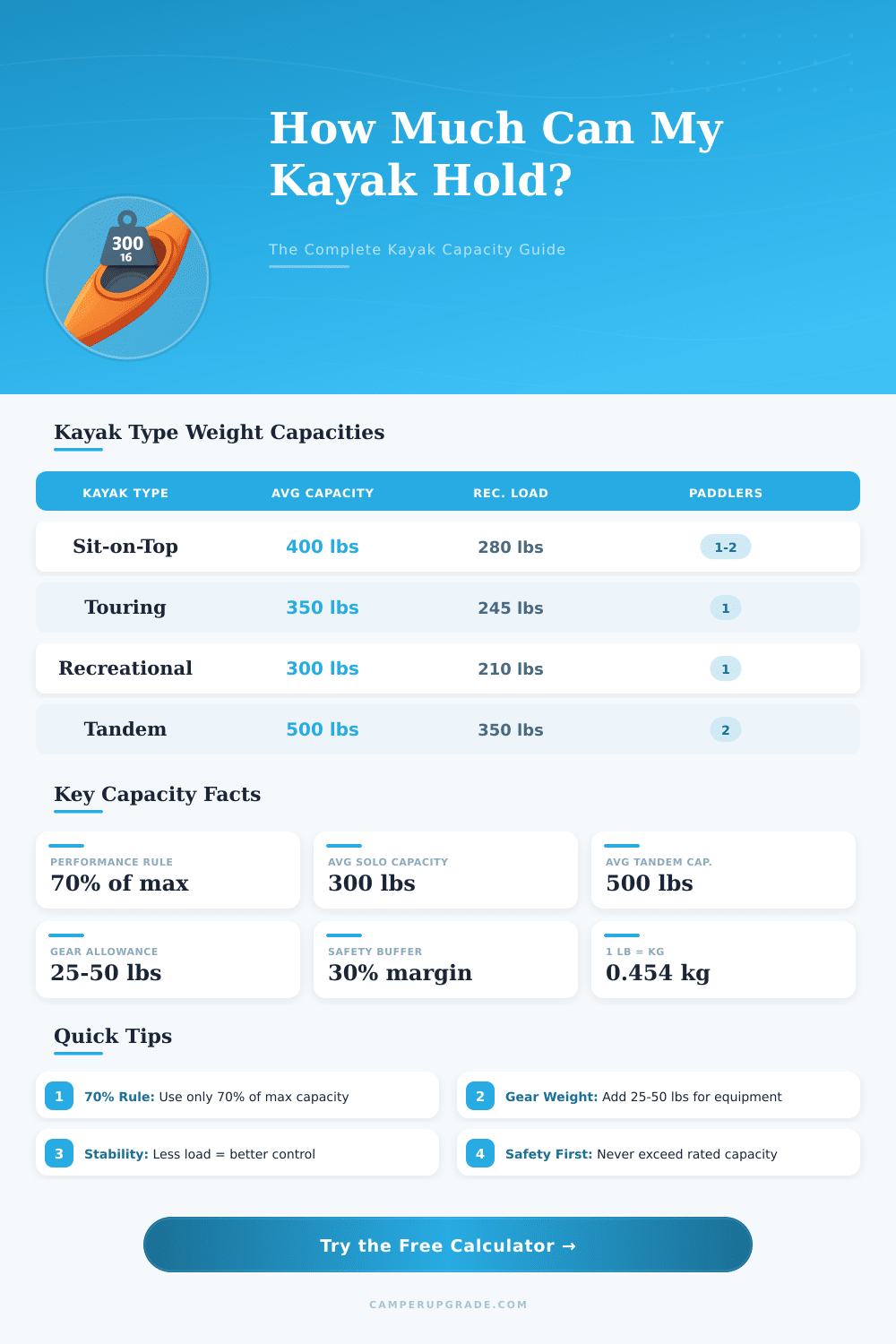
| Kayak Type | Max Capacity (lbs) | Max Capacity (kg) | Rec. Load (70%) | Typical Paddlers |
|---|---|---|---|---|
| Recreational | 250 – 300 | 113 – 136 | 175 – 210 lbs | 1 |
| Touring / Sea | 300 – 400 | 136 – 181 | 210 – 280 lbs | 1 |
| Sit-on-Top | 350 – 500 | 159 – 227 | 245 – 350 lbs | 1–2 |
| Fishing Kayak | 400 – 550 | 181 – 249 | 280 – 385 lbs | 1–2 |
| Tandem Kayak | 450 – 600 | 204 – 272 | 315 – 420 lbs | 2 |
| Whitewater | 150 – 250 | 68 – 113 | 105 – 175 lbs | 1 |
| Inflatable | 400 – 750 | 181 – 340 | 280 – 525 lbs | 1–3 |
| Folding Kayak | 300 – 450 | 136 – 204 | 210 – 315 lbs | 1 |
| Gear Item | Approx. Weight (lbs) | Approx. Weight (kg) | Notes |
|---|---|---|---|
| PFD / Life Jacket | 1 – 3 | 0.5 – 1.4 | Always required |
| Paddle | 1.5 – 3 | 0.7 – 1.4 | Fiberglass or carbon |
| Dry Bag (full, 20L) | 5 – 15 | 2.3 – 6.8 | Clothing, food, etc. |
| Camping Tent | 4 – 8 | 1.8 – 3.6 | Backpacking style |
| Sleeping Bag | 2 – 5 | 0.9 – 2.3 | Compressed in bag |
| Water Supply (1 gal) | 8.3 | 3.8 | 8.34 lbs per gallon |
| Fishing Tackle Box | 5 – 20 | 2.3 – 9.1 | Varies widely |
| Cooler (small, full) | 15 – 30 | 6.8 – 13.6 | Ice adds weight |
| Bilge Pump + Paddle Float | 1 – 2 | 0.5 – 0.9 | Safety gear |
| Electronics / GPS | 0.5 – 2 | 0.2 – 0.9 | VHF radio, etc. |
| Max Capacity (lbs) | 15% Buffer — Max Load | 25% Buffer — Max Load | 30% Buffer — Max Load |
|---|---|---|---|
| 200 lbs | 170 lbs (77 kg) | 150 lbs (68 kg) | 140 lbs (64 kg) |
| 250 lbs | 213 lbs (97 kg) | 188 lbs (85 kg) | 175 lbs (79 kg) |
| 300 lbs | 255 lbs (116 kg) | 225 lbs (102 kg) | 210 lbs (95 kg) |
| 350 lbs | 298 lbs (135 kg) | 263 lbs (119 kg) | 245 lbs (111 kg) |
| 400 lbs | 340 lbs (154 kg) | 300 lbs (136 kg) | 280 lbs (127 kg) |
| 500 lbs | 425 lbs (193 kg) | 375 lbs (170 kg) | 350 lbs (159 kg) |
| 600 lbs | 510 lbs (231 kg) | 450 lbs (204 kg) | 420 lbs (191 kg) |
| Water Type | Suggested Max Load % | Reason | Buffer Rec. |
|---|---|---|---|
| Calm Lakes / Ponds | 75–80% | Stable, predictable | 20–25% |
| Coastal / Bays | 65–70% | Tidal changes, wind | 30% |
| River / Moving Water | 60–70% | Currents, obstacles | 30% |
| Ocean / Open Water | 60–65% | Waves, high swells | 35%+ |
| Whitewater / Rapids | 55–65% | High instability risk | 35–45% |
kayak weight capacity rank between those themes, that seems easy, but really causes a lot of confusion, especially for newcomers. Any industry has common rules about that, as one counts the maximum weight for kayak what complicates everything.
Here the main idea. Average touring kayak carries 250 to 300 pounds. Travel and sea models normally fit to 350 pounds.
How Much Weight Can a Kayak Carry
Kayaks with seat on the edge carry 350 to 400 pounds. Double kayaks have total limit of 500 to 600 pounds. Inflatable kayaks sometimes reach even bigger values, sometimes above 800 pounds.
So here is the secret, that many folks do not know. The listed maximum capacity simply marks the moment, when the kayak almost sinks. A kayak with limit of 250 pounds carries so much weight and stays on the surface, but that does not guarantee good handilng at that load.
The practical heavy limit, so that the kayak really well works, falls around 30 to 35 percent under the maximum listed by the factory. Like this kayak with 600 pound capacity works best at around 390 to 420 pounds whole load.
Stay under 80 percent of the listed capacity value as good guideline. Go over that, and the kayak becomes unstable and the waves become really unpleasant.
One must recall, that the weight capacity covers everything. It includes the rider, the paddle, the gear, the drinks, the coolers, the dogs, the tents and every other thing, that one brings. Practical way is too add the body weight with that of the gear, later divide by 0.7 to find right maximum limit of the kayak.
Folk weighing 175 pounds with 25 pounds gear would need kayak with limit at least of 285 pounds.
Long kayaks usually have bigger weight limits. Going from 9 or 10 foot model to 12 or 13 foot makes big change. One folk weighing around 280 pounds chose 12 foot kayak with 500 pound capacity and found it very stable on water.
For some weighing around 340 pounds, kayak with limit of 450 pounds would work, because it leaves 30 percent reserve.
Some makers of kayaks remove the weight of the kayak itself, the seat and the extras from the listed capacity, to reach the actual usable weight. One kayak with 500 pound limit only had 379 pounds usable capacity after removal of the weight of the kayak and its extras. Sea kayaks themselves commonly weigh 50 to 60 pounds, and fiberglass ones cost even more.
Overloading kayak pushes it much more into danger and makes it harder to recover after tipping. Cutting the extra gear and heavyclothing helps to stay inside safe limits.