🛝 Playground Mulch Calculator
Calculate cubic yards, bags, and weight for any playground mulch project
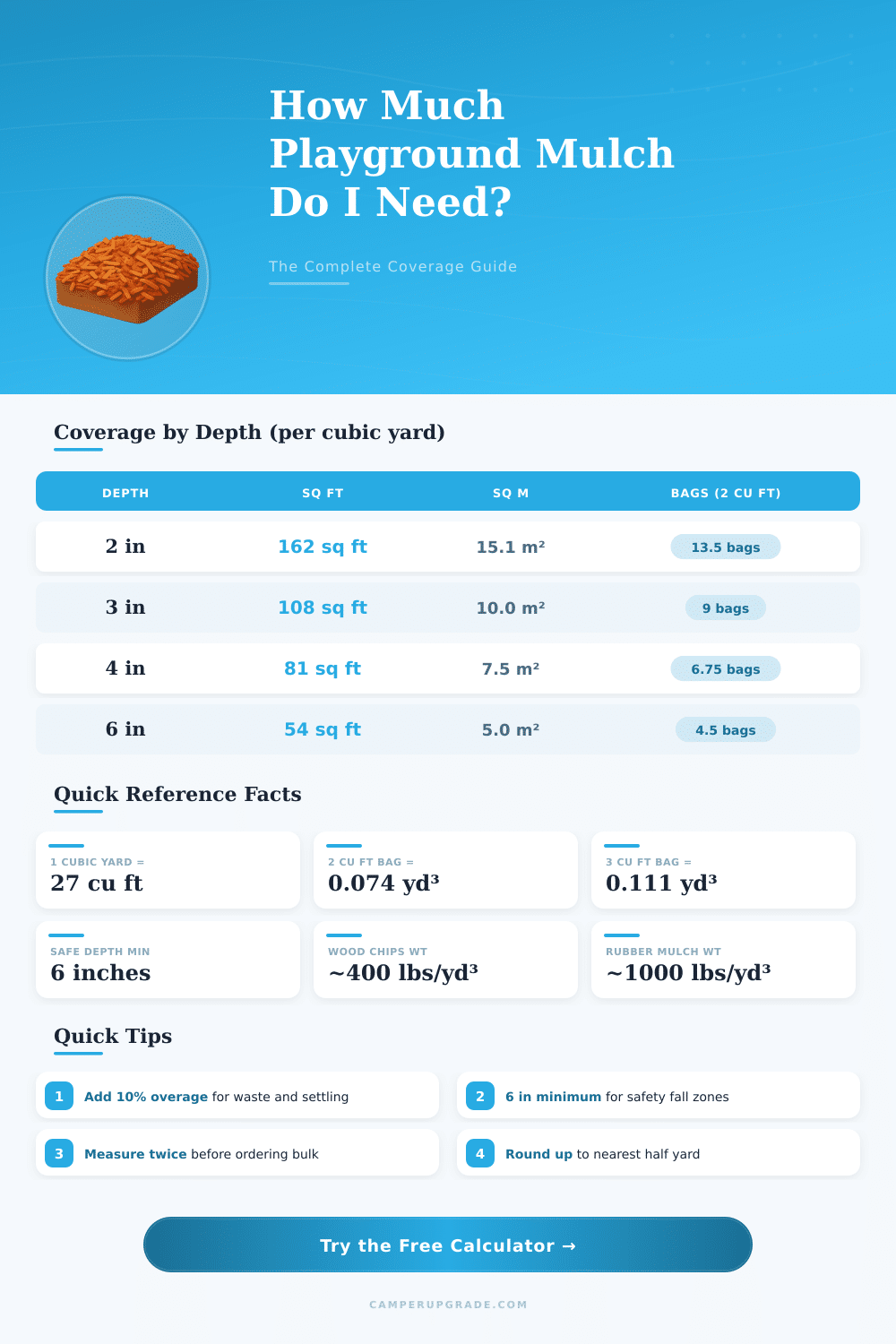
| Depth | Sq Ft Covered | Sq Meters | 2 cu ft Bags Needed | 3 cu ft Bags Needed |
|---|---|---|---|---|
| 1 inch (2.5 cm) | 324 sq ft | 30.1 m² | 13.5 bags | 9 bags |
| 2 inches (5 cm) | 162 sq ft | 15.1 m² | 13.5 bags | 9 bags |
| 3 inches (7.6 cm) | 108 sq ft | 10.0 m² | 13.5 bags | 9 bags |
| 4 inches (10 cm) | 81 sq ft | 7.5 m² | 13.5 bags | 9 bags |
| 6 inches (15 cm) | 54 sq ft | 5.0 m² | 13.5 bags | 9 bags |
| 9 inches (23 cm) | 36 sq ft | 3.3 m² | 13.5 bags | 9 bags |
| 12 inches (30 cm) | 27 sq ft | 2.5 m² | 13.5 bags | 9 bags |
| Bag Size | Volume (cu ft) | Volume (m³) | Bags per Yard | Covers at 3 in Depth |
|---|---|---|---|---|
| Small bag | 1 cu ft | 0.028 m³ | 27 bags | 4 sq ft |
| Standard bag | 2 cu ft | 0.057 m³ | 13.5 bags | 8 sq ft |
| Large bag | 3 cu ft | 0.085 m³ | 9 bags | 12 sq ft |
| Half yard | 13.5 cu ft | 0.38 m³ | — | 54 sq ft |
| 1 cubic yard (bulk) | 27 cu ft | 0.76 m³ | — | 108 sq ft |
| Project | Area (sq ft) | Cu Yards at 6 in | 2 cu ft Bags at 6 in |
|---|---|---|---|
| Small backyard swingset | 400 sq ft | 7.4 yd³ | 100 bags |
| Medium play structure | 600 sq ft | 11.1 yd³ | 150 bags |
| Large backyard set | 900 sq ft | 16.7 yd³ | 226 bags |
| School / park playground | 2,000 sq ft | 37.0 yd³ | 500 bags |
| Round sandbox (12 ft dia) | 113 sq ft | 2.1 yd³ | 28 bags |
| Toddler corner zone | 225 sq ft | 4.2 yd³ | 57 bags |
playground mulch is made from natural wood, that usually one gets from sawmills. It works well for paths and playgrounds, where children run around. Parks and schools around the whole world use mulch for playgrounds, to protect children against painful falls.
Some kinds of playground covers receive approval from the International Association of Makers of Play Equipment, because they match ASTM standards for engineered wooden fiber.
Which Mulch Is Best for Playgrounds
Two main kinds deserve thought: wooden cover and rubber. Wooden playground covers one makes from pure wood what makes them quite a lot safe. They cost less than many alternatives.
One big advantage is their natural origin. Like this, when one removes the play structure after years, no need to care about bits of rubber. The wood simply breaks down naturally.
Materials like engineered wooden fiber are reusable and naturally breaking down.
Rubber cover presents another option. It more effectively grabs shocks, which does reduce risk of wounds during falls. On the other hand, rubber covers are much more expensive.
Some parents shared doubts about their safety and about that, that they break into little particles, that enter the surrounding ground. Widely one thinks, that fun games on playgrounds with tire-based covers beat the dangers, even so more studies yet lack. In the positive side, such covers help to keep used tyres away from dumps.
Hemlock wooden chips are liked for playground covers, because hemlock does not split easily. For sandy play areas one chooses rounded sand chips instead of sharp ones, which forms another option. More rough cover commonly hurts more, because well chopped material can bother the skin.
Keeping nine-inch depth of wooden chips can lower the effect of play falls by around forty-four percent. Even so that thickness maybe beats expectations.
Wooden chips break down over time, so one must regularly cover them, to ensure safe surface four play. Wooden chip covers do not always match ADA rules. For fewer issues, one can consider locally poured rubber, connected rubber plates or fake ground.
Connected plates slip when they get wet and break down on outdoor ground, but inside they work well. Mats under swings help to reduce how much cover one kicks away.
Average mulch stops weeds and controls water loss. Playground cover is another case and does not spill organic stuff in the ground, like garden mulch. Even so wooden chip covers in playgrounds help feed the soil with nutrients and keep water.
One makes all colored covers with water-based dyes. If one does not keep enough cover to safety standards, the responsible group, like a community leader or school, could meetlegal trouble because of neglect. During planning of playground, one must think about flow of folks, height of gear and what games will happen here.