🚛 Tongue Weight Percentage Calculator
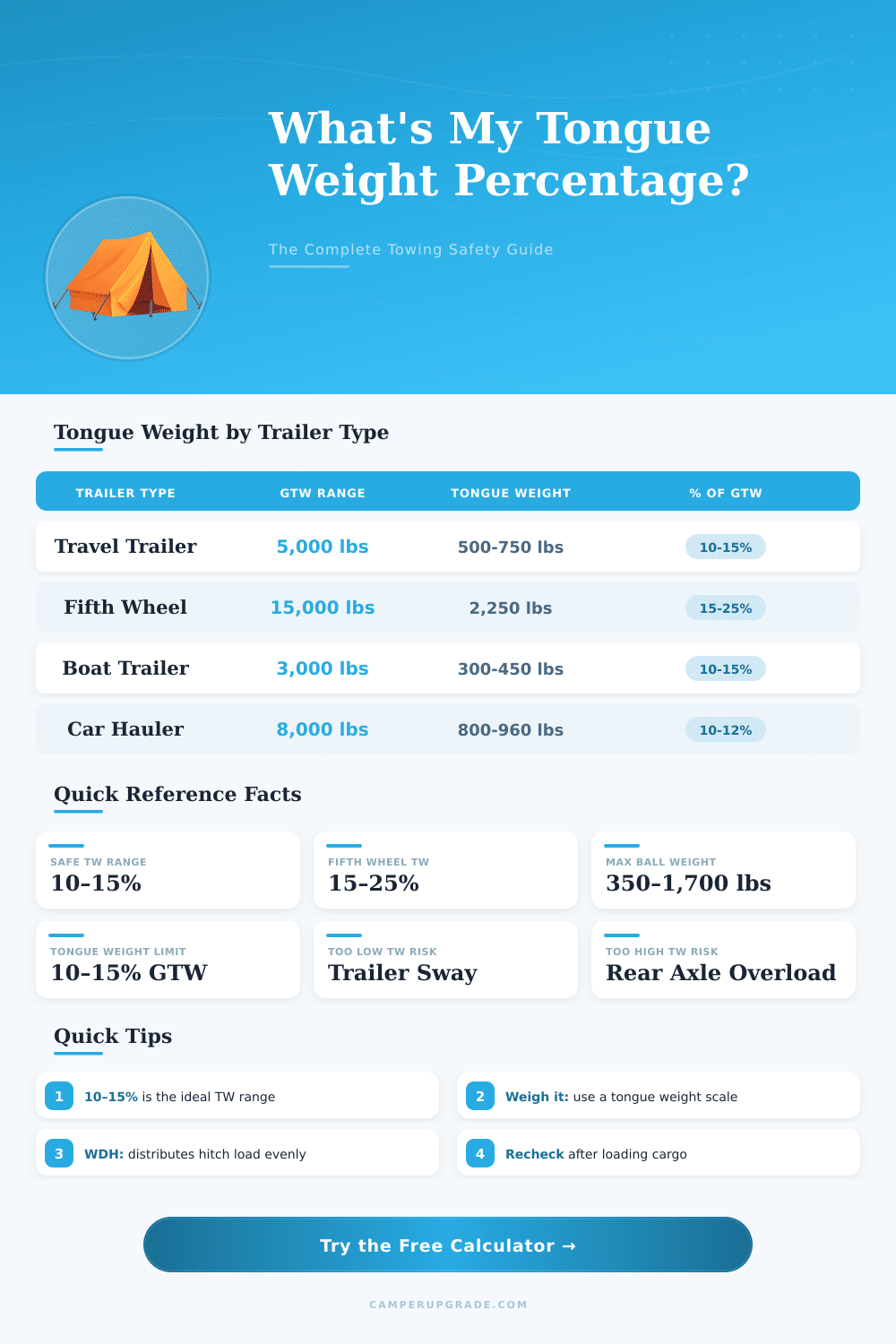
Check if your trailer tongue weight is within the safe 10–15% range for your tow vehicle
| Gross Trailer Weight | 10% TW (Min Safe) | 12% TW (Ideal) | 15% TW (Max Safe) |
|---|---|---|---|
| 2,000 lbs (907 kg) | 200 lbs (91 kg) | 240 lbs (109 kg) | 300 lbs (136 kg) |
| 3,000 lbs (1,361 kg) | 300 lbs (136 kg) | 360 lbs (163 kg) | 450 lbs (204 kg) |
| 5,000 lbs (2,268 kg) | 500 lbs (227 kg) | 600 lbs (272 kg) | 750 lbs (340 kg) |
| 7,500 lbs (3,402 kg) | 750 lbs (340 kg) | 900 lbs (408 kg) | 1,125 lbs (510 kg) |
| 10,000 lbs (4,536 kg) | 1,000 lbs (454 kg) | 1,200 lbs (544 kg) | 1,500 lbs (680 kg) |
| 12,000 lbs (5,443 kg) | 1,200 lbs (544 kg) | 1,440 lbs (653 kg) | 1,800 lbs (816 kg) |
| 15,000 lbs (6,804 kg) | 1,500 lbs (680 kg) | 1,800 lbs (816 kg) | 2,250 lbs (1,021 kg) |
| 20,000 lbs (9,072 kg) | 2,000 lbs (907 kg) | 2,400 lbs (1,089 kg) | 3,000 lbs (1,361 kg) |
| Hitch Class | Max GTW | Max Tongue Weight | Typical Use |
|---|---|---|---|
| Class I | 2,000 lbs (907 kg) | 200 lbs (91 kg) | Small utility / bike racks |
| Class II | 3,500 lbs (1,588 kg) | 350 lbs (159 kg) | Small trailers, boats |
| Class III | 8,000 lbs (3,629 kg) | 800 lbs (363 kg) | Travel trailers, boats |
| Class IV | 12,000 lbs (5,443 kg) | 1,200 lbs (544 kg) | Large trailers |
| Class V | 20,000 lbs (9,072 kg) | 1,700 lbs (771 kg) | Heavy-duty trailers |
| Fifth Wheel | 30,000 lbs (13,608 kg) | 6,000+ lbs (2,722 kg+) | Fifth wheel RVs |
| Gooseneck | 30,000+ lbs | 7,500+ lbs | Livestock, equipment |
| Cargo Position | Effect on TW | Result | Safety Risk |
|---|---|---|---|
| Too far forward | Increases tongue weight | TW > 15% GTW | Rear axle overload, steering loss |
| Ideal: 60% forward | Balanced TW | TW 10–15% GTW | Safe ✔ |
| Too far rearward | Decreases tongue weight | TW < 10% GTW | Trailer sway / fishtailing |
| Heavy items low & centered | Lowers center of gravity | Improved stability | Best practice ✔ |
The tongue weight represents the downward pressure that the trailer puts on the hitch spot of the towing vehicle. Getting this value right matters for safety, comfort and long survival of the vehicle. One sometimes calls it hitch weight, and it is made up of the pressure on the hitch ball together with any gear behind the back axle of the towing auto.
For most recreational vehicles the tongue weight ideally falls between 10 and 15 percent of the whole trailer weight. Some travel trailers work best in the range of 13 to 15 percent. Commonly one describes the perfect values as 13-15 percent of the loaded weight of the trailer.
Trailer Tongue Weight: What It Is and How to Measure
In owner manuals of towing vehicles, the maximum tongue weight usually limits at 10 percent of the towing ability.
Here is what commonly confuses folks. The listed tongue weight in the booklet almost never matches the reality in practice. One camper, whose advertised tongue weight was 608 pounds, found that it arrived at around 825 puonds after adding propane and batteries, almost 850 after loading for a journey, and even 900 after filling the tank for fresh water.
Another trailer had a listed tongue weight of 222 pounds, but with two batteries and two tanks for propane it jumped to about 378 pounds. After full loading you no longer will find that bottom number.
The tongue weight never should pass the hitch ability of your towing vehicle. That limit relates to the vehicle itself, not only too the recreational vehicle. The whole weight of the trailer tongue weight and axle weight, together with their total, must stay under the empty vehicle weight of the trailer.
There are several ways to estimate the tongue weight. A special scale for tongue weight works for that task. Another option is a bathroom scale.
You lay the tongue of the trailer at the same height as the towing ball, read the number and multiply by four thanks to the 4:1 ratio in that system. Also visiting a commercial weighing station, like CAT-scale, is possible. Weigh the truck without the trailer, but loaded fully for a journey with fuel, passengers and gear.
Later weigh it with the attached trailer. Subtract the first value from the second to get the real tongue weight.
Placing heavy objects forward in the trailer helps to keep proper tongue weight. Even tiny moves, like switching a spare tire or changing places of batteries, can change the situation. Too little tongue weight can cause swaying of the trailer, that usually shows up when the speed reaches 45 to 50 miles an hour.
Before you measure, load therecreational vehicle with everything usually brought, so that the reading is correct.