🥾 Hiking Distance Calculator
Calculate total distance, elevation-adjusted time, steps, and calories for any hike
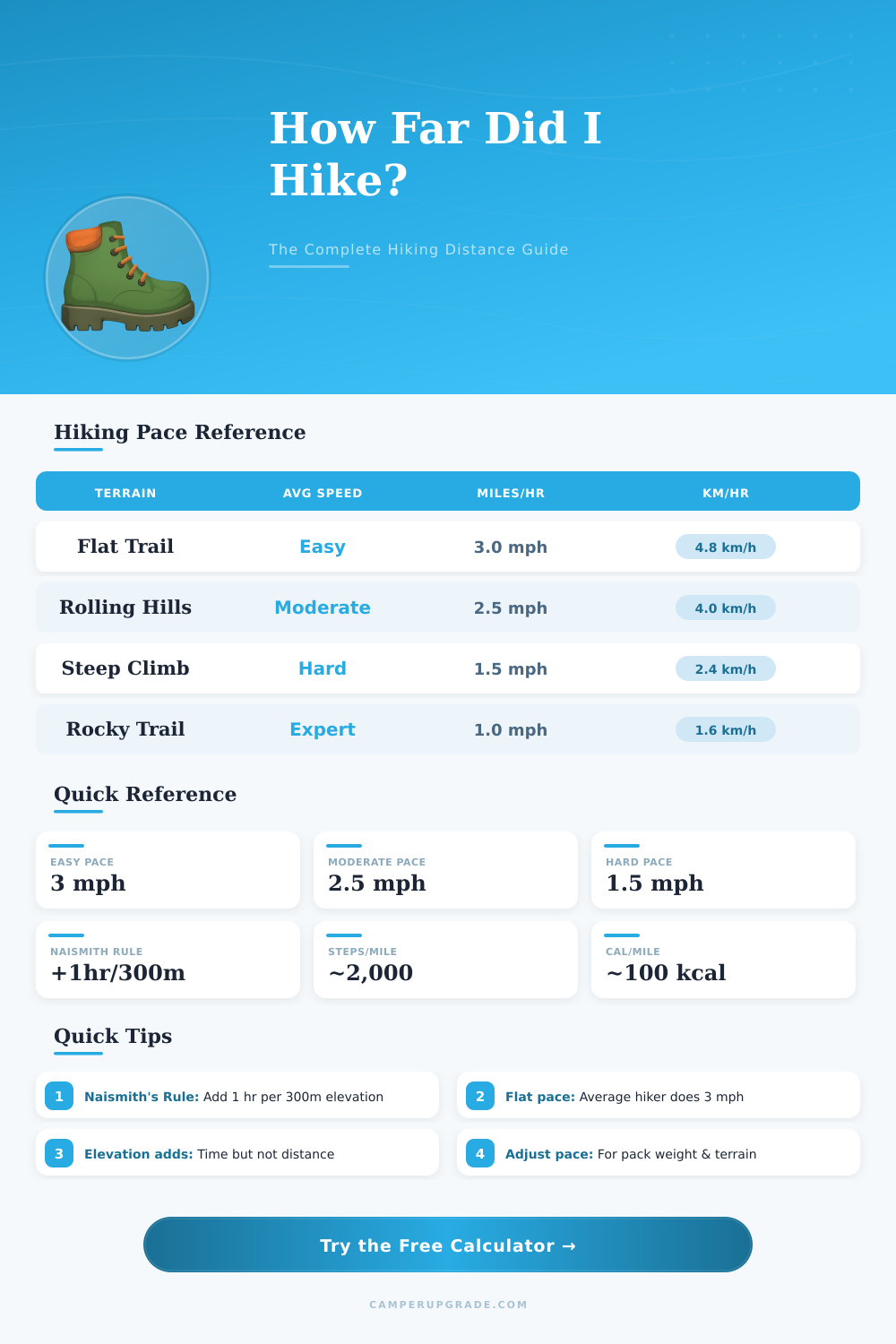
| Distance (mi) | Distance (km) | Slow (2.0 mph) | Moderate (2.5 mph) | Average (3.0 mph) | Fast (3.5 mph) |
|---|---|---|---|---|---|
| 1.0 mi | 1.6 km | 30 min | 24 min | 20 min | 17 min |
| 2.0 mi | 3.2 km | 1h 00m | 48 min | 40 min | 34 min |
| 3.0 mi | 4.8 km | 1h 30m | 1h 12m | 1h 00m | 51 min |
| 5.0 mi | 8.0 km | 2h 30m | 2h 00m | 1h 40m | 1h 26m |
| 8.0 mi | 12.9 km | 4h 00m | 3h 12m | 2h 40m | 2h 17m |
| 10.0 mi | 16.1 km | 5h 00m | 4h 00m | 3h 20m | 2h 51m |
| 13.1 mi | 21.1 km | 6h 33m | 5h 14m | 4h 22m | 3h 45m |
| 26.2 mi | 42.2 km | 13h 06m | 10h 29m | 8h 44m | 7h 29m |
| Elevation Gain (ft) | Elevation Gain (m) | Extra Time Added | Difficulty |
|---|---|---|---|
| 0 – 250 ft | 0 – 76 m | +0 min | Minimal |
| 250 – 500 ft | 76 – 152 m | +5 – 10 min | Gentle |
| 500 – 1,000 ft | 152 – 305 m | +10 – 20 min | Moderate |
| 1,000 – 2,000 ft | 305 – 610 m | +20 – 40 min | Strenuous |
| 2,000 – 3,000 ft | 610 – 914 m | +40 – 60 min | Very Strenuous |
| 3,000 – 5,000 ft | 914 – 1524 m | +60 – 100 min | Expert |
| 5,000 ft+ | 1524 m+ | +100 min+ | Extreme |
| Distance (mi) | Approx. Steps | Calories (150 lb) | Calories (200 lb) |
|---|---|---|---|
| 1 mi | ~2,000 | ~80 kcal | ~105 kcal |
| 2 mi | ~4,000 | ~160 kcal | ~210 kcal |
| 3 mi | ~6,000 | ~240 kcal | ~315 kcal |
| 5 mi | ~10,000 | ~400 kcal | ~525 kcal |
| 8 mi | ~16,000 | ~640 kcal | ~840 kcal |
| 10 mi | ~20,000 | ~800 kcal | ~1,050 kcal |
| 13.1 mi | ~26,200 | ~1,050 kcal | ~1,378 kcal |
| 26.2 mi | ~52,400 | ~2,100 kcal | ~2,756 kcal |
| Hike Type | Typical Distance | Typical Elevation | Avg Time (Moderate) |
|---|---|---|---|
| Nature Walk | 1 – 2 mi (1.6 – 3.2 km) | Under 200 ft | 30 – 60 min |
| Easy Half-Day | 3 – 5 mi (4.8 – 8 km) | 200 – 600 ft | 1.5 – 3 hrs |
| Moderate Day Hike | 6 – 9 mi (9.7 – 14.5 km) | 600 – 1500 ft | 3 – 5 hrs |
| Strenuous Day Hike | 10 – 14 mi (16 – 22.5 km) | 1500 – 3000 ft | 5 – 8 hrs |
| Backpacking Day | 8 – 15 mi (12.9 – 24 km) | 1000 – 2500 ft | 4 – 8 hrs |
| Half Marathon Trail | 13.1 mi (21.1 km) | Varies | 5 – 7 hrs |
| Trail Marathon | 26.2 mi (42.2 km) | Varies | 9 – 14 hrs |
Figuring out how many miles one can cover in one day depends on many different factors. Theoretically, many folks would manage to reach between 16 and 24 miles, if everything were ideal. Even so, here it differs from reality a bit greatly.
When scientists asked a group of hikers around 37% of them said that their maximum daily distance was 12 miles or less. There is a surprisingly big difference between what is theoretically possible, and what folks genuinely do on the way.
How Many Miles Can You Hike in One Day?
If you are just starting, you probably aim for something between 3 and 8 miles, without too much height. Most newcomers reach around 6 miles and feel very tired after that. So a total distance of 10 to 12 kilometers is a good starting level.
Remember only, that when one lists the length of a trail, it usually includes the reutrn trip, which matters more than one imagines during planning of your day.
Expert hikers commonly find 8 miles as their ideal distance, although between 5 and 10 miles all feel well. There are those that like to push to 12 to 18 miles. Quite a lot to spend a hole part of the day outside, without big problems about supplies.
Some go even more and struggle with more than 20 miles, if the conditions are good. On the other hand, during multi-day backpacking trips with heavy loads, folks most commonly limit to 13 or 14 miles daily. Daily trips without big weights?
Capable hikers easily reach 20 to 25 miles.
Naturally, there are entirely other types of hikers. Endurance athletes with lightweight gear can cover 25 to 45 miles or more in one day, but it genuinely depends on your training and what the trail adds to you. The factors that determine that are many: terrain, your gear, how much weight you carry and what you aim to reach.
Elevation gain changes everything. A good rule says that one needs around 30 minutes for every 1000 feet of climbing. A good target that widely works is 10 miles with 2000 feet of height.
If you fall a bit below that, the trail feels a bit too easy; if you go above, you probably have painful legs the next morning. Take Half Dome, it is 7.1 miles one way, but with 4800 feet of gain, so one must plan about 8 hours total, when one considers all that climbing.
Long-range Hiking forms its own category. A typical thru-hiker on the Appalachian Trail needs around 180 days to finish, with an average of 12.2 miles daily. Such journeys can last from a weekly adventure to a month or more, and some folks finish the whole Pacific Crest Trail in almost six months.
It needs just as much mental strength as physical endurance. If you cover more than 200 miles and it lasts more than two weeks, most call that long-range Hiking. More than the simplicity of pace, it matters to keep a steady step through thewhole day.
Trekking is not the same as Hiking. It usually means a longer trail through hills, and the word “expedition” describes the feel better than “Hiking”. Interestingly, European marks on trails commonly show time instead of distance, which makes more sense when one goes through mountains.