⛺ Tent Ventilation Calculator
Calculate required vent area, airflow rate, and condensation control for any tent or shelter setup
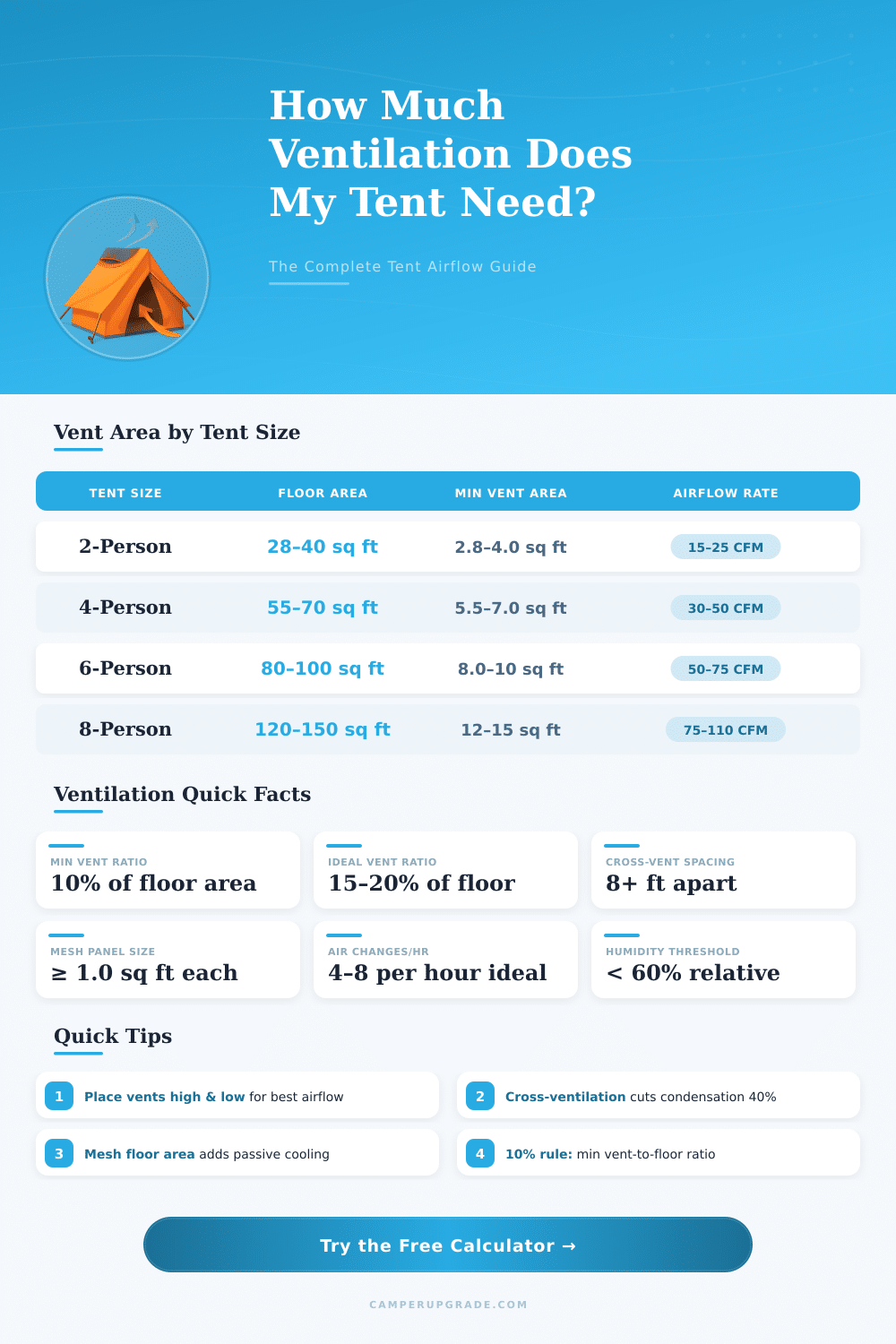
| Occupants | Min Vent Area (sq ft) | Min Vent Area (m²) | Recommended CFM | Recommended m³/hr |
|---|---|---|---|---|
| 1 | 1.0 – 1.5 | 0.09 – 0.14 | 10 – 15 | 17 – 25 |
| 2 | 2.0 – 3.0 | 0.19 – 0.28 | 15 – 25 | 25 – 42 |
| 3 | 3.0 – 4.5 | 0.28 – 0.42 | 22 – 35 | 37 – 59 |
| 4 | 4.0 – 6.0 | 0.37 – 0.56 | 30 – 50 | 51 – 85 |
| 6 | 6.0 – 9.0 | 0.56 – 0.84 | 45 – 75 | 76 – 127 |
| 8 | 8.0 – 12.0 | 0.74 – 1.11 | 60 – 100 | 102 – 170 |
| 10 | 10.0 – 15.0 | 0.93 – 1.39 | 75 – 125 | 127 – 212 |
| Climate | Vent Ratio (% of floor) | Airflow Multiplier | Condensation Risk | Priority |
|---|---|---|---|---|
| Hot & Humid | 20 – 25% | 1.4x | Very High | Cross-ventilation |
| Summer (warm/dry) | 12 – 18% | 1.1x | Moderate | Mesh panels |
| Spring / Fall | 10 – 15% | 1.0x | Low – Moderate | Adjustable vents |
| Rainy | 15 – 20% | 1.3x | High | Roof vents + fly gap |
| Desert / Arid | 18 – 25% | 1.35x | Low | Shade + airflow |
| Winter / Cold | 5 – 10% | 0.7x | High (condensation) | Small top vent |
| Floor Area (sq ft) | Floor Area (m²) | Min Vent (10%) | Ideal Vent (15%) | Max Vent (20%) |
|---|---|---|---|---|
| 20 sq ft | 1.86 m² | 2.0 sq ft | 3.0 sq ft | 4.0 sq ft |
| 40 sq ft | 3.72 m² | 4.0 sq ft | 6.0 sq ft | 8.0 sq ft |
| 60 sq ft | 5.57 m² | 6.0 sq ft | 9.0 sq ft | 12.0 sq ft |
| 80 sq ft | 7.43 m² | 8.0 sq ft | 12.0 sq ft | 16.0 sq ft |
| 100 sq ft | 9.29 m² | 10.0 sq ft | 15.0 sq ft | 20.0 sq ft |
| 150 sq ft | 13.94 m² | 15.0 sq ft | 22.5 sq ft | 30.0 sq ft |
| 200 sq ft | 18.58 m² | 20.0 sq ft | 30.0 sq ft | 40.0 sq ft |
| 300 sq ft | 27.87 m² | 30.0 sq ft | 45.0 sq ft | 60.0 sq ft |
| Scenario | Recommended ACH | CFM per Person | m³/hr per Person |
|---|---|---|---|
| Sleeping (cool weather) | 2 – 4 ACH | 5 – 10 CFM | 8.5 – 17 m³/hr |
| Sleeping (warm weather) | 4 – 6 ACH | 10 – 15 CFM | 17 – 25 m³/hr |
| Light activity / relaxing | 6 – 8 ACH | 15 – 20 CFM | 25 – 34 m³/hr |
| Hot & humid daytime | 8 – 12 ACH | 20 – 30 CFM | 34 – 51 m³/hr |
| Cooking nearby | 10 – 15 ACH | 25 – 40 CFM | 42 – 68 m³/hr |
| Winter condensation control | 2 – 3 ACH | 5 – 8 CFM | 8.5 – 14 m³/hr |
Well get airflow in tent more seriously than many folks reckon. Good ventilation in a shelter helps the flow of air between the outside and the interior. Like this one can control the temperature, for instance pushing warm air away and drawing fresh air inward.
The air inside tent usually is more muggy than outside, hence swapping the wet inside air with drier outside air gives big advantage.
Keep Air Moving in Your Tent
Tents almost entirely lack insulation. They protect you against wind and rain, but ideally one wants that fresh air flow through it as much as possible. Many tents have big net panels, that allows airflow from the interior to the space between the tent itself and the rainfly.
The rainfly does not form a tight bar against teh soil, so the whole system stays quite open.
Some models of tents come with zip windows, that can close fully or open up for more airflow, together with rain covers, that covers only the top and leave the sides opened. Use small fans during all seasons is a common way to reduce buildup. When the ventilation is weak, the moisture from breathing and body heat builds on the cold walls of the tent.
Buildup happens, because the tent material has no insulation and matches the outside temperature.
In warm weather limiting the covering of side walls helps too keep heat under control. Little rechargeable fans with flexible feet can be attached to the frame of the tent and direct airflow over there, where it is needed. Remove the rainfly entirely, when rain does not threaten, is another method for bringing the inside temperature closer to the outside air.
Without any gear the interior of tent never will become cooler than the air outside.
Tents with panels placed in smart spots help airflow and help to cool things during warm nights. Good tent can last storms, wind, heat and cold, while it still offers good ventilation and keeps insects away. Camping in humid climates adds extra problems with heat and moisture, and proper ventilation of the tent becomes even more important for the comfort.
Because of that, whoever uses a heater in tent, should search models with built-in openings for pipes or fans for heaters. They ensure safe use of the heater and give ventilation, that lowers the risk of buildup of smoke and gases inside. Glowing coals and embers, that do not make visible smoke, still stay dangerous.
As long as the fuel glows, at least a bit of ventilation must stay opened. Fires should be entirely put out before closing any opening of the tent. Without enough airflow the levels of oxygen quickly drop, andthat is the main cause of serious accidents in closed shelters.
Storm-proof shed tents sometimes have a special window for storms, that allows airflow even during bad weather. Real preparations for wind help, because tents are not airtight. Simply open the flap of a window or door commonly suffices.