🏔️ Appalachian Trail Elevation Gain Calculator
Calculate total elevation gain, difficulty rating, and hiking time for any AT section or custom hike
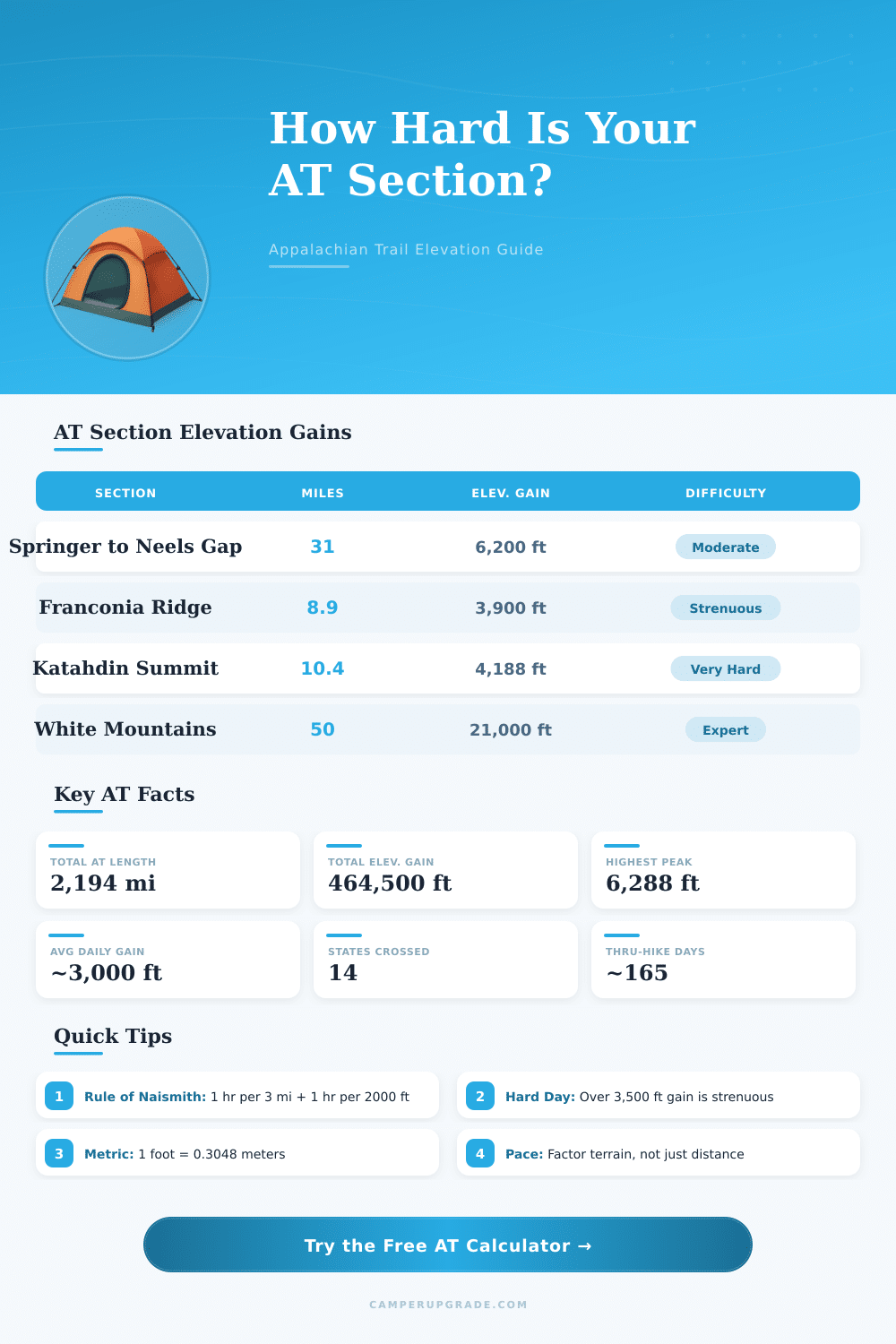
| Section | Miles | Elev. Gain (ft) | Elev. Gain (m) | Difficulty |
|---|---|---|---|---|
| Springer Mtn → Neels Gap, GA | 31.0 | 6,200 | 1,890 | Moderate |
| Blood Mountain, GA | 4.2 | 1,550 | 472 | Moderate |
| Nantahala Section, NC | 57.0 | 12,400 | 3,780 | Strenuous |
| Max Patch, NC | 2.6 | 620 | 189 | Easy |
| Grayson Highlands, VA | 10.0 | 1,900 | 579 | Moderate |
| Shenandoah NP, VA | 101.0 | 18,200 | 5,547 | Strenuous |
| Franconia Ridge, NH | 8.9 | 3,900 | 1,189 | Strenuous |
| Presidential Traverse, NH | 23.0 | 8,900 | 2,713 | Very Hard |
| White Mountains (Full), NH | 50.0 | 21,000 | 6,401 | Very Hard |
| Katahdin (Baxter Peak), ME | 10.4 | 4,188 | 1,277 | Very Hard |
| Distance (mi) | Elev. Gain (ft) | Beginner | Intermediate | Advanced | Expert |
|---|---|---|---|---|---|
| 5 | 1,000 | 3.5 hrs | 2.8 hrs | 2.3 hrs | 1.8 hrs |
| 8 | 2,000 | 6.5 hrs | 5.0 hrs | 4.0 hrs | 3.2 hrs |
| 10 | 3,000 | 9.0 hrs | 7.0 hrs | 5.5 hrs | 4.4 hrs |
| 15 | 4,000 | 13.0 hrs | 10.0 hrs | 8.0 hrs | 6.4 hrs |
| 20 | 5,000 | 17.5 hrs | 13.5 hrs | 10.5 hrs | 8.5 hrs |
| 25 | 7,500 | 23.0 hrs | 17.5 hrs | 14.0 hrs | 11.0 hrs |
| Feet | Meters | Gain per Mile | Grade % |
|---|---|---|---|
| 500 ft | 152 m | 500 ft/mi | 9.5% |
| 1,000 ft | 305 m | 1,000 ft/mi | 18.9% |
| 2,000 ft | 610 m | — | — |
| 3,000 ft | 914 m | — | — |
| 4,000 ft | 1,219 m | — | — |
| 5,280 ft (1 mi) | 1,609 m | — | — |
| 6,288 ft (Mt. Washington) | 1,917 m | — | — |
You often hear about “Elevation Gain” when you run or cycle in hills. The thing is that it not fully means what many folks believe. It counts the whole vertical distance that you climb during the whole way.
So, if the path goes upward to a hill, later falls and again climbs, you collect each of those hard parts. Descent does not reduce the whole, it simply does not add to it. The Elevation Gain deals only about the rises.
What Is Elevation Gain?
Picture this way. You run upward for 50 metres, later go down and again upward? So that does 100 metres of Elevation Gain, not only 50.
Because it measures the total of every vertical distance that you actually climb; not only the difference between the start and the highest place. On the other hand, flat ground does not add anything to the total.
Here everything matters, when you guess how hard a certain way will be. A hundred-mile bike way with 2,000 feet of rises is fully other thing than one with 10,000 feet. Assume that you climb three 100-foot hills during a bike ride, that matches to 300 feet of Elevation Gain.
While a longer way could have something like 100 feet each mile, what starts to feel really hilly.
In the western Cascade Mountains and similar regions, a typical daily rise can reach 2,500 to 4,000 feet of Elevation Gain. Some people choose more hard and aim for 5,000 or 6,000 feet. Here it usually goes past 1,000 feet each mile.
A 50-mile run could cross 10,000 to 15,000 feet of Elevation Gain without too many surprises.
And then there are the Manitou Incline in Colorado. It is really hard (you climb 2),000 feet in less then one mile through 2,768 sharp stairs. Important detail.
GPS devices measure the height by means of air pressure and satellite data, later add everything that you climbed. The problem is that those apps are not always right. When one compares them with reliable charts, one app was off by around 15 percent, while another was off by about 10 percent on a hilly way.
While an up-down repeat of the same path? The mistakes can reach more than 70 percent.
The height also affects the run otherwise. At around 5,000 feet, like in Denver, your speed naturally drops by 1 to 3 percent, because there is less oxygen available. Add sharp rise to the mix, and the slowdown becomes even worse.
For everyday exercise, monthly runs can include 300 to 400 feet of Elevation Gain. When you reach 700 to 800 feet, the hills start feeling clearly hard. Hilly repeats on a sharp bit can reach 400 to 500 feet each mile, because you go down during half of the time and the math like this becomes really tough.
Running 10 kilometers five times weekly with 400 to 500 metres of Elevation Gain always, that is an intense program thatbuilds strong fitness, but also raises the risk of injuries.