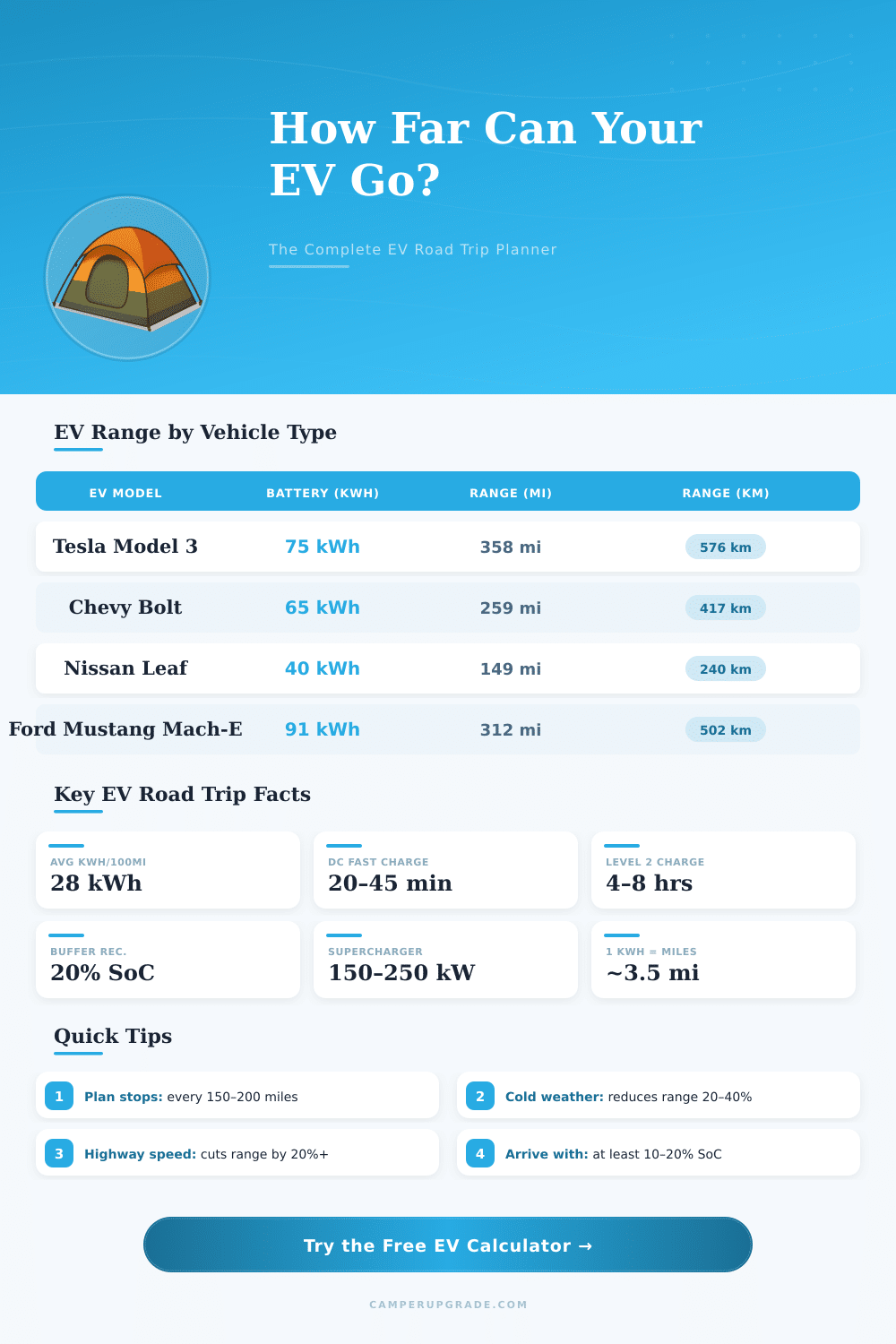
⚡ EV Road Trip Calculator
Plan charging stops, estimate range, and calculate energy needs for your electric vehicle journey
| EV Type | Efficiency (mi/kWh) | kWh/100 mi | km/kWh |
|---|---|---|---|
| Compact EV | 3.8 | 26.3 | 6.1 |
| Standard Sedan | 3.5 | 28.6 | 5.6 |
| Long Range Sedan | 4.0 | 25.0 | 6.4 |
| Small SUV | 3.2 | 31.3 | 5.1 |
| Large SUV / Truck | 2.8 | 35.7 | 4.5 |
| Electric Van | 2.5 | 40.0 | 4.0 |
| Performance / Sports | 3.0 | 33.3 | 4.8 |
| Charger Type | Power (kW) | 10%→80% (75 kWh) | Miles Added/Hr |
|---|---|---|---|
| Level 2 (Home) | 7.2 kW | ~7.3 hrs | 25 mi/hr |
| Level 2 (Public) | 11 kW | ~4.8 hrs | 38 mi/hr |
| DC Fast Charge | 50 kW | ~1.1 hrs | 175 mi/hr |
| DC Fast Charge | 150 kW | ~21 min | 525 mi/hr |
| Tesla Supercharger V3 | 250 kW | ~13 min | 875 mi/hr |
| Ultra-Fast DCFC | 350 kW | ~9 min | 1,225 mi/hr |
| Condition | Range Adjustment | Efficiency Factor | Notes |
|---|---|---|---|
| Ideal (65°F, light) | +0% | 1.00 | Baseline EPA rating |
| Mixed highway/city | –15% | 0.85 | Typical real-world |
| Cold (< 32°F) | –25% | 0.75 | Battery chemistry slow |
| Severe winter | –40% | 0.60 | Heating + cold batt |
| High speed (80+ mph) | –20% | 0.80 | Aerodynamic drag |
| Full load + AC | –10% | 0.90 | HVAC + weight |
| Route | Distance (mi) | Distance (km) | Stops Needed (75 kWh) |
|---|---|---|---|
| NYC — Boston | 215 mi | 346 km | 0–1 |
| NYC — Washington DC | 225 mi | 362 km | 0–1 |
| LA — San Francisco | 380 mi | 612 km | 1–2 |
| Chicago — Detroit | 280 mi | 451 km | 1 |
| Dallas — Houston | 240 mi | 386 km | 0–1 |
| Seattle — Portland | 175 mi | 282 km | 0 |
| Miami — Orlando | 235 mi | 378 km | 0–1 |
| Denver — SLC | 525 mi | 845 km | 2–3 |
Before, a Road Trip by EV seemed almost impossible, because the battery would not last for long and there were no places to charge. Even so during the past ten years the use of EVs spread through the United States, and now fast charging stations are available more than ever. A cross-country trip in such a car is fully possible.
It simply needs a bit of planning.
How to Plan an Electric Car Road Trip
If you have a home charger, go from the home with 90% to 95% of charge. Like this the journey starts well. For instance, models like the Hyundai Ioniq 6 or Kia EV6 charge very quickly and can recharge on the road in under 20 minutes.
However, the Chevy Bolt does that slowly, which can take an hour or even more. Also the speed of the vehicle matters. When you drive at high speeds, the range quickly drops, just like in gas cars.
When the rest of the battery sinks, the best advice is slow down.
Planning the route ahead really helps. A program called A Better Routeplanner, or ABRP, makes the search for the best routes easier and sets up stops for charging with current directions. Some EVs have that built in.
The Ioniq 5, for instance, counts the schedule and charging pauses itself, when you enter the target. Tesla vans work the same way; simply point the target, and it builds teh chart with charging stops.
Surprisingly, many find that the pauses for charging can turn out funny. Plug in the cable, visit the toilet, drink coffee and taste snacks, sit at a picnic table, and already the car reaches almost 80% or 85%, before anyone is ready to go. Such stops commonly happen beside restaurants or at least cafes.
They become a moment four the whole family.
Even so, Road Trips by EV do last more long. For instance, one 529-mile route needed three hours and six minutes of total charge time. By contrast, a gas car on the same route needed only one short fuel stop.
That difference you cannot deny, and it can be annoying. Access to the Tesla charger network offers much more opportunity on the road, which is useful. Also, soon NEVI chargers will be installed every 50 miles, which will ease trips in less covered western regions.
Since 2015, some folks already did Road Trips by EV without big problems. Then there was commonly only one available charger on the way, without backup options. Since then everything has improved a lot.
Mapping the charging spots and interesting features ahead is the best way for a smooth trip and saving money. EVs can even power a tent with devices like an electric pan for morning meals, whichmakes them nice friends for Road Trips. Long Road Trips by EV stay a popular topic, and with good reason.