🥾 Hiking Boot Size Converter
Convert hiking boot sizes across US, UK, EU, and CM systems for men, women & kids
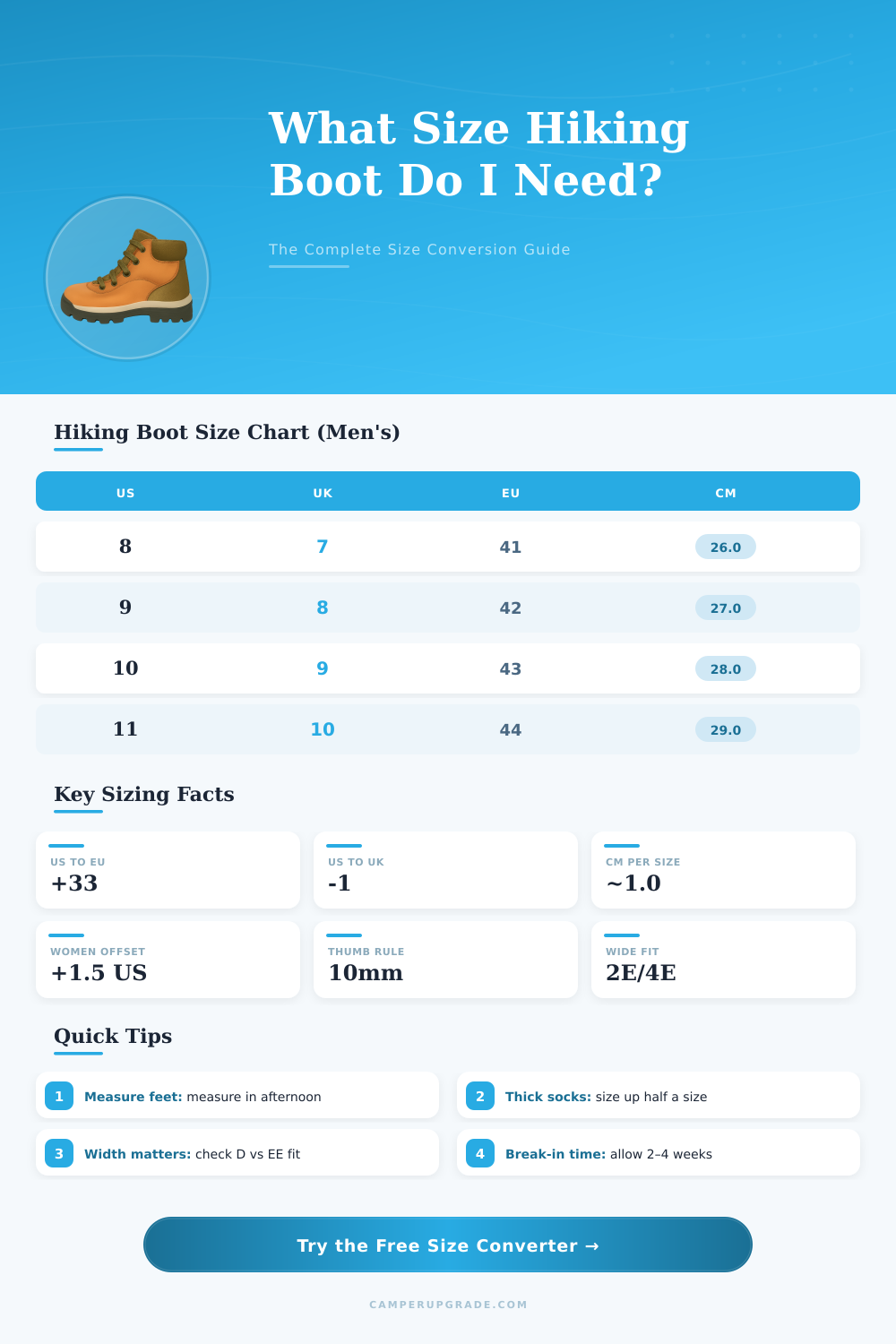
| US | UK | EU | CM | Inches (foot length) |
|---|---|---|---|---|
| 6 | 5 | 39 | 24.0 | 9.25" |
| 6.5 | 5.5 | 39.5 | 24.5 | 9.5" |
| 7 | 6 | 40 | 25.0 | 9.625" |
| 7.5 | 6.5 | 40.5 | 25.5 | 9.75" |
| 8 | 7 | 41 | 26.0 | 9.9375" |
| 8.5 | 7.5 | 41.5 | 26.5 | 10.125" |
| 9 | 8 | 42 | 27.0 | 10.25" |
| 9.5 | 8.5 | 42.5 | 27.5 | 10.4375" |
| 10 | 9 | 43 | 28.0 | 10.5625" |
| 10.5 | 9.5 | 43.5 | 28.5 | 10.75" |
| 11 | 10 | 44 | 29.0 | 10.9375" |
| 11.5 | 10.5 | 44.5 | 29.5 | 11.125" |
| 12 | 11 | 45 | 30.0 | 11.25" |
| 13 | 12 | 46 | 31.0 | 11.625" |
| 14 | 13 | 47 | 32.0 | 12.0" |
| US Women's | UK Women's | EU | CM | US Men's Equiv. |
|---|---|---|---|---|
| 5 | 3 | 36 | 22.5 | 3.5 |
| 5.5 | 3.5 | 36.5 | 22.5 | 4 |
| 6 | 4 | 37 | 23.0 | 4.5 |
| 6.5 | 4.5 | 37.5 | 23.5 | 5 |
| 7 | 5 | 38 | 24.0 | 5.5 |
| 7.5 | 5.5 | 38.5 | 24.0 | 6 |
| 8 | 6 | 39 | 25.0 | 6.5 |
| 8.5 | 6.5 | 39.5 | 25.5 | 7 |
| 9 | 7 | 40 | 26.0 | 7.5 |
| 9.5 | 7.5 | 40.5 | 26.5 | 8 |
| 10 | 8 | 41 | 27.0 | 8.5 |
| 10.5 | 8.5 | 41.5 | 27.5 | 9 |
| 11 | 9 | 42 | 28.0 | 9.5 |
| 12 | 10 | 43 | 29.0 | 10.5 |
| US Kids' | UK Kids' | EU | CM | Age Guide |
|---|---|---|---|---|
| 1 | 0.5 | 32 | 19.5 | ~5–6 yrs |
| 1.5 | 1 | 33 | 20.0 | ~6 yrs |
| 2 | 1 | 33 | 20.5 | ~6–7 yrs |
| 2.5 | 1.5 | 34 | 21.0 | ~7 yrs |
| 3 | 2 | 34 | 21.5 | ~7–8 yrs |
| 3.5 | 2.5 | 35 | 22.0 | ~8 yrs |
| 4 | 3 | 36 | 22.5 | ~8–9 yrs |
| 4.5 | 3.5 | 36.5 | 23.0 | ~9 yrs |
| 5 | 4 | 37 | 23.5 | ~9–10 yrs |
| 6 | 5 | 38 | 24.0 | ~10–11 yrs |
| 7 | 6 | 39 | 25.0 | ~11–12 yrs |
| Width Code | Men's Label | Women's Label | Description |
|---|---|---|---|
| 2A / AA | Narrow | Extra Narrow | Slim foot profile |
| B | Narrow | Standard | Slender mid-width |
| D | Standard | Wide | Most common men's fit |
| 2E / EE | Wide | X-Wide | Wider forefoot |
| 4E / EEEE | X-Wide | — | Very wide, high volume |
| 6E | XX-Wide | — | Maximum width |
Hiking boot present everywhere, and choosing the right pair often seems really hard. There is not something as a universal “best” model of hiking boot, because your feet differ from mine, your tastes do not match with those of any other, and the terrain that you explore, can be entirely different than that of your friends. What feels perfect on the foot of one person, can be unpleasant for another.
Comfort and good fit beat all other parts. You want a boot that does not press, does not squeeze or rub somewhere. The fingers of your feet should not rise up in the front when you go down steep slopes.
How to Choose the Right Hiking Boots
Here is the secret of a right boot: it must stay comfortable at the end of the day, when you stand up, because the feet naturally swell during the day. Take measures for the length and width of both feet, then choose size according to the one that is the biggest. Do not forget to use the real hiking socks that you plan to wear…
The thickness of their material really matters.
If you are new in this world and feel a bit confused, let yourself lean toward lightweight and comfortable shoes instead of heavy boots full of extra soles. Those heavy soles help more on long journeys, like week- or month-long loaded marches, where you carry a whole ton of weight. For shorter trips with maybe only a 9-kilo pack, many cheap boots with EVA midsole work well (they give that light), bouncy feeling.
Brands like Merrell, Salomon, Lowa, Scarpa and Vasque often come up in discussions. Many everyday hikers find a brand that fits them, and stay faithful to it over years, because the form simply matches their foot. The Lowa Renegade GTX Mid won a strong name as a reliable and comfortable choice, that well balances support without too much wait.
Boots from the Salomon line have long stayed popular choices. Merrell gets praise because of its comfort, although some notice that they do not last as long as more expensive rivals.
Some models replace EVA with polyurethane midsole, that works with heavy loads and lasts longer. Models from full grain leather; Zamberlan offers some great ones. Give strong durability and water resistance.
A quality boot at a high price can serve years, while a cheap one maybe lasts only half of that time.
Also weather plays a role. A lightweight Gore-Tex boot works for warm, wet conditions or simple city walking of just some minutes. On the other hand, some hikers simply skip water resistance to not sweat the feet.
Styles from the Pacific Northwest, with thick leather and water-repelling breathability, keep the moisture away around, withoutdepending on fancy textile layers.
Work boots do not work as a replacement for hiking boot. They do not have enough arch support, do not shape themselves according to the natural curves of your foot, and the cushioning stays pretty weak. Support for the ankle is more important than one thinks, because boots without it leave you at risk to get hurt by twisting ankles on uneven ground.