🔥 Propane Tank Size for Fire Pit Calculator
Find the right propane tank size and estimated runtime for your fire pit or outdoor burner
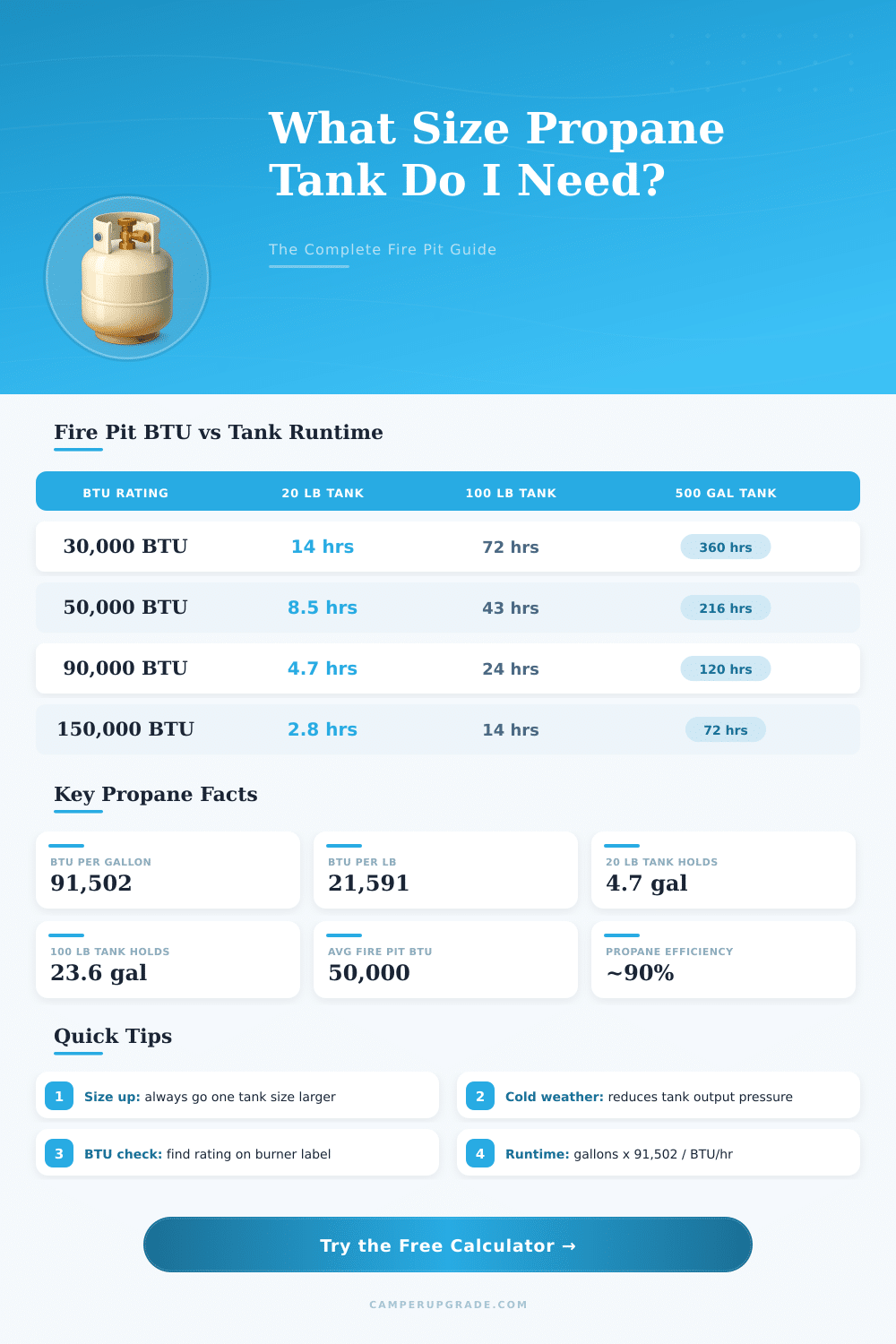
| Fire Pit BTU | 20 lb Tank | 40 lb Tank | 100 lb Tank | 500 gal Tank |
|---|---|---|---|---|
| 20,000 BTU | 21.5 hrs | 43 hrs | 107.5 hrs | 541 hrs |
| 30,000 BTU | 14.3 hrs | 28.6 hrs | 71.7 hrs | 360 hrs |
| 50,000 BTU | 8.6 hrs | 17.2 hrs | 43 hrs | 216 hrs |
| 60,000 BTU | 7.2 hrs | 14.3 hrs | 35.8 hrs | 180 hrs |
| 90,000 BTU | 4.8 hrs | 9.5 hrs | 23.9 hrs | 120 hrs |
| 150,000 BTU | 2.9 hrs | 5.7 hrs | 14.3 hrs | 72 hrs |
| 200,000 BTU | 2.1 hrs | 4.3 hrs | 10.7 hrs | 54 hrs |
| Tank Size | Propane Weight (lbs) | Volume (gallons) | Volume (liters) |
|---|---|---|---|
| 1 lb Cylinder | 1 lb | 0.24 gal | 0.9 L |
| 5 lb Mini | 5 lbs | 1.18 gal | 4.5 L |
| 11 lb Tank | 11 lbs | 2.6 gal | 9.8 L |
| 20 lb BBQ | 20 lbs | 4.7 gal | 17.8 L |
| 33 lb Forklift | 33 lbs | 7.8 gal | 29.5 L |
| 40 lb Tank | 40 lbs | 9.4 gal | 35.6 L |
| 100 lb Tank | 100 lbs | 23.6 gal | 89.3 L |
| 250 gal Tank | 420 lbs | 100 gal | 378.5 L |
| 500 gal Tank | 990 lbs | 200 gal | 757 L |
| Fire Pit Type | Typical BTU Range | Typical BTU (kW) | Recommended Tank |
|---|---|---|---|
| Tabletop Fire Bowl | 15,000–30,000 BTU | 4.4–8.8 kW | 1 lb – 20 lb |
| Standard Fire Pit | 40,000–60,000 BTU | 11.7–17.6 kW | 20 lb – 40 lb |
| Large Fire Pit Ring | 60,000–100,000 BTU | 17.6–29.3 kW | 40 lb – 100 lb |
| Linear Fire Table | 50,000–90,000 BTU | 14.6–26.4 kW | 40 lb – 100 lb |
| Outdoor Fireplace | 60,000–150,000 BTU | 17.6–44 kW | 100 lb – 250 gal |
| Commercial Burner | 100,000–250,000 BTU | 29.3–73.3 kW | 100 lb – 500 gal |
| Camping Stove | 10,000–40,000 BTU | 2.9–11.7 kW | 1 lb – 20 lb |
propane tank come in all sizes, from little one-pound throwaway bottles to giants that at least 2,000 gallons store. The right size depends on your home and the number of devices that run on propane. Propane tank of 20 pounds, for example, are the most used, commonly called propane bottles.
They work for gas grills and store around 4.7 gallons of propane.
Propane Tank Sizes, Cost and Safety
For camping, grilling, homes or home heating one uses propane tanks. Special tanks exist for forklifts, marine uses and recreational vehicles. They are made from steel or aluminium, and one can choose vertical or horizontal forms.
Between the available sizes exist 5-pound, 10-pound, 20-pound, 33-pound and 40-pound types. In some recreational vehicles they even install fixed tanks that fit 35 gallons or even more.
To buy a new 20-pound bottle without trade-in, one pays between 50 and 65 dollars. Filling it costs around 18 dollars, because it at least 4.5 gallons stores at around 4 dollars per gallon. A 100-pound tank, that keeps 23.6 gollans, needs 71 to 94 dollars to fill.
On average propane costs between 40 and 50 cents per pound, depending on the market situation.
Choosing self-fill over exchange can make a big difference. In stores the exchange programs commonly only 75 percent fill the tanks. At a local propane supplier one gets usually more gas for less money.
Some stores charge a fixed price no matter the amount of pounds, while others charge by weight.
Propane has the advantage that it does not pollute or go bad. It stays almost always usable. The tank itself simply needs repainting sometimes and the regulator changed every few years.
Black iron tubes in home systems last a whole lifetime, if one checks them regularly. Even sew tanks have an expiry date, and some stations refuse to fill outdated units. Portable tanks need recertifying, though fixed tanks on recreational vehicles sometimes do not need it.
Safety is an important cause. Propane burns very easily and can explode when compressed. Little throwaway bottles one should keep outside, not in a car, where they can get too warm.
Home propane tanks work as separate storage, where liquid propane stays stored before it turns into gas for the home. Properly handled, propane is a safe and cheap replacement for electricity, heating oil or natural gas.
For camping the 5-pound and 11-pound tanks are popular as a fire pit fuel source. The 11-pound bottle works well for portable grills andweekend trips. In high places during cold season little throwaway tanks commonly fail, so a bit bigger refillable tank becomes the best solution.