🚗 Roof Rack Weight Limit Checker
Enter your vehicle type, rack system, and cargo to instantly verify you're within safe load limits.
📊 Weight Limit Check Results
| Cargo Item | Typical Weight (lbs) | Typical Weight (kg) | Notes |
|---|---|---|---|
| Road / Hybrid Bike | 18–28 lbs | 8–13 kg | Lightweight alloy/carbon |
| Mountain Bike | 25–40 lbs | 11–18 kg | Full suspension heavier |
| E-Bike | 45–70 lbs | 20–32 kg | Battery adds significant weight |
| Kayak (recreational) | 40–65 lbs | 18–29 kg | Fishing kayaks up to 80 lbs |
| Canoe | 50–90 lbs | 23–41 kg | Aluminum heavier than composite |
| SUP Board | 15–30 lbs | 7–14 kg | Inflatable boards lighter |
| Ski Set (skis + poles) | 10–18 lbs | 5–8 kg | Per person, no boots |
| Snowboard + Boots | 12–20 lbs | 5–9 kg | Per board setup |
| Roof Cargo Box (empty) | 35–65 lbs | 16–29 kg | Thule, Yakima, Rhino-Rack |
| Rooftop Tent (2-person) | 100–175 lbs | 45–79 kg | Check vehicle roof rating |
| Lumber (8 ft boards x10) | 80–130 lbs | 36–59 kg | Pine vs hardwood varies |
| Cargo Basket (empty) | 20–45 lbs | 9–20 kg | Steel heavier than aluminum |
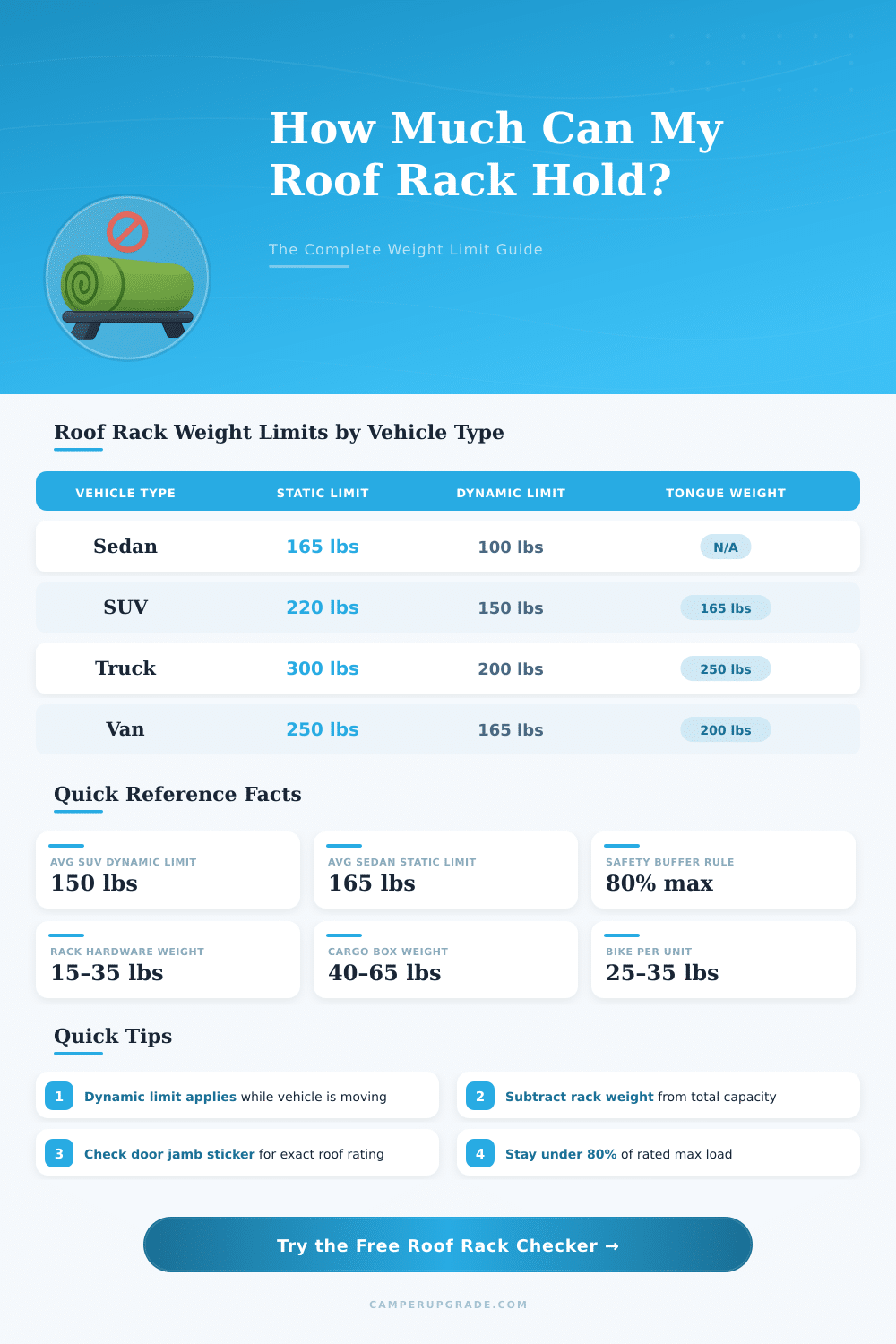
| Limit Type | Definition | When It Applies | Typical Ratio |
|---|---|---|---|
| Static Limit | Max weight rack can hold when vehicle is stationary | Loading, storage, camping | ~165–330 lbs |
| Dynamic Limit | Max safe weight while vehicle is in motion | Driving — MOST IMPORTANT | 50–70% of static |
| Roof Crush Rating | Structural roof strength (safety standard) | Rollover protection | Not a cargo rating |
| Tongue Weight Limit | Applies to tow bars / hitch-mounted racks | Hitch racks only | 10% of tow capacity |
| Vehicle | OEM Static Limit | OEM Dynamic Limit | Aftermarket Potential |
|---|---|---|---|
| Toyota RAV4 | 176 lbs (80 kg) | 132 lbs (60 kg) | Up to 220 lbs |
| Subaru Outback | 176 lbs (80 kg) | 132 lbs (60 kg) | Up to 200 lbs |
| Jeep Wrangler | 220 lbs (100 kg) | 165 lbs (75 kg) | Up to 300 lbs |
| Ford F-150 (bed rack) | N/A | 300 lbs (136 kg) | Up to 450 lbs |
| Honda CR-V | 165 lbs (75 kg) | 110 lbs (50 kg) | Up to 180 lbs |
| Toyota 4Runner | 220 lbs (100 kg) | 165 lbs (75 kg) | Up to 330 lbs |
| Ford Explorer | 220 lbs (100 kg) | 165 lbs (75 kg) | Up to 250 lbs |
| Volkswagen Golf | 165 lbs (75 kg) | 100 lbs (45 kg) | Up to 176 lbs |
| Subaru Forester | 176 lbs (80 kg) | 132 lbs (60 kg) | Up to 220 lbs |
| Dodge Caravan (Van) | 200 lbs (91 kg) | 150 lbs (68 kg) | Up to 220 lbs |
The dynamic (in-motion) weight limit is what matters when you're on the road. It is typically 50–70% of the static (parked) limit. Always check your vehicle owner's manual for the exact figure — look for "roof load" or "roof carrier" in the index.
Your rack hardware itself (crossbars, towers, mounting feet) weighs 15–55 lbs depending on the system. This weight must be subtracted from your rack's rated limit before adding any cargo. A 165 lb limit with a 25 lb rack leaves only 140 lbs for gear.
RV roof rack stands deliver excellent ways to add support and transport heavy objects on top of your vehicle. That helps well for carrying stuff like kayaks, surfboards or cargo boxes. All such stands fit for many kinds of RVs and rural shelters and the most of them are designed to be simple in the assembly.
Popular option is the Low Profile Professional roof rack, that works with Sprinter, Transit and ProMaster vans. It has aerodynamic form, can adapt and is easy to install. The weight is around 64 pounds.
RV Roof Rack Stands: Uses, Weight and How to Install
Safari roof rack stands weigh more, between 150 and 185 pounds. Too high creation of a built roof rack often causes troubles with wind resistance and passing under a bridge. Usually one intends to stay under 10 feet in whole hieght for truck construction.
Known brands like Thule, Rhino Rack, Yakima, Rola, Inno and Malone offer roof rack systems. Stands from Yakima give reliable base for bikes, boats, floats and cargo. Some models from those companies do not require tools and set flatly.
They do cost a lot, but mostly they serve during long time. For instance, one Yakima roof rack was used on four different cars and SUVs for more than 15 years.
Some owners of RVs use roof rack stands for lightweight cargo, for instance chairs, hammocks or pop-up tents. Like this one releases the upper cabin space for heavier items. A roof rack carrier combines with a cargo bag or net too stop objects sorted.
Some prefer to carry solar panels or a double roof tent on their stands.
Installing a roof rack on a pop-up camper or travel trailer requires special attention. Best are set the stands to the frame instead of only to the roof. Raised rails help to spread the weight more broadly and prevent problems with leaking.
Holes in the roof always risk water flow, what disturbs many owners. Some folks fixed roof rack leaks around mounts for ladders and cargo stands, and even thought to remove them outright.
Bringing heavy objects to the roof can be difficult work. One way is extend long ladder with feet in front of the RV and draw the load upward by means of rope. A piece of plywood with small wheels can give the load a smootherpath.
Some even consider to build a lift on the back part of the RV for raising items.
Weight forms another spot to think. A heavy stand can reduce your cargo limit. More lightweight options answer more for long journeys.
Fiberglass bodies weigh around 150 pounds, although some owners lay much more by means of usage of rugged crossbars and firm foot bracket fixtures.