⛰️ Trail Elevation Gain Calculator
Enter your trail waypoints to calculate total elevation gain, loss, net change & difficulty rating
Enter elevation for each waypoint along the trail. The calculator counts every uphill segment as gain and every downhill segment as loss.
| # | Waypoint Name | Elevation (ft) | Remove |
|---|
| Difficulty | Gain (ft) | Gain (m) | Typical Distance | Fitness Level |
|---|---|---|---|---|
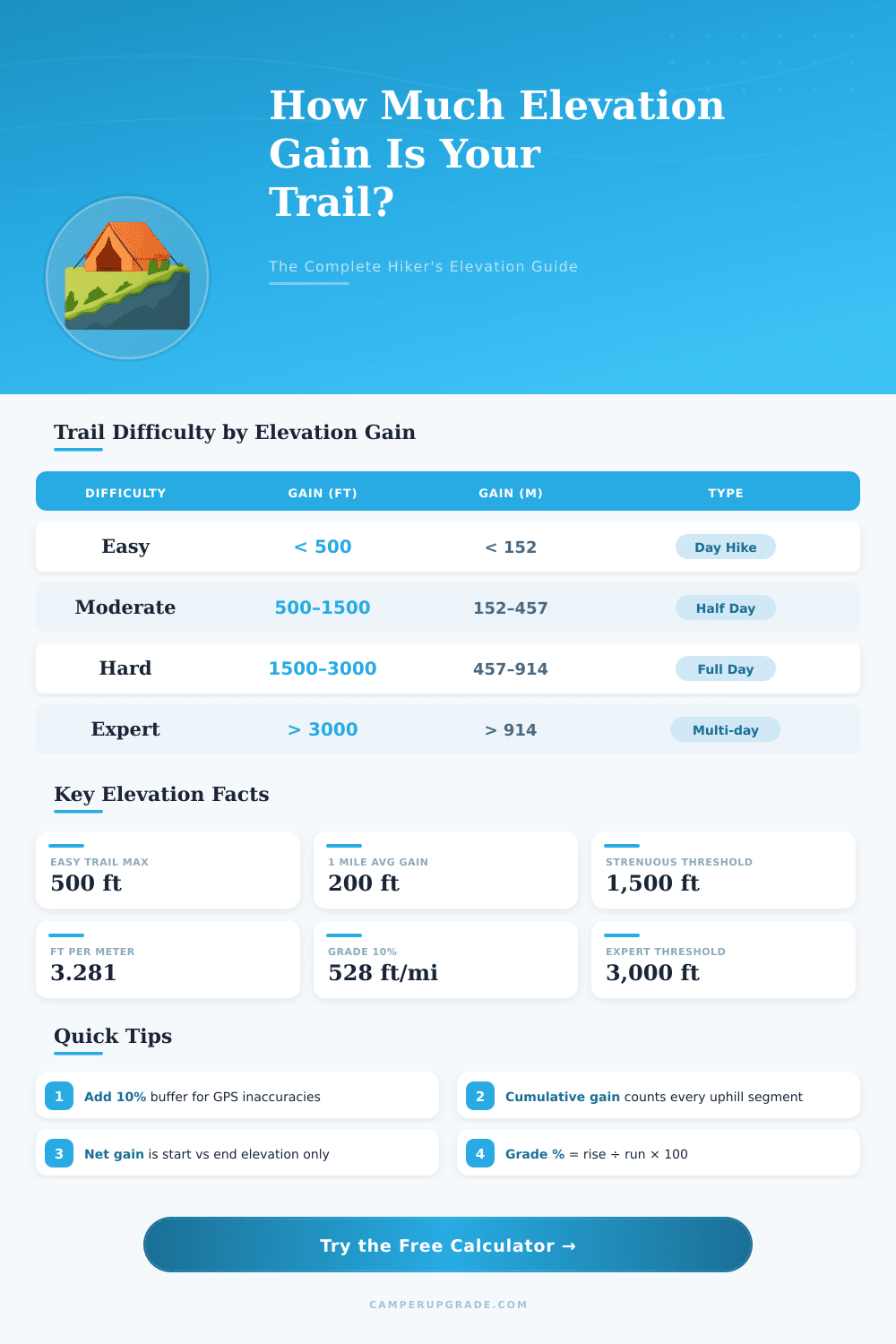
| Easy | 0 – 500 | 0 – 152 | 1–5 miles | Beginner |
| Moderate | 500 – 1,500 | 152 – 457 | 3–10 miles | Intermediate |
| Hard | 1,500 – 3,000 | 457 – 914 | 6–15 miles | Advanced |
| Very Hard | 3,000 – 5,000 | 914 – 1,524 | 10–20 miles | Expert |
| Extreme | 5,000+ | 1,524+ | 15+ miles | Elite |
| Grade % | Gain per Mile (ft) | Gain per km (m) | Feel |
|---|---|---|---|
| 2% | 106 | 20 | Barely noticeable |
| 5% | 264 | 50 | Gentle slope |
| 10% | 528 | 100 | Moderate climb |
| 15% | 792 | 150 | Steep trail |
| 20% | 1,056 | 200 | Very steep |
| 30% | 1,584 | 300 | Hands-and-feet terrain |
| Trail | Total Gain (ft) | Total Gain (m) | Distance (mi) | Difficulty |
|---|---|---|---|---|
| Angels Landing, UT | 1,488 | 454 | 5.4 | Hard |
| Half Dome, CA | 4,800 | 1,463 | 14.2 | Very Hard |
| Bright Angel, AZ | 4,380 | 1,335 | 9.5 | Very Hard |
| Mt. Whitney, CA | 6,100 | 1,859 | 22.0 | Extreme |
| Appalachian Trail (avg day) | 1,200 | 366 | 10–15 | Moderate |
| Rim-to-Rim Grand Canyon | 5,760 | 1,756 | 21.0 | Extreme |
| Enchanted Rock, TX | 425 | 130 | 4.0 | Easy |
| Bear Lake Loop, RMNP | 195 | 59 | 3.6 | Easy |
| From | To | Multiply By | Example |
|---|---|---|---|
| Feet | Meters | 0.3048 | 1,000 ft = 304.8 m |
| Meters | Feet | 3.28084 | 500 m = 1,640 ft |
| Miles | Kilometers | 1.60934 | 5 mi = 8.05 km |
| Kilometers | Miles | 0.62137 | 10 km = 6.21 mi |
| ft/mile (grade) | m/km (grade) | 0.18939 | 500 ft/mi = 94.7 m/km |
Total (cumulative) elevation gain counts every uphill segment separately — even if the trail goes up, comes down, then goes up again. Net elevation gain is simply your ending elevation minus your starting elevation. Most trail ratings use cumulative gain because it better reflects total effort.
Consumer GPS devices (phones, watches) can overstate elevation gain by 10–30% due to barometric drift and satellite error. Use the +10% buffer option to get a conservative estimate when planning. Dedicated GPS units with barometric altimeters are more accurate than phone GPS alone.
trail with elevation gain is one of those themes that seems easy, but actually can become a bit confusing. When someone simply walks upward to reach the top, the total elevation gain is only the difference between the top and the starting height. For instance, if the trail starts at 100 metres above sea level and ends at 600 metres, then the positive gain is 500 metres.
Here it becomes complex. The most many guides simply state the starting height of the highest point to estimate how much climb you expect. That method gives what genuinely should be called pure elevation gain.
What is elevation gain on a trail
It matches the amount of all ups minus the amount of all downs. Because many trails form circuits that return to the starting point, the pure gain for the whole march always is zero. That approach has only limited benefit.
The total elevation gain is a much more practical amount. It considers every bit of hard climbing that climbs, including all little hills along the path. Some runs, like the Ultra-trail of Mont Blanc, start and end at the same place so the pure gain is zero.
So the total height helps better estimate the trouble of the trail.
The patterns can differ a lot depending on the source. Some apps for trails maybe point other elevation gain than what you count from charts. Some programs are called hard, when the difference between start and finish reaches 4,000 feet, but the shown gain does not match with that.
One hiker followed a trail and covered around 3,400 feet of vertical top, crossing every hill without using shortcuts.
A rough rule to estimate the time of climb is 30 minutes for every mile plus another 30 minutes for every 1,000 feet of elevation gain. Like this, a seven-mile trail with around 2,500 feet of gain could take five and half to six hours for the whole way. Trails in regions like the Cascades usually have 2,500 to 4,000 feet of gain, although some day marches reach 5,000 ore even 6,000 feet.
Training to match the elevation gain of the coming run is a clever method. If the run stores 2,000 feet of gain during 10 miles, search a trail with 200 feet of gain per mile works well. Get at least so much vertical gain each week, as far as is the whole running total, is a common training target.
People that prepare for a trail marathon with 3,000 feet of gain in the first half, usually get 3,000 to 4,000 feet of vertical every week.
Average slope of around 7 percent, with 350 feet of gain per mile, counts as starting to mid-level march. Anything in the 5-percent range is challenging. The most severe ultra marches reach around 10-percent slope, which is truly exciting.
Also matters where someone lives. In plains, even 300 metres ofgain can be almost found only far away.