🛶 Canoe Weight Capacity Checker
Calculate safe paddler and gear loads for any canoe type — stay safe on the water
Safe: 280 lbs
Safe: 595 lbs
Safe: 700 lbs
Safe: 420 lbs
Safe: 525 lbs
Safe: 840 lbs
Factor
Above Water
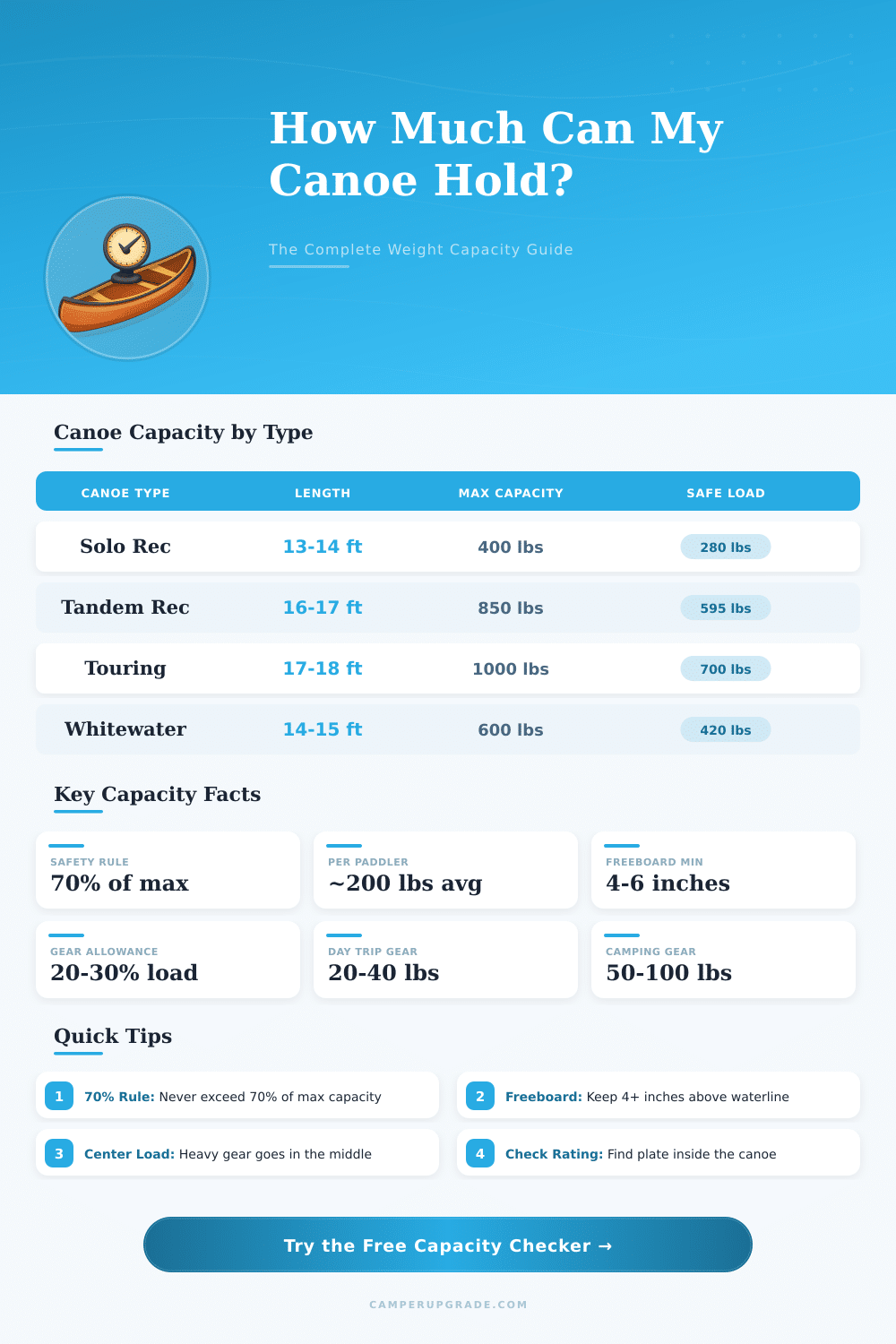
| Canoe Type | Length | Max Rated (lbs) | Safe Load at 70% (lbs) | Max Rated (kg) | Typical Paddlers |
|---|---|---|---|---|---|
| Solo Recreational | 13–14 ft | 400 | 280 | 181 | 1 |
| Tandem Recreational | 16–17 ft | 850 | 595 | 386 | 2 |
| Touring / Expedition | 17–18 ft | 1,000 | 700 | 454 | 1–2 |
| Large Canoe (18+ ft) | 18–20 ft | 1,200 | 840 | 544 | 2–3 |
| Whitewater | 13–15 ft | 600 | 420 | 272 | 1 |
| Fishing Canoe | 15–17 ft | 750 | 525 | 340 | 1–2 |
| Trip Type | Gear Weight (lbs) | Gear Weight (kg) | Notes |
|---|---|---|---|
| Day Paddle (light) | 5–15 | 2–7 | Water, snacks, safety gear |
| Day Paddle (full) | 15–40 | 7–18 | + dry bags, camera, extra clothing |
| Overnight Trip | 40–70 | 18–32 | Tent, sleeping bag, food |
| Weekend Camping | 60–90 | 27–41 | Full camp kit |
| Extended Expedition | 80–120 | 36–54 | Multi-day food + gear |
| Fishing Trip | 30–60 | 14–27 | Tackle, rods, cooler |
| Paddler Type | Weight (lbs) | Weight (kg) | Planning Note |
|---|---|---|---|
| Child (under 12) | 50–100 | 23–45 | Always use life jacket |
| Teen (12–17) | 100–150 | 45–68 | Include gear in total |
| Average Adult | 150–200 | 68–91 | US average ~180 lbs |
| Larger Adult | 200–260 | 91–118 | Choose higher cap. canoe |
| Average Paddler (planning) | 180 | 82 | Conservative estimate |
| Load vs. Capacity | Est. Freeboard | Safety Level | Recommendation |
|---|---|---|---|
| Under 60% | 8+ inches | Very Safe | Ideal for beginners / rough water |
| 60%–70% | 5–8 inches | Safe | Recommended range for most paddlers |
| 70%–80% | 4–5 inches | Acceptable | Calm water, experienced paddlers only |
| 80%–90% | 2–4 inches | Risky | Not recommended; waves can swamp |
| Over 90% | Under 2 inches | Dangerous | Do not paddle — reduce load |
Each Canoe has a maximum Weight Capacity, and passing that limit can cause the Canoe to sink more deep in the water. It becomes hard to paddle and steer. The waterline gets close to the upper edges of the Canoe and even tiny waves risk flooding the boat.
So knowing the Weight Capacity really matters.
How Much Weight Can a Canoe Hold
Size of a Canoe plays a big role in the amount of weight that it can hold. Big two-person Canoes usually hold between 750 and 1200 pounds, while small single models hold around 300 to 400 pounds. Size of the Canoe directly affects its Weight Capacity.
A Canoe of 14 to 16 feet holds around 700 to 940 pounds, and a 17-foot Canoe can handle around 1140 pounds. In a longer and wider Canoe, the more weight it spreads across the water, which creates bigger ability to float.
There is a simple method for guessing this on the spot. You multiply the length of the Canoe by its beam, then divide the result by 15. That gives the number of folks it can hold, if each weighs 150 pounds.
For example, a 16-foot Canoe with 3 feet of beam works for three people, so 450 pounds. A 17.4-foot Canoe with 3.5 feet of beam works for four folks, or around 600 pounds.
Still not all Canoes of same size have the same Weight Capacity. A 16-foot Navarro Otter has a listed Weight Capacity of 675 pounds, while the Old Town Discovery 158, which is similar in size and shape, holds almost 1200 pounds. The Old Town Tripper has a Weight Capacity of 1100 pounds.
Old Town also makes single Canoes like the 119 with 350-pound Weight Capacity and the Next model with 450-pound Weight Capacity.
Weight of the Canoe itself also adds to the total Weight Capacity. A 75-pound boat limits much more then a 40-pound one. Some materials for Canoes weigh more than others.
Canoes from aluminum or fiberglass usually weigh less than those from kevlar or ultra-lightweight materials.
Rated values for Weight Capacity are based on the amount of water that the body pushes when there are six inches of freeboard above the waterline. That is quite a lot of safety margin. The best Canoes work best when you load them only around 60 percent of the rated Weight Capacity.
Use 50 to 70 percent of the rated Weight Capacity for rough situations like waves, moving gear or folks that move around. A Canoe rated for 700 pounds can safely hold around 350 to 500 pounds. Central and low placing of heavy loads helps stability.
Some Canoes with flat bottoms have labels about coastal safetybuilt inside. Many boats also have stamped metal plates that show the maximum load.
Total load of a Canoe includes folks together with gear. Everything inside the Canoe adds to that total.