🪢 Paracord Length Calculator
Calculate exactly how much paracord you need for bracelets, lanyards, dog collars & more
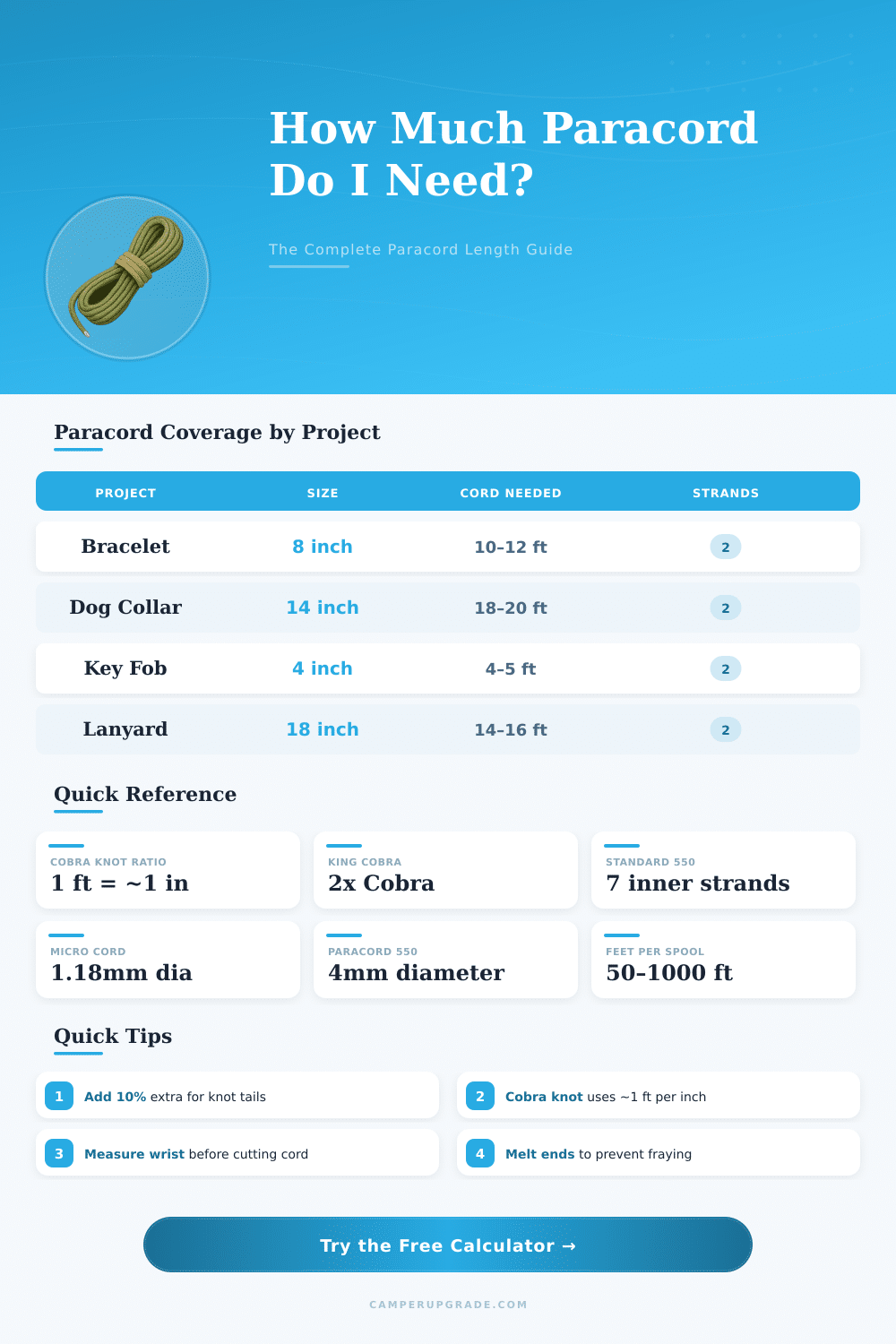
| Project | Finished Length | Knot Type | Cord Needed (ft) |
|---|---|---|---|
| Bracelet | 7–9 in | Cobra | 10–12 ft |
| Bracelet | 7–9 in | King Cobra | 20–22 ft |
| Bracelet | 7–9 in | Fishtail | 7–9 ft |
| Dog Collar (S) | 10–12 in | Cobra | 12–14 ft |
| Dog Collar (M) | 13–16 in | Cobra | 16–20 ft |
| Dog Collar (L) | 17–20 in | Cobra | 20–24 ft |
| Key Fob | 3–5 in | Diamond | 4–6 ft |
| Lanyard | 16–20 in | Cobra | 18–24 ft |
| Belt (M 32–34) | 36–38 in | Cobra | 40–48 ft |
| Dog Leash (6 ft) | 72 in | Cobra | 80–90 ft |
| Spool Size | Length (ft) | Bracelets (Cobra) | Dog Collars (Cobra) |
|---|---|---|---|
| Small spool | 50 ft | ~4–5 | ~2–3 |
| Standard spool | 100 ft | ~8–10 | ~5–6 |
| Medium spool | 250 ft | ~20–25 | ~12–15 |
| Large spool | 500 ft | ~40–50 | ~25–30 |
| Bulk spool | 1000 ft | ~80–100 | ~50–60 |
| Cord Type | Diameter | Break Strength | Inner Strands |
|---|---|---|---|
| Nano Cord | 0.75 mm | 36 lbs | 1 |
| Micro Cord | 1.18 mm | 100 lbs | 1 |
| Paracord 95 (Type I) | 3 mm | 95 lbs | 1–3 |
| Paracord 275 (Type II) | 2.4 mm | 275 lbs | 4–7 |
| Paracord 550 (Type III) | 4 mm | 550 lbs | 7–9 |
| Paracord 750 (Type IV) | 4.5 mm | 750 lbs | 11 |
| Paracord 1100 | 5.5 mm | 1100 lbs | 8–9 |
| Clasp Type | Add to Finished Length | Extra Cord Needed | Notes |
|---|---|---|---|
| Standard Side-Release Buckle | 0 in | ~2 ft total | Length measured buckle-to-buckle |
| Slim Side-Release Buckle | 0 in | ~1.5 ft total | Smaller profile |
| D-Ring | 0.5 in | ~2 ft total | Allows length adjustment |
| Lobster Claw Clasp | 0.5 in | ~2 ft total | Common for bracelets |
| Snap Hook | 1 in | ~2.5 ft total | Larger hardware needs more room |
| No Clasp / Tied Ends | 1.5 in | ~3 ft total | Extra for finishing knots |
paracord is simply lightweight knitted string, done from nylon and polyester mixed together. The force or thickness of it depends on the amount of threads knitted in the core, more threads give more sturdy and solid string. It comes in almost every color, and for something special there are types that glow in darkness, reflect light or change color.
The most popular size is 550-paracord. One commonly mentions also Dwarf, Micro, 95, 275 and 325-paracord as other good options. Average 550-paracord holds 550 pounds before breaking, what really impresses for such lightweight material.
How Much Paracord Do You Need
On the other hand, the more lightweight versions; that hold around 200 pounds, are much lighter. That really helps, because it allows you to carry longer lengths without reaching the weight limit, compared with the same distance using the heavy 550-strings.
Here is something wonderful about 550-paracord: one foot of it can extend to almost eight feet of usable cable only by pulling out the internal threads. It really is useful when one requires more length, but does not have place or resources to carry extra.
For bracelets, according to my attempts, you require one foot of string for every inch of weaving during usage of 550-paracord. Add the length of the key thread to that, and throw in an extra foot or two as safety reserve. Only the central threads usually extend to around one and half feet.
Hence one sells paracord in ten-foot lengths; it is ideal to finish most bracelets. A wise idea is knit one inch according to your template, destroy it and estimate exactly how much string was used. Later do the calculations for the whole draft and add around 25 percent of extra.
When doing two-color bracelets, it matters weather both colors work as main threads or one simply stays as core.
My tests show something surprising: one requires almost nine inches of loose string for every inch of braid, regardless of the diameter of the string. I did not expect that that counts for everything.
When you plan to use outside, the amount needed depends on your activity. Daily march or fast journey? Between 25 and 50 feet work for basic tasks like binding tools or fixing things.
For urgent situations I found that 50 to 100 feet in a bag works well, with some hundreds kept home as reserve. A 75-foot bit packs itself in a rucksack as a tight roll without a lot of trouble. The advantage is that paracord is so lightweight, so carrying 100 feet does not weigh much.
Leaving paracord in its full 100-foot length causes troubles. Splitting it in shorter parts, like 12 or 20 feet, makes it much more practical. Around six feet work for simply binding a tent and maybe three more give you a ridgepole and tripod for shelter.
If you hang food from a tree, you would want at least 50 feet. Longer stays? Take even more.
In thick forests, 20 to 50 feet cover building of shelter and basic repairs. For something brave like a raft, one could require severalhundreds of feet though.