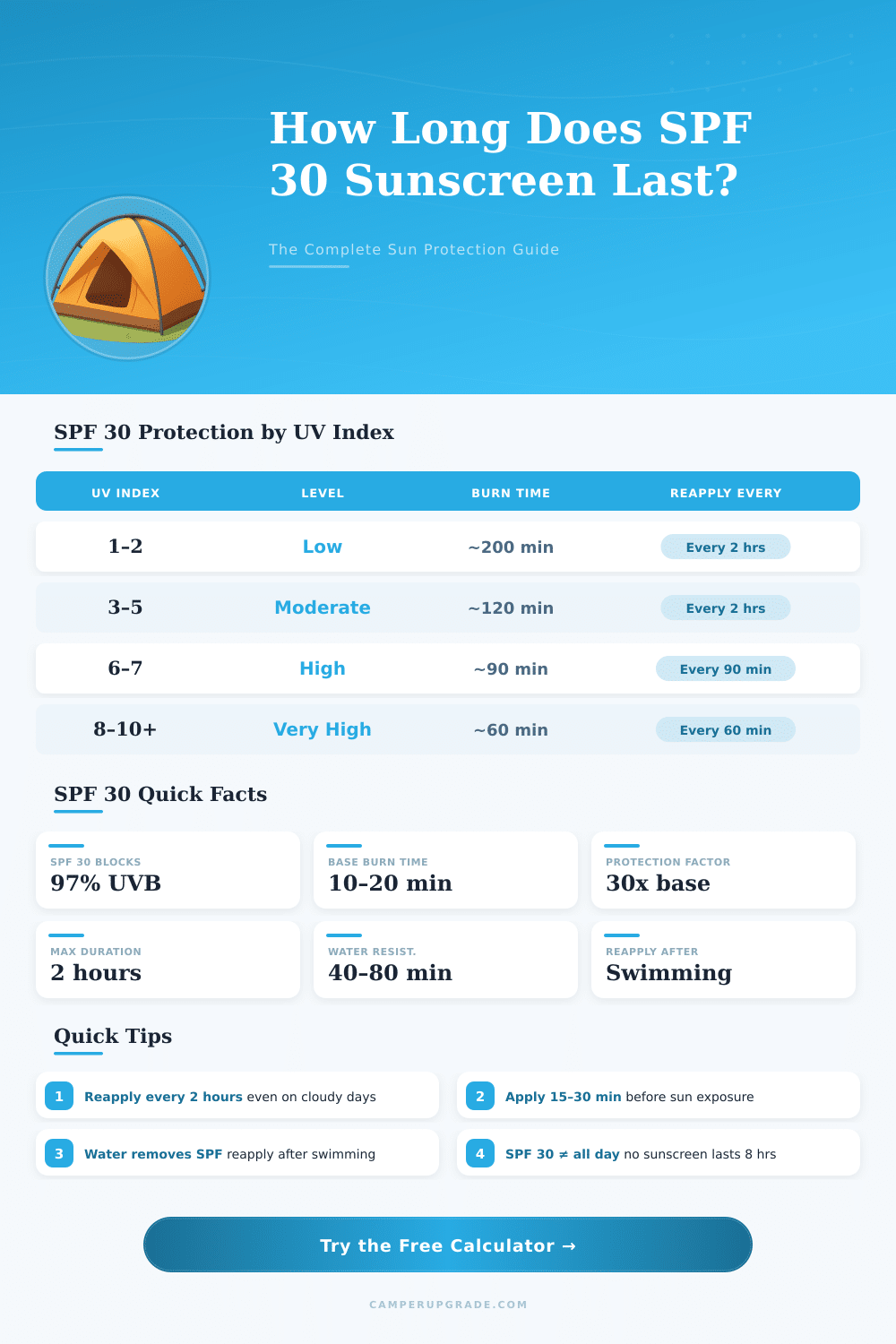
☀️ SPF 30 Sunscreen Duration Calculator
Calculate exactly how long your sunscreen lasts based on UV index, skin type, activity & more
| Skin Type | Natural Burn Time | UV 3–5 Duration | UV 6–7 Duration | UV 8–10 Duration |
|---|---|---|---|---|
| Type I (Very Fair) | 5 min | ~75 min | ~50 min | ~38 min |
| Type II (Fair) | 7 min | ~105 min | ~70 min | ~52 min |
| Type III (Medium) | 10 min | ~120 min | ~100 min | ~75 min |
| Type IV (Olive) | 15 min | ~120 min | ~120 min | ~112 min |
| Type V (Brown) | 20 min | ~120 min | ~120 min | ~120 min |
| Type VI (Dark) | 30 min | ~120 min | ~120 min | ~120 min |
| Activity Type | Effective Duration Reduction | FDA Water Resist. Rating | Reapply After |
|---|---|---|---|
| Sitting / Driving | 0% reduction | Not applicable | Every 2 hours |
| Light Walking | ~15% reduction | Not applicable | Every 2 hours |
| Hiking / Sports | ~30% reduction | Not applicable | Every 90 min |
| Heavy Sweating | ~45% reduction | Sweat-resistant if labeled | Every 60 min |
| Swimming (Water-Resistant) | ~50% reduction | 40 or 80 min rating | After exiting water |
| Swimming (Regular SPF) | ~70% reduction | Not water-resistant | Immediately after |
| UV Index | Risk Level | Time to Burn (Fair Skin) | SPF 30 Extends To | Extra Steps Needed |
|---|---|---|---|---|
| 1–2 | Low | 60+ min | Up to 2 hrs | Sunscreen optional |
| 3–5 | Moderate | 45 min | Up to 2 hrs | SPF 30 recommended |
| 6–7 | High | 25 min | ~90–120 min | Hat + shade breaks |
| 8–10 | Very High | 15 min | ~60–90 min | Protective clothing |
| 11+ | Extreme | 10 min | ~40–60 min | Avoid peak hours |
| Body Area | Amount Needed | Teaspoon Equivalent | Notes |
|---|---|---|---|
| Face & Neck | ~1.2 mL (1.2 g) | ¼ teaspoon | Don't forget ears |
| Each Arm | ~2.5 mL | ½ teaspoon | Both sides of arm |
| Chest / Abdomen | ~5 mL | 1 teaspoon | Full front torso |
| Back | ~5 mL | 1 teaspoon | Including lower back |
| Each Leg | ~5 mL | 1 teaspoon | Front and back |
| Full Body (Adult) | ~30–35 mL | 6–7 teaspoons | ~1 oz (28g) per application |
sunscreen is a product that one puts on the skin to help defend against sunburn and stop skin cancer. It has several other names, for instance sunblock, sun lotion or sun cream. The product comes in various forms, like creams, sprays, gels and foams.
If one uses sunscreen correctly together with other protective products that really helps guard against sun damage and too early skin aging.
Sunscreen: What It Is and How to Use It
SPF stands for Solar Protective Factor. It measures how much more time one can stay under the sun before getting the same amount of UVB damage than without it. So, if you use SPF 10, it takes ten times more time to reach that damage.
It is good to choose sunscreen with broad spectrum, which means that it blocks both UVA and UVB rays, and that is waterproof with SPF 30 or more. Some prefer SPF 50 or even higher, because in everyday life one usually puts on much less than in the test studies.
Putting it on again is really important. The usual advice is every two hours, and also just after sweating or swimming. Waterproof sunscreen does not really stay strong against water.
Most folks apply too little. Around 30 grams is needed to cover the whole body. Easy to forget places like the tops of ears, back of neck, tops of feet and parts around clothing and sunglasses.
Setting alarms on your phone is useful, because under the sky one easily looses the feeling of time.
There are mineral sunscreen types and chemical sunscreen types. Mineral ones use stuff like zinc oxide, which seems a bit more effective than titanium oxide. Physical UV blockers commonly look chalky and are hard to rub in, although new versions spread quickly and absorb well with little white trace.
Lightweight gel sunscreen works for oily or mixed skin, while chemical or thick cream better suits dry skin.
sunscreen made to European standards is thought more effective than many American ones. Australian sunscreen tends to be thicker and heavier, commonly made to resist water. Korean and Japanese sunscreen products are much more lightweight, because they are not meant for swimming really.
Reef-safe sunscreen products are free of chemicals like oxybenzone and octinoxate, that were found to cause problems. Aerosol sunscreen carries risk of fire, because it has flammable stuff. There were cases when folks using aerosol sunscreen caught fire after being close to a grill or burning candle, causing bad burns that needed medical help.
From more than 2 200 sunscreen products checked in one guide, only around one from four met the standards for good sun protection while avoiding stuff linked to health risks. Sunscreen is only one part of staying healthy. Limiting time under the sun, especially aroundnoon, is also important.