🦟 Repel Insect Repellent Duration Calculator
Find out exactly how long your repellent will last based on active ingredient, concentration, and activity level
10–98%
20%
7.5–20%
30%
Clothing
BioUD 7.75%
Swimming
Heavy Sweat
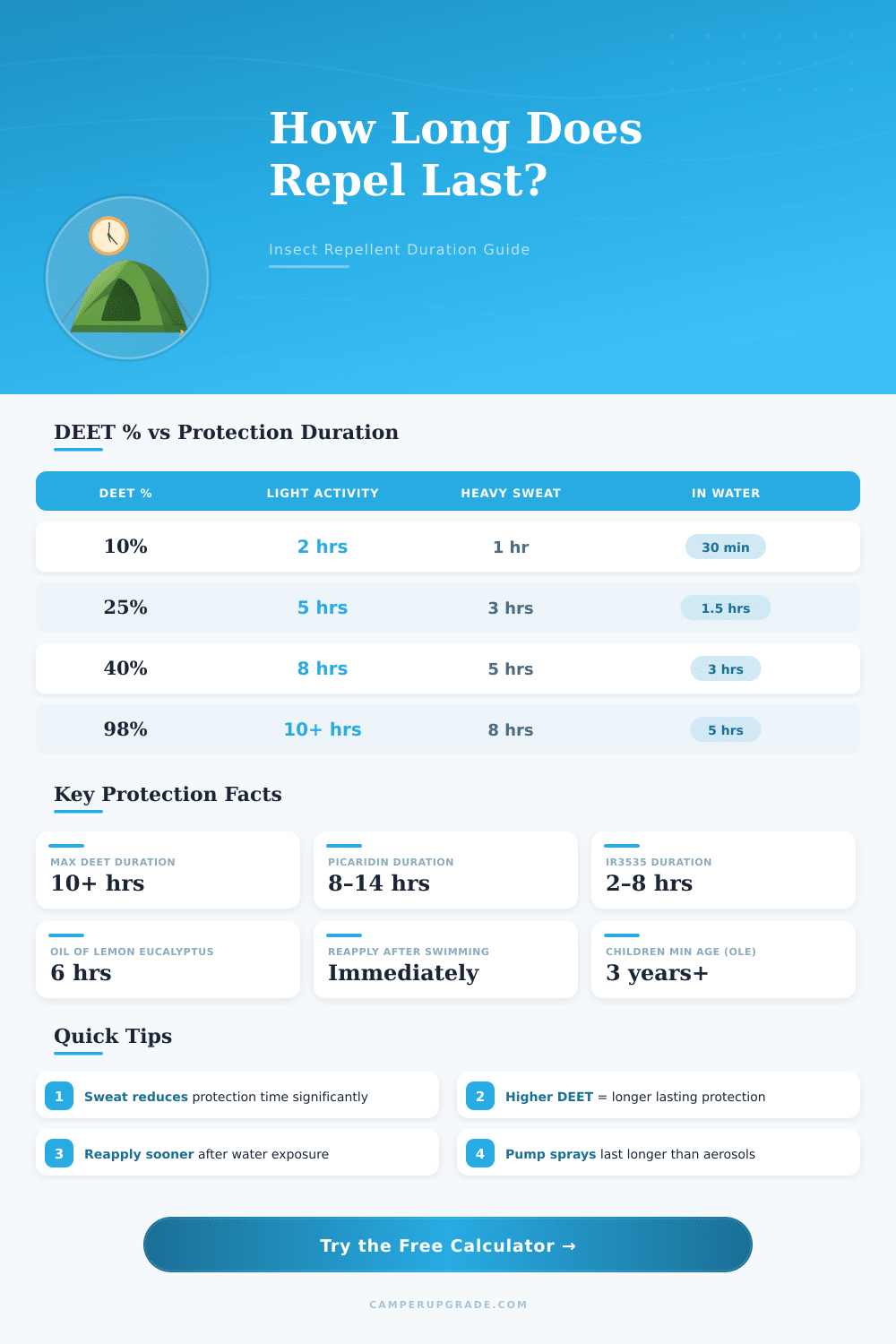
| DEET % | Light Activity | Moderate Activity | Heavy Sweating | After Swimming |
|---|---|---|---|---|
| 5% | 1–2 hrs | ~1 hr | ~30 min | Reapply immediately |
| 10% | 2–3 hrs | ~2 hrs | ~1 hr | Reapply immediately |
| 15% | 3–4 hrs | ~2.5 hrs | 1.5 hrs | ~30 min |
| 20% | 4–5 hrs | ~3 hrs | ~2 hrs | ~45 min |
| 25% | 5–6 hrs | ~4 hrs | 2–3 hrs | ~1 hr |
| 30% | 6–7 hrs | ~5 hrs | ~3 hrs | 1–1.5 hrs |
| 40% | 8–9 hrs | ~6 hrs | ~4 hrs | 1.5–2 hrs |
| 98% | 10–12 hrs | ~8 hrs | 5–6 hrs | 2–3 hrs |
| Formula Type | Duration Modifier | Best For | Notes |
|---|---|---|---|
| Pump Spray | Base duration (1.0x) | General outdoor use | Even coverage, standard evaporation |
| Aerosol Spray | −10% duration (0.9x) | Quick application | Propellant slightly reduces effectiveness |
| Lotion / Cream | +15% duration (1.15x) | Humid environments | Slower evaporation, more consistent |
| Towelettes / Wipes | −20% duration (0.8x) | Travel, on-the-go | Less product deposited per application |
| Clip-On Fan Device | Ambient protection only | Seated/static use | Metofluthrin — area repellent, not skin |
| Extended Release | +25% duration (1.25x) | Long expeditions | Encapsulated formula for slow release |
| Condition | Impact on Duration | Example Reduction |
|---|---|---|
| Temperature >90°F (32°C) | −20–30% | 4hr product → ~3 hrs |
| Temperature 70–90°F (21–32°C) | Base (no change) | 4hr product → ~4 hrs |
| Temperature <70°F (21°C) | +5–10% | 4hr product → ~4.4 hrs |
| High Humidity (>70%) | −15–25% | 4hr product → ~3.2 hrs |
| Low Humidity (<40%) | −5% (faster evap) | 4hr product → ~3.8 hrs |
| Swimming / Full Immersion | −60–90% | Reapply immediately |
| Wading / Partial Water | −30–50% | 4hr product → ~2 hrs |
| Heavy Exercise / Sweating | −40–60% | 4hr product → ~2 hrs |
| Toweling Off After Water | Removes product | Reapply immediately after |
| Age Group | Recommended Ingredient | Max Concentration | Application Notes |
|---|---|---|---|
| Adults (18+) | Any EPA-registered | Up to 98% DEET | Follow label; avoid eyes/mouth |
| Children 3–17 | DEET, Picaridin, IR3535 | Up to 30% DEET | Adult applies; avoid hands/face |
| Children <3 years | Picaridin or IR3535 only | ≤10% Picaridin | OLE and DEET NOT recommended |
| Infants <2 months | None — physical barriers | N/A | Use mosquito nets, covered strollers |
| Pregnant / Nursing | DEET (up to 30%) is considered safe per CDC | 30% DEET | Consult healthcare provider |
Insect Repellent is made up of any chemical created to stop bugs and crawling creatures away from your skin, clothing or anything that protects you. One commonly calls it bug spray or Insect Repellent. Cool about this stuff is that it does not really kill insects, they simply make you a much less attractive target.
Different active ingredients are present in various products. DEET probably is the one that most people know. It exists since around 1957 and people studied it so much what makes it the basic standard for rating other products.
Types of Insect Repellent and How to Use Them
EPA endorsed it, and it comes as an oily liquid that you rub on your skin. Also picaridin works just as well. Some prefer products based on picaridin, and you find them in spray form or wipes, for example Natrapel is a famous brand.
For something more natural, oil from eucalyptus of lemon is the pick of CDC. It belongs to the few plant-based products proved effective against bugs, and honestly, it sometimes works better against certain bug types than DEET. Also, many plants appear in various products, citronella, neem, lavender, cinnamon, thymol, soy oil, tea tree oil, geraniol, the list geos on.
Even so, here the warning: natural oils do not have FDA approval for protecting against serious diseases like Zika or Lyme disease, so best to have them as backup.
Repel is another reliable option, but with an important warning. Never put it directly on your skin. It stays effective on clothing and gear.
Some types leave burning residue after drying, which shows that you must avoid open fires while you wear treated clothes. You can buy ready clothing already treated with Insect Repellent, if you want too skip the application process.
Insect Repellent comes in many different forms. Aerosols, creams, wipes, rollers, patches and plant-based labels all exist. Many work for the whole family, including children, and some entirely skip DEET for using natural substances.
Smoke from a campfire acts also as a natural Repel method. Toss sage oil, oil of lemon balm or leaves of citronella in the fire, and it will boost the power against bugs, those plants have smells that insects hate. Burned coffee grounds work the same and smell like cinnamon while they burn.
Devices like Thermacell heat permethrin-based insecticide to create steam that covers about a ten-foot area. They help well against bugs. A regular box fan does the task also, it simply blows bugs and tiny flies awayfrom your campsite.
If you have children or pets, diatomaceous earth is a natural safe product that works well around campsite areas.