☀️ Physical Sunscreen Reapplication Calculator
Find out exactly how long your physical sunscreen lasts & when to reapply based on SPF, activity, and conditions
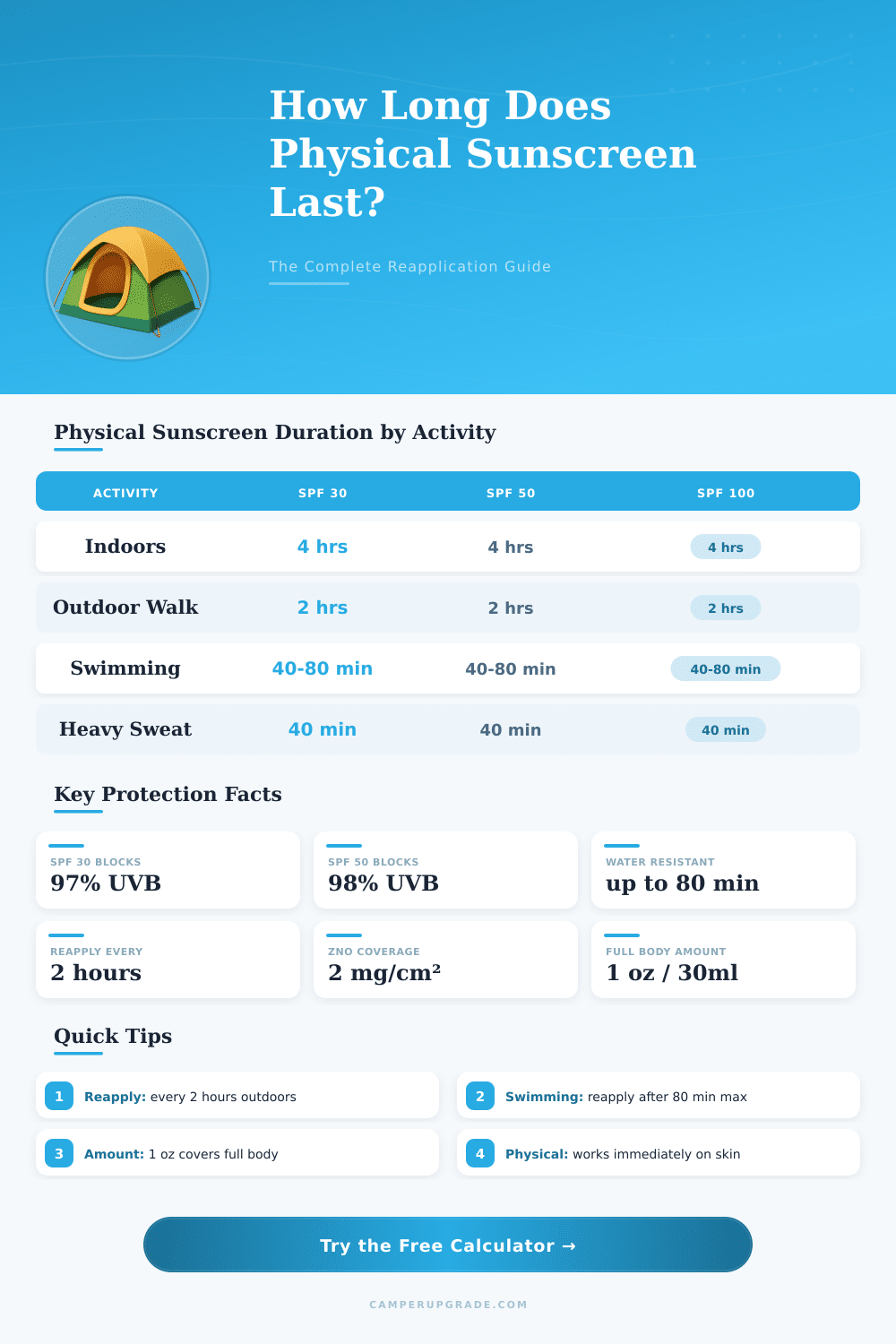
| Activity / Condition | Not Water Resistant | 40-Min Resistant | 80-Min Resistant |
|---|---|---|---|
| Indoors / Sedentary | Up to 4 hrs | Up to 4 hrs | Up to 4 hrs |
| Moderate Outdoor (no sweat) | 2 hrs | 2 hrs | 2 hrs |
| Light Outdoor Activity | 2 hrs | 2 hrs | 2 hrs |
| Heavy Sweat / Exercise | 40–60 min | 40 min | 80 min |
| Swimming (continuous) | 30–40 min | 40 min | 80 min |
| Skiing / High Altitude | 60–90 min | 90 min | 90 min |
| Toweling off after swim | Immediately | Immediately | Immediately |
| UV Index | Risk Level | Recommended SPF | Reapply Interval |
|---|---|---|---|
| 1–2 | Low | SPF 15+ | Every 4 hours |
| 3–5 | Moderate | SPF 30+ | Every 2–3 hours |
| 6–7 | High | SPF 30–50+ | Every 2 hours |
| 8–10 | Very High | SPF 50+ | Every 1.5 hours |
| 11+ | Extreme | SPF 50+ (max) | Every 1 hour |
| Skin Type | Description | Min Burn Time (unprotected) | Min SPF Rec. |
|---|---|---|---|
| Type I | Very fair / freckles, always burns | 5–10 min | SPF 50+ |
| Type II | Fair, usually burns, rarely tans | 10–20 min | SPF 50+ |
| Type III | Medium, sometimes burns, tans gradually | 20–30 min | SPF 30+ |
| Type IV | Olive, rarely burns, tans easily | 30–45 min | SPF 30+ |
| Type V | Brown skin, very rarely burns | 45–60 min | SPF 15+ |
| Type VI | Dark skin, almost never burns | 60+ min | SPF 15+ |
| Ingredient | UV Coverage | Starts Working | Best For |
|---|---|---|---|
| Zinc Oxide | UVA + UVB (broad spectrum) | Immediately | Sensitive skin, babies |
| Titanium Dioxide | UVB + short UVA | Immediately | Daily wear, fair skin |
| Zinc + Titanium Blend | Full broad spectrum UVA/UVB | Immediately | Outdoor activities |
Physical sunscreen is a kind of protection against sun, that uses natural minerals to defend the skin against UV rays. Unlike chemical sunscreens that absorb UV light, physical sunscreen stays on the surface of the skin and reflects the rays away. In such products you find two main parts: zinc oxide and titanium dioxide.
Only these mineral UV filters received approval for use in sunscreens without a recipe.
What Is Physical Sunscreen?
A great plus of physical sunscreens is that they work right after you put them on. Chemical types need around 20 minutes to start working. So, when one quickly goes out or fast enters the sun the mineral type is a lot more useful.
The FDA views zinc oxide and titanium dioxide widely as safe and effective. That happens because of worries about some chemical ingredients in sunscreens, like oxybenzone, octinoxate, octisalate and avobenzone. Recent studies point out that some chemicals in sunscreens can enter the bloodstream, although the results are not fully clear.
Physical sunscreen does not go into the skin. It stays on teh surface and creates a barrier, which is a plus from every viewpoint.
Physical sunscreens suit well for folks with sensitive or acne-prone skin. The mineral parts irritate less than some chemical options. Non-nano forms of those minerals are even better, because they sit gently on the skin.
Sunscreens for babies usually use only physical ingredients, like zinc or titanium dioxide, to protect tender skin.
So, now about the downsides. Physical sunscreens commonly have thicker makeup. Zinc oxide and titanium dioxide are known for being hard to spread and leaving white cover on the skin.
Older mineral sunscreens were especially bad, because the particles were not ground small enough, so one looked nearly like a white ghost. Today’s products improved a lot thanks to smaller particles. New formulas use non-nano zinc oxide, that blends easily without thick white trace.
Also tinted versions exist, that help too mask leftover cover.
Such sunscreens still need to be put on again every two to four hours. When one swims or sweats a lot, more common use matters, because physical sunscreens lose their strength over time. Zinc and titanium however tend to last longer than chemical filters.
Physical sunscreens come in many forms, like lotions, sprays, powders, creams and smooth sticks. Some of them are friendly to reefs, which makes them better for swimming in oceans, rivers or lakes. Mineralsunscreen helps protect folks and creatures in the water.