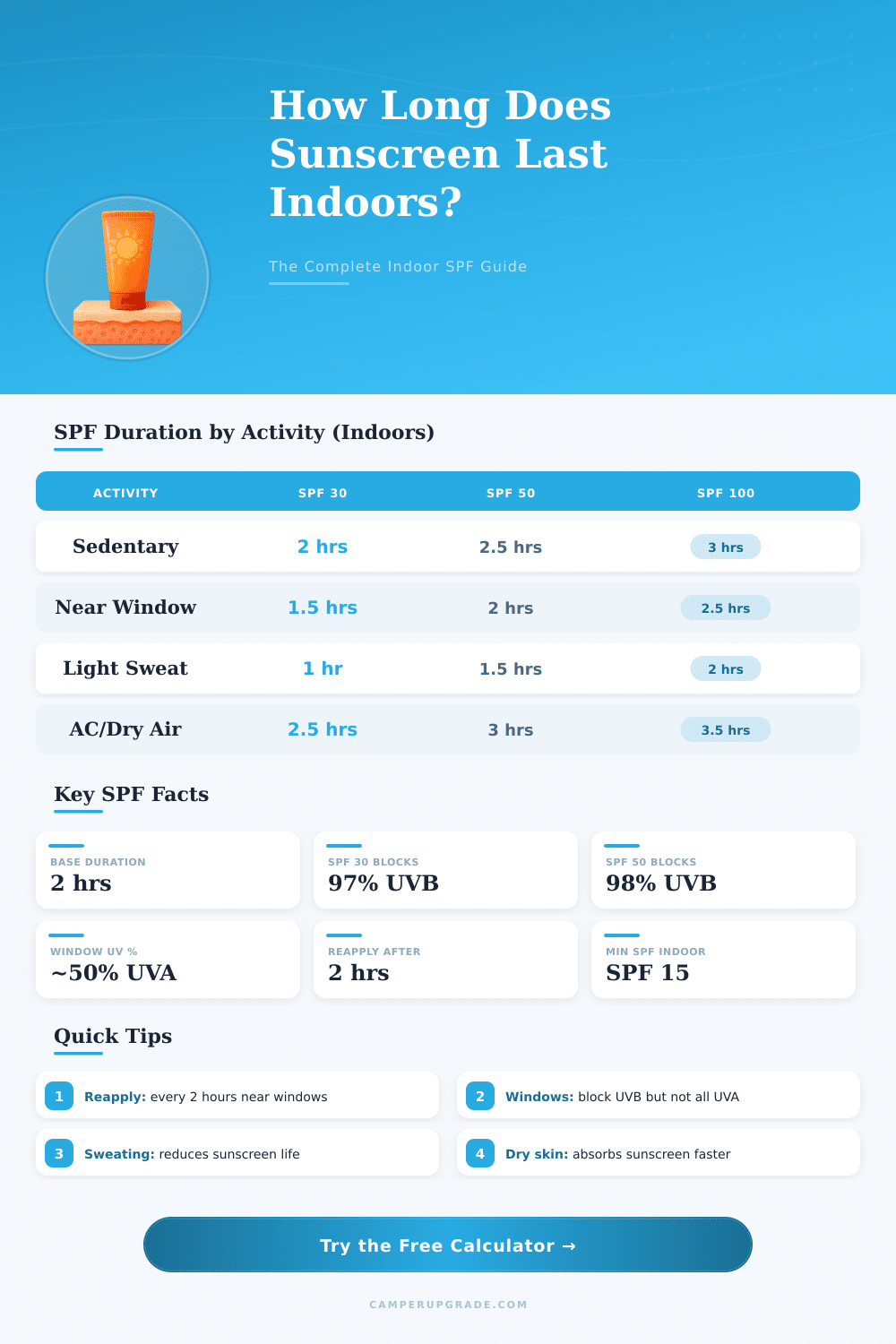
🧴 Sunscreen Duration Calculator (Indoors)
Estimate how long your sunscreen lasts on skin when you’re inside. Get personalized reapplication timing based on SPF, skin type, activity, and indoor UV exposure.
| Indoor Location | UV Risk | SPF 30 Duration | SPF 50 Duration | SPF 100 Duration |
|---|---|---|---|---|
| Office — No Windows | Very Low | 4–6 hrs | 5–7 hrs | 6–8 hrs |
| Office — Near Window | Low–Moderate | 2–3 hrs | 2.5–3.5 hrs | 3–4 hrs |
| Home — General Interior | Low | 3–5 hrs | 4–6 hrs | 5–7 hrs |
| Car — Sitting by Window | Moderate | 1.5–2 hrs | 2–3 hrs | 2.5–3.5 hrs |
| Conservatory / Sunroom | Moderate–High | 1–1.5 hrs | 1.5–2 hrs | 2–2.5 hrs |
| Near UV / Fluorescent Lamp | Low | 2–4 hrs | 3–5 hrs | 4–6 hrs |
| Skin Type | Duration Modifier | Reason | Recommended SPF |
|---|---|---|---|
| Dry Skin | +10% | Less sebum to break down formula | SPF 30+ |
| Normal Skin | Baseline | Standard absorption rate | SPF 30+ |
| Oily Skin | –20% | Sebum dilutes & degrades formula | SPF 50+ |
| Combination Skin | –10% | Oily T-zone reduces coverage | SPF 30–50 |
| Sensitive Skin | +5% | Usually mineral-based, more stable | SPF 30–50+ |
| Factor | Type | Duration Modifier | Reapply Guidance |
|---|---|---|---|
| Sedentary (desk/resting) | Activity | Baseline | Every 2 hrs near windows |
| Light Activity (walking) | Activity | –10% | Every 2 hrs |
| Moderate (light exercise) | Activity | –25% | Every 1.5 hrs |
| High (heavy sweating) | Activity | –40% | Every 60–80 min |
| Air Conditioning (dry) | Environment | +10% | Normal schedule |
| Humid / No AC | Environment | –15% | More frequent |
| Heated Indoor Air | Environment | –5% | Standard schedule |
| Light Application | Amount | –30% | Reapply sooner |
| Standard Application | Amount | Baseline | Normal schedule |
| Generous Application | Amount | +15% | Can extend slightly |
| Glass / Window Type | UVB Transmission | UVA Transmission | Sunscreen Needed? |
|---|---|---|---|
| Standard Float Glass | ~0% | ~75% | Yes, near window |
| Car Side Window | ~0% | ~50–65% | Yes, definitely |
| Car Windshield (laminated) | ~0% | ~1–3% | Low risk |
| UV-blocking Window Film | ~0% | <1% | Minimal |
| Conservatory Glass | ~5–20% | ~70–80% | Yes, strongly |
| No Window / Interior Room | 0% | ~0% | Optional |
Sunscreen is a product that one puts on the skin to help protect against sunburn and maybe also stop skin cancer. One calls it also sunscreen, sunblock, solar lotion or simply solar cream. It comes in various forms for instance as lotions, aerosols, gels and foams.
Using sunscreen is an important part of a complete plan for sun protection, to preserve the skin against sun damage.
How to Use Sunscreen
It matters also how one uses sunscreen. The way of putting it on and the other protective steps strongly affect, if the skin stays safe against sunburn, skin cancer and early skin aging. A good way is to choose cream with broad spectrum, that means that it filters both UVA and UVB rays.
It is useful to search also for water resistance, together with SPF 30 or higher. SPF means Sun Protection Factor and shows how much longer sun exposure is needed to receive the same amount of UVB damage, compared with bare skin. So having SPF 10 means that you need tenfold more tiem for the same damage.
Reapplying is very important. After around two hours in the sun, one must put it on again. Likewise after swimming or sweating.
Even “waterproof” sunscreen is not truly waterproof. Most folks also use too little. About one ounce is required to cover the whole body.
Easily forgotten places are the tops of the ears, the back of the neck, the top of the feet, and areas around clothing and sunglasses.
There are mineral and chemical sunscreens. The mineral ones commonly use ingredients like zinc oxide, that according too many protects against the sun a bit more well than titanium dioxide. Physical UV blockers commonly are a bit “chalky” and harder to rub on the skin, although some newer products spread quickly and soak in easily, with only a tiny white tint.
Zinc-based, waterproof sunscreens that are reef-friendly are seen as among the safest choices for both folks and wild creatures.
Sunscreen should match your skin type. Lightweight gel sunscreens work well for oily or mixed skin. For dry skin thicker creams or formulas with moisturizing ingredients work better.
Some sunscreens are made with soothing and moisturizing ingredients for yearlong use.
Aerosol spray sunscreens bring fire risk. There were cases when folks applied aerosol sunscreen and later got close to a grill, lighter or candle, and their skin lit. Such aerosols carry flammable chemicals, and some were pulled after they caused severe burns.
Australian sunscreens commonly are thicker and heavy, because they commonly are made to be waterproof, while Korean and Japanese sunscreens usually are more lightweight, because they are not truly designed for swimming. Setting phonereminders to reapply is a clever idea, because it is easy to lose the feeling about time outside.