🥫 Homemade Dehydrated Food Shelf Life Calculator
Estimate how long your dehydrated food will last based on food type, moisture content, and storage method
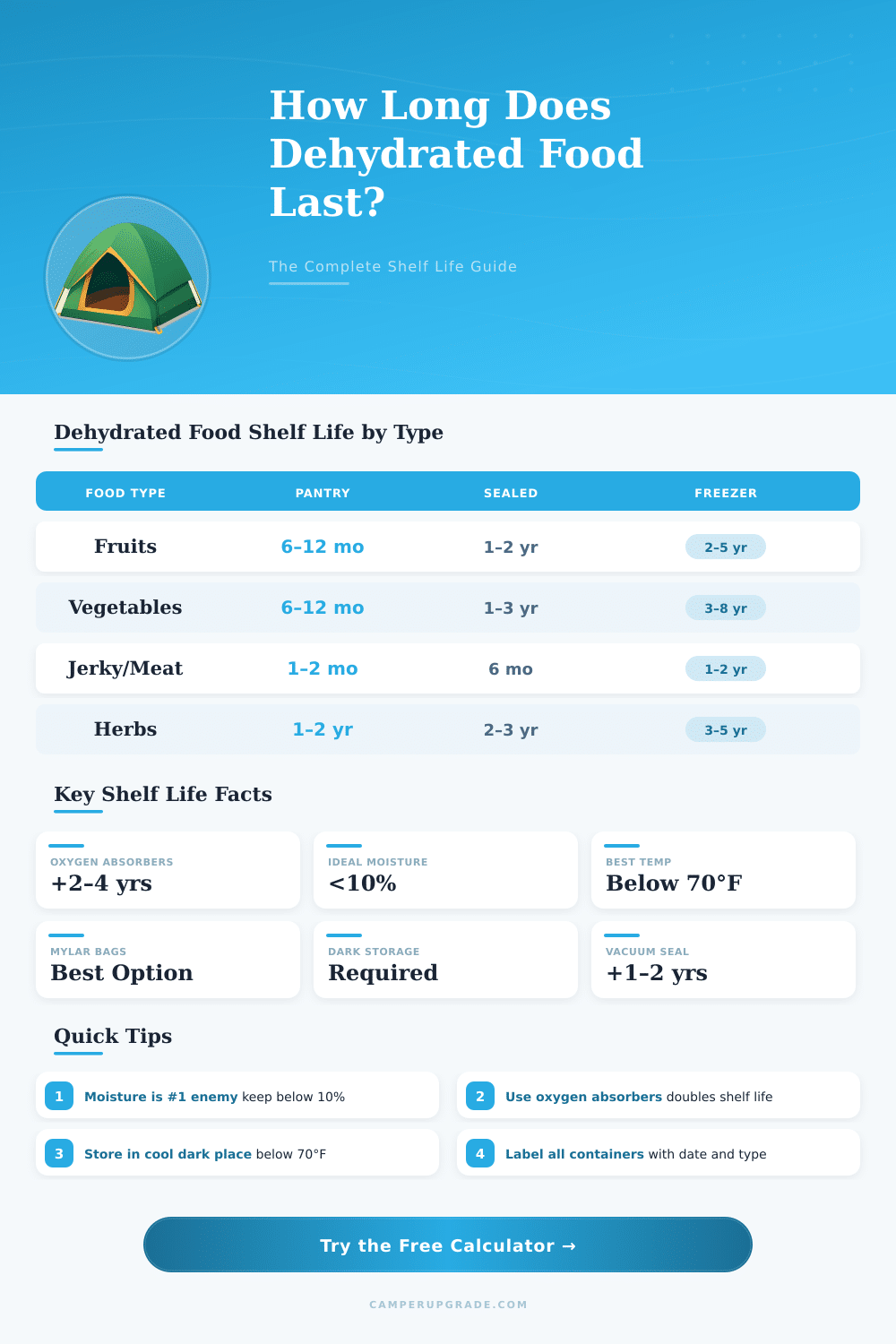
| Food Type | Open Container | Glass Jar / Vacuum | Mylar + O2 Absorber |
|---|---|---|---|
| Fruit Slices | 1–3 months | 6 mo – 1 year | 1–5 years |
| Vegetables | 2–6 months | 1–2 years | 2–8 years |
| Meat & Jerky | 1–2 months | 3–6 months | 6 mo – 2 years |
| Herbs & Spices | 6–12 months | 1–3 years | 3–5 years |
| Grains & Legumes | 6–12 months | 2–5 years | 5–25 years |
| Mushrooms | 1–3 months | 6 mo – 1 year | 1–3 years |
| Egg Powder | 1–2 months | 1–2 years | 5–10 years |
| Fruit Leather | 1 month | 3–6 months | 6–12 months |
| Temperature | °F | °C | Shelf Life Impact |
|---|---|---|---|
| Freezer | 0 – 32°F | –18 – 0°C | Maximizes shelf life (2x–5x longer) |
| Ideal Cool Storage | 50 – 60°F | 10 – 15°C | Excellent — full shelf life potential |
| Room Temperature | 65 – 70°F | 18 – 21°C | Good — standard shelf life |
| Warm Pantry | 75 – 80°F | 24 – 27°C | Reduced — 25–50% shorter life |
| Hot Storage | 80+°F | 27+°C | Poor — significantly shortened |
| Container Type | O2 Protection | Moisture Block | Shelf Life Boost |
|---|---|---|---|
| Mylar Bag + O2 Absorber | Excellent | Excellent | Up to 5x longer |
| Vacuum Sealed Jar/Bag | Very Good | Very Good | 2x–3x longer |
| Glass Jar (airtight lid) | Good | Good | 1.5x–2x longer |
| Zip-Lock Plastic Bag | Fair | Fair | Minimal boost |
| Paper Bag / Open | None | None | No boost |
Dehydrated food is simply that, what stays after one removed almost all moisture from it. The main idea of dehydration is to quickly remove the water to stop the decay and stop growth of germs. Vegetables and fruits store around 80 to 95 percent of water while meats and cooked grains have about 70 percent.
When one removes that water, stay the precious parts like proteins, fats, sugars, fibers, vitamins and minerals.
Dehydrated Food: What It Is and How to Use It
Folks commonly ask whether dehydrated food loses nutrients. The process usually keeps carbohydrates, proteins, fats and minerals without change. Some reckon that it keeps the original nutritional value of the food.
Even so, vitamins soluble in water can be lost, especially vitamin C and riboflavin. Drying of fruits and vegetables causes a bigger toll of nutrients than other kinds of foods. Despite that dehydration commonly loses fewer nutrients than many other methods of keeping food.
The grocery industry is one of the biggest users of dehydrated food. Many products here are dried by means of spray drying, so one turns them into a fine mist and later blows warm air on it. The moisture evaporates immediately, and stay milky powder.
Dehydrated food has truly long shelf life. Some products can last forever without freezing. That makes it ideally fit for emergencies.
For instance, one family lived from it during 17 days in a difficult situation. It works also for camping, backpacking trips and everyday cooking. The food weighs little, because it does not have the water weight, which is a big advantage for long marches wear weight matters.
Dehydration offers the best balance between cost, calories and weight. Freeze-dried foods can be even more lightweight for the same amount of calories, but they cost much more. Home prepared meals by means of a dehydrator is a much better way than buying ready variants.
For the price of four or five ready dehydrated meals one can buy a mid-sized dehydrator.
There is big variety of possibilities. Apples, oranges, tomato sauce, ground beef, beans, vegetables and whole meals like chili, broths or stew can all be dehydrated. Ground beef works well, if one washes it after cooking to remove the fat and passes it through a food processor to make smaller bits.
Add breadcrumbs to ground meat to help stop it from getting sticky. Fruit slices can soak in a mix of lemon juice and water to stop browning, and one should cut them in same size.
To eat dehydrated foods, simply mix the parts, add water, boil a few minutes and then taste. Grinding the food into powder after drying even allows rehydration by means of cold water. The taste of homemade dehydrated food commonly beats that of store products, andthat alone is worth the work.