🔥 Flint Fire Starter Lifespan Calculator
Estimate how long your ferro rod or flint striker will last based on rod size, strike frequency, and usage habits
Strike Capacity
Strike Capacity
Strike Capacity
Strike Capacity
Strike Capacity
Strike Capacity
Strike Capacity
Strike Capacity
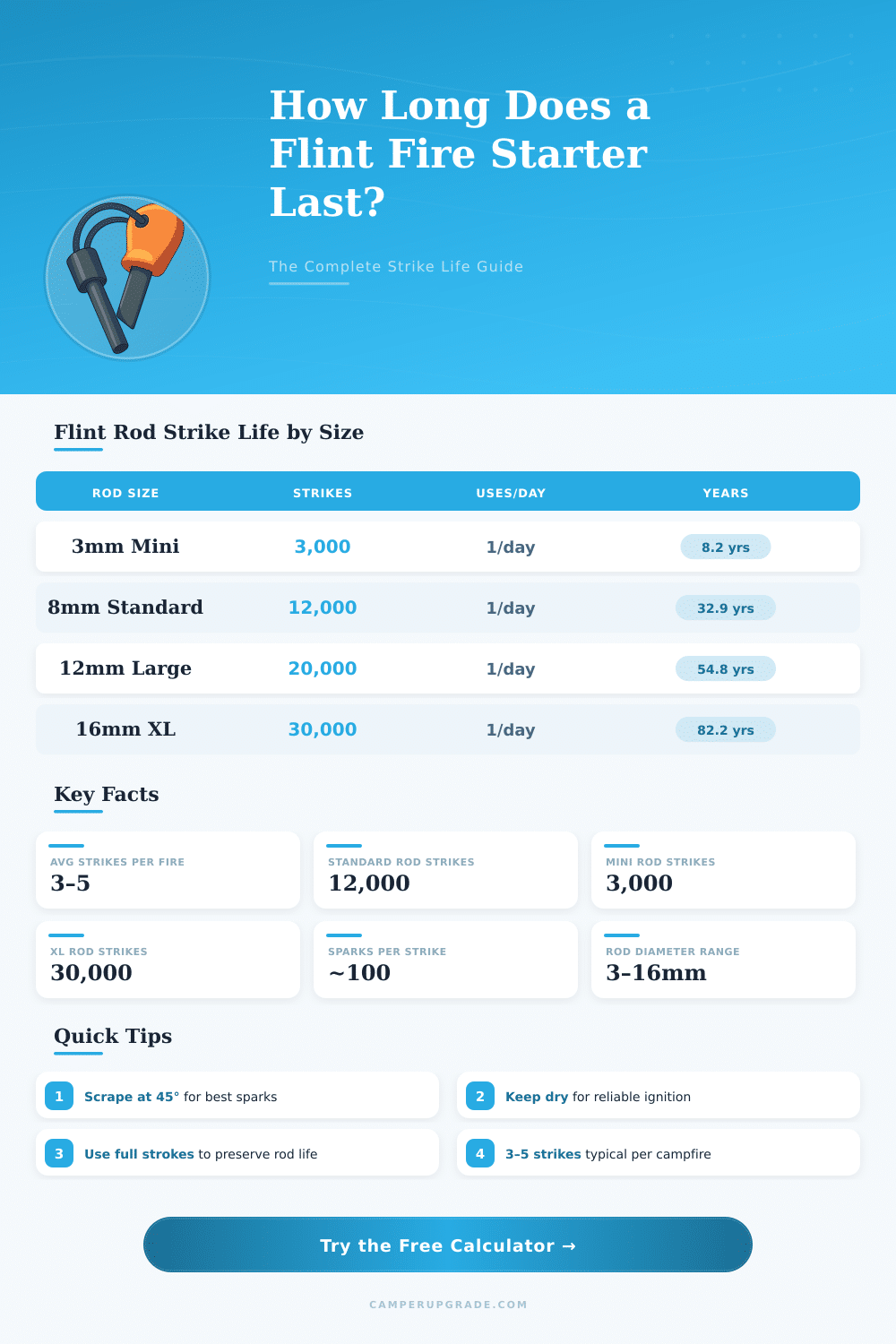
| Rod Type | Total Strikes | 1 Fire/Day (3 strikes) | 2 Fires/Day (3 strikes) | Seasonal Use (90 days/yr) |
|---|---|---|---|---|
| Mini (3mm) | 3,000 | 2.7 years | 1.4 years | 11.1 years |
| Small (5mm) | 7,000 | 6.4 years | 3.2 years | 25.9 years |
| Standard (8mm) | 12,000 | 11.0 years | 5.5 years | 44.4 years |
| Large (10mm) | 18,000 | 16.4 years | 8.2 years | 66.7 years |
| XL (12mm) | 25,000 | 22.8 years | 11.4 years | 92.6 years |
| XXL (16mm) | 40,000 | 36.5 years | 18.3 years | 148 years |
| Natural Flint | ~1,200 | 1.1 years | 0.5 years | 4.4 years |
| Magnesium Block | ~350 | 0.32 years | 0.16 years | 1.3 years |
| Skill Level | Dry Tinder | Damp Tinder | Commercial Tinder | Avg Strikes/Fire |
|---|---|---|---|---|
| Expert | 1–2 | 3–5 | 1 | 1–3 |
| Experienced | 2–4 | 5–10 | 1–2 | 3–5 |
| Intermediate | 4–8 | 10–20 | 2–3 | 5–10 |
| Beginner | 10–20 | 20–50 | 3–5 | 10–20 |
| Novice | 20–50 | 50–100+ | 5–10 | 20–50 |
| Length (in) | Length (cm) | Est. Strikes | Years at 3/day | Years at 1/day (3 strikes) |
|---|---|---|---|---|
| 2 in | 5.1 cm | ~6,000 | 5.5 yrs | 5.5 yrs |
| 3 in | 7.6 cm | ~9,000 | 8.2 yrs | 8.2 yrs |
| 4 in | 10.2 cm | ~12,000 | 11.0 yrs | 11.0 yrs |
| 5 in | 12.7 cm | ~15,000 | 13.7 yrs | 13.7 yrs |
| 6 in | 15.2 cm | ~18,000 | 16.4 yrs | 16.4 yrs |
| Scenario | Fires/Year | Strikes/Year | 8mm Rod Life | Mini Rod Life |
|---|---|---|---|---|
| Weekend Camper | ~100 | ~300 | 40 years | 10 years |
| Monthly Camper | ~30 | ~90 | 133 years | 33 years |
| Seasonal (Summer) | ~180 | ~540 | 22 years | 5.5 years |
| Daily Outdoorsman | 365 | 1,095 | 11 years | 2.7 years |
| Thru-Hiker (6 months) | ~360 | ~1,080 | 11.1 years | 2.8 years |
| Emergency Kit Only | ~5 | ~15 | 800 years | 200 years |
The Flint and steel Fire Starter ranks between the most ancient ways to get fire. It works by slapping a Flint piece against metal to make sparks. Even so those sparks stay very small.
They alone will not light something, unless dry tinder is ready to receive them. The tinder must be fine dry and easily flammable, for instance charcloth or fibers packed in a tiny pile.
How to Start a Fire with Flint and Steel
Using this method to get fire requires real practice. Even during ideal weather, the small first sparks must be protected and carefully fed until flame. It commonly fails despite the biggest efforts.
The real skill consists not only in creating the sparks, but in catching them with tinder and blowing nicely until flame appears. Later, kindling and sticks help to strengthen the fire from here.
A huge distance separates the traditional Flint and steel tool from the ferrocerium rod. Ferrocerium forms an alloy from metals like iron, magnesium, lanthanum and cerium. It produces much more sparks, including bigger ones.
By comparison, natural Flint and steel gives only a few small ones. Moreover, the iron rods work even in moisture, which forms a huge benefit.
Some Fire Starter kits come with a magnesium block fixed. The idea is to grate magnesium shavings in piles and then strike the Flint to light them. One can use more or less magnesium according too the weather and available tinder.
Those magnesium tools cost little and serve a long period if one uses them well. The secret does not rest in repeat blows on the Flint as if with an iron rod.
Fire Starter kits offer various versions. Some carry a forged steel striker, Flint and charcloth to teach ancient techniques of fire starting. Others have more modern features, like BPA-free handles, rust-resistant steel strikers and strong nylon cord.
One favourite model shows a three-quarter-inch thick iron rod with metal striker and string, that works in wet and dry situations. Compact forms fit easily in a pocket, backpack or glove box.
Having backup methods is always smart. Commonly one advises to carry at least two or three methods to make fire, for instance a lighter, matches and an iron rod together. All of them cost little, weigh a bit and last long.
The Flint and steel tool serves a very long time and has no mechanism that could break. A match works only one time, while a lighter willfinally run out of fuel. Rather, the weakness of Flint and steel is that it does not give a fast big flame.
Files from high-carbon steel, like 1095 spring-steel, can serve as good strikers. New files sometimes only have surface hardness and do not make sparks well. Also worth mentioning.
The edges of Flint can injure fingers during slapping, even if they are not especially sharp.