🧴 DEET Insect Repellent Duration Calculator
Calculate how long your DEET repellent will protect you based on concentration, activity level, and conditions
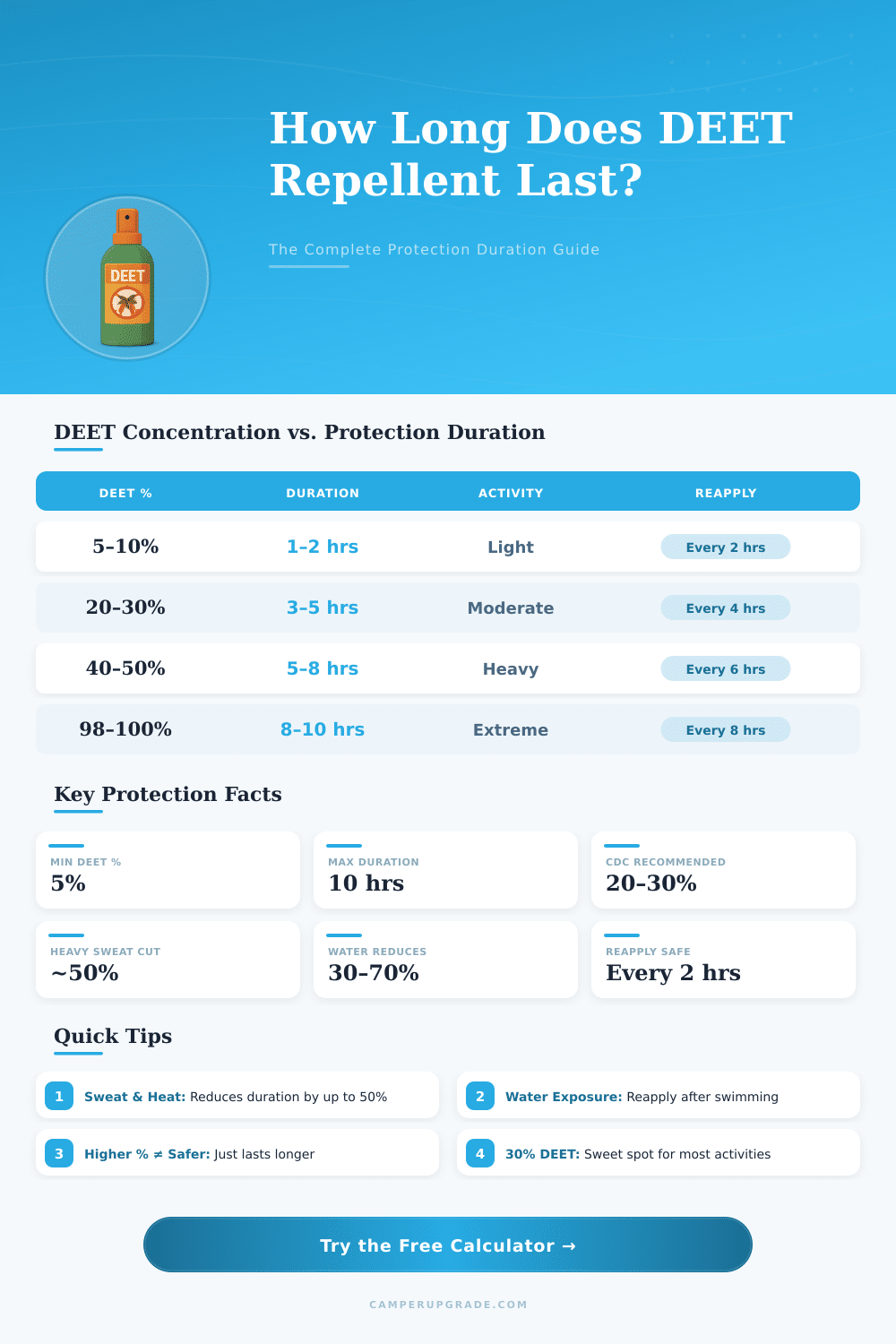
| DEET Concentration | Mosquito Duration | Tick Duration | Reapply After |
|---|---|---|---|
| 5% | 1.0 – 1.5 hrs | ~1 hr | Every 1–1.5 hrs |
| 10% | 1.5 – 2.5 hrs | ~1.5 hrs | Every 2 hrs |
| 15% | 2 – 3 hrs | ~2 hrs | Every 2–3 hrs |
| 20% | 3 – 4 hrs | ~2.5 hrs | Every 3–4 hrs |
| 25% | 3.5 – 4.5 hrs | ~3 hrs | Every 4 hrs |
| 30% | 4 – 5 hrs | ~3.5 hrs | Every 4–5 hrs |
| 40% | 5 – 6 hrs | ~4 hrs | Every 5–6 hrs |
| 50% | 6 – 8 hrs | ~5 hrs | Every 6 hrs |
| 75% | 7 – 9 hrs | ~6 hrs | Every 7–8 hrs |
| 98–100% | 8 – 10 hrs | ~8 hrs | Every 8–10 hrs |
| Condition | Duration Reduction | Why It Happens | Action |
|---|---|---|---|
| Light sweating | −10 to 20% | Dilutes surface concentration | Monitor effectiveness |
| Heavy sweating | −40 to 50% | Washes DEET off skin | Reapply sooner |
| Swimming (30 min) | −60 to 70% | Water removes repellent | Reapply after exit |
| Rain / Humidity | −30 to 40% | Moisture reduces adhesion | Use lotion form |
| Hot temps (90°F+) | −15 to 25% | Faster evaporation rate | Use higher % or lotion |
| Wind | −10 to 15% | Speeds evaporation | Reapply in exposed areas |
| Rubbing / Wiping | −20 to 30% | Physical removal | Avoid wiping treated areas |
| Cool, still conditions | +10 to 20% | Slower evaporation | Duration may be extended |
| Formulation | Duration vs. Spray | Water Resistance | Best Use |
|---|---|---|---|
| Aerosol Spray | Baseline | Low | Quick, general use |
| Pump Spray | Similar to aerosol | Low | Targeted application |
| Lotion / Cream | +15 to 20% longer | Moderate | Sweaty / water activities |
| Towelette / Wipes | −10 to 15% shorter | Low | Travel, convenience |
| Stick | +10% longer | Moderate | Face, targeted areas |
| Extended Release | +30 to 50% longer | Moderate–High | All-day protection |
| Pest | Min. DEET % | Recommended % | Notes |
|---|---|---|---|
| Mosquitoes | 5% | 20–30% | Most DEET-responsive pest |
| Ticks (Deer Tick) | 20% | 30–50% | Requires higher concentrations |
| Biting Flies | 20% | 30%+ | Often less responsive than mosquitoes |
| No-See-Ums / Midges | 30% | 50%+ | Difficult to repel; high % recommended |
| Chiggers | 10% | 20–30% | Apply to socks and clothing too |
| Gnats / Black Flies | 25% | 30–50% | Use in combination with clothing coverage |
Deet ranks among the most known Insect Repellent products around the world. Its chemical name refers to N,N-Diethyl-m-toluamide. The American Army created it in 1946 and in 1957 it received approval for use by all folks.
Currently, more than 200 millions of people everywhere on the globe apply Deet to defend themselves against mosquitoes, fleas, ticks, flies and chiggers. Because of that, one escapes stings, that could bring insect diseases, truly big profit.
Deet: How It Stops Mosquitoes and Tick Bites
One intends to use Deet directly on the skin. Rather than kill insects, it simply stops biting creatures from smelling folks. That colorless liquid has only weak scent and does not disappear easily.
Some users are worried about the greasy or oily feeling during application. But that greasy structure truly can help, so that it stays more steadily on the skin, especially in warm and wet places.
The CDC advises products with 30 to 50 percent of Deet to stop the spread of insect diseases. Levels of 20 to 30 percent of Deet are enough for good guard in the most common situations. Although, stronger levels have their benefit, because some mosquitoes do not care about weaker doses.
A study from 2008 shows, that bigger amounts of Deet also keep insects away more well through fabrics. Such products come in various forms, as sprays, wipes and creams.
Deet protects against mosquitoes and ticks, that carry Lyme-disease, West Nile-virus and other serious issues. It already passed longer tests and more strict attempts than almost all other Insect Repellent products. There is no proven proof, that it harms folks, if one follows the instructions.
For more then 60 years, Deet stayed the main choice among insect defenses.
Ben’s Deet is a famous brand, prepared and tested in the dense woods of New Hampshire. Sold as strong all-day guard, it works well for camping, hiking, hunting and journeys to places full of insects. Some folks bring the full strength version of Ben’s Deet during trips and lay it on the skin when needed.
Picaridin gives an option with same effect, but with fewer surrounding problems. Oil from lemon eucalyptus also received the approval of the CDC for fighting against mosquitoes. Mixing Deet with clothes treated with permethrin forms a solid way to escape stings.
Permethrin works as Insect Repellent for fabrics, while Deet works for the skin. Covering clothes from the top to the bottom heavily reduces the need of Insect Repellent. Simply keep permethrin-treated fabrics away from water, because itrisks aquatic life.