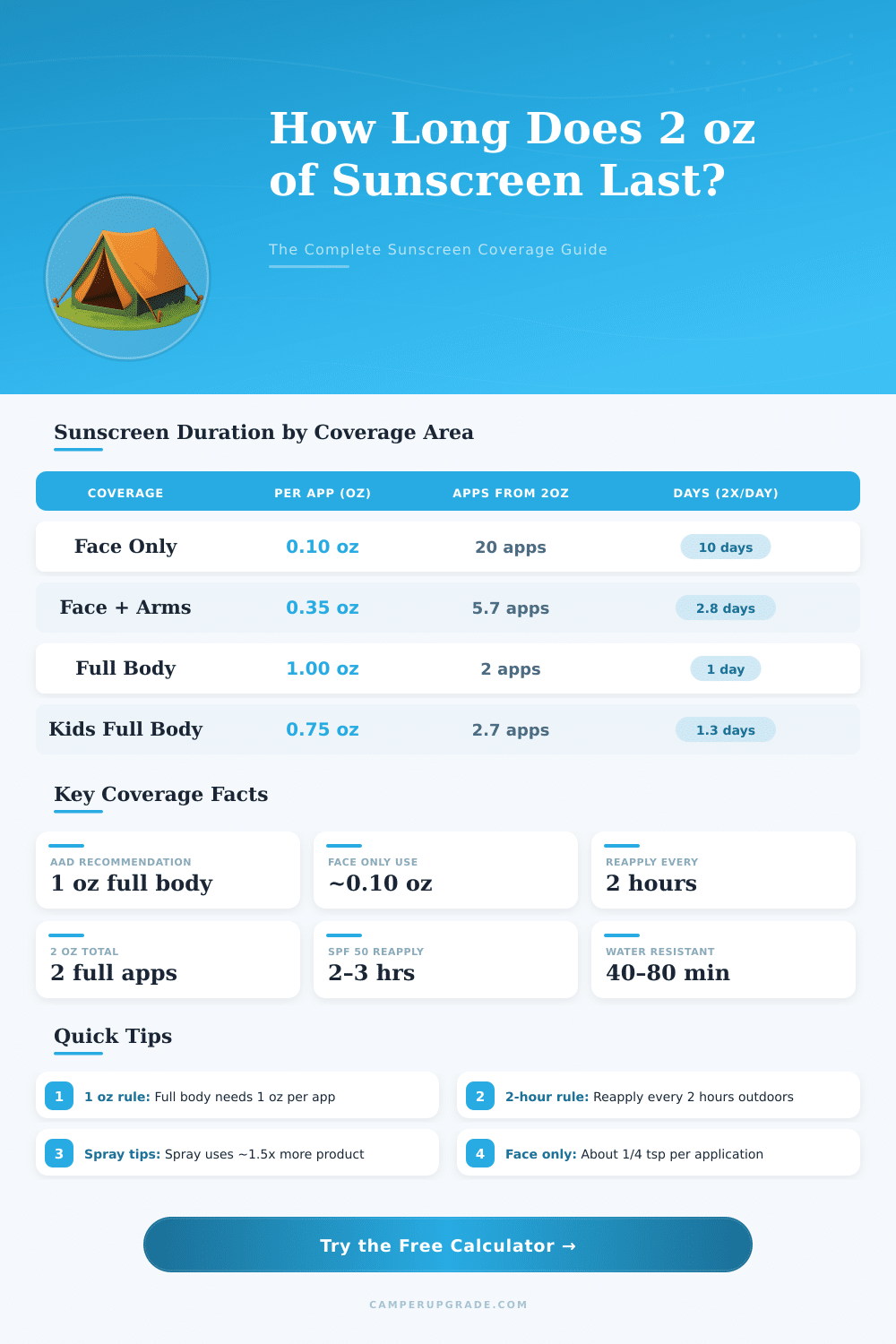
🌞 How Long Does 2 oz of Sunscreen Last?
Calculate applications, days of coverage, and reapplication schedule based on your body coverage area
| Coverage Area | oz Per App | ml Per App | Apps from 2 oz | Days (2 apps/day) |
|---|---|---|---|---|
| Face Only | 0.10 oz | 3 ml | 20 apps | 10 days |
| Face & Neck | 0.20 oz | 6 ml | 10 apps | 5 days |
| Face, Neck & Arms | 0.35 oz | 10 ml | 5.7 apps | 2.9 days |
| Upper Body | 0.60 oz | 18 ml | 3.3 apps | 1.7 days |
| Legs Only | 0.50 oz | 15 ml | 4 apps | 2 days |
| Lower Body | 0.55 oz | 16 ml | 3.6 apps | 1.8 days |
| Full Body (Adult) | 1.00 oz | 30 ml | 2 apps | 1 day |
| Child Full Body | 0.75 oz | 22 ml | 2.7 apps | 1.3 days |
| Product Type | Multiplier | Notes | Relative Efficiency |
|---|---|---|---|
| Lotion / Cream | 1.0x (baseline) | Most accurate coverage | ★★★★★ |
| Spray Sunscreen | 1.4x more product | Hard to gauge coverage | ★★★ |
| Stick Sunscreen | 1.2x more product | Best for small areas | ★★★★ |
| Gel Sunscreen | 1.0x (same as lotion) | Spreads easily | ★★★★★ |
| Tinted SPF Moisturizer | 0.5x (less product) | Typically face only | ★★★ |
| Mineral / Zinc Oxide | 1.1x more product | Thicker consistency | ★★★★ |
| Bottle Size | ml Equivalent | Full Body Apps | Days at 2 apps/day | Weeks Supply |
|---|---|---|---|---|
| 1 oz (travel size) | 30 ml | 1 app | 0.5 days | — |
| 2 oz (standard) | 60 ml | 2 apps | 1 day | — |
| 3 oz (TSA max) | 89 ml | 3 apps | 1.5 days | — |
| 4 oz | 118 ml | 4 apps | 2 days | — |
| 6 oz | 177 ml | 6 apps | 3 days | — |
| 8 oz | 237 ml | 8 apps | 4 days | — |
| 16 oz (pump) | 473 ml | 16 apps | 8 days | ~1 week |
sunscreen is the best friend of your skin when dealing with defense against the sun. One commonly calls it sunblock, sunscreen or sun cream… Everything shows the same product.
Currently it comes in many forms: creams, sprays, gels, foams, even you can imagine. Including sunscreen in your everyday routine can truly help to avoid sunburn, risk of cancer and that early aging, that none would like to get.
How to Use Sunscreen the Right Way
But here the key. The way you apply sunscreen is likewise important as the use itself. Moreover, everything you do to protect yourself against sun rays decides whether your skin stays truly covered.
Reapplying is not optional. When you spend more than two hours outside you need to again put it on the body. That counts also after swimming or heavy sweating, it does not work to believe that the prior coat still works.
And that label “waterproof”? Do not believe it. It does not resist water like this, as one would hope.
Honestly, many folks use too little sunscreen. It is not easy to cover the whole body right. And those tender areas that one commonly forgets?
The tops of ears, back of the neck, tops of feet and places where clothing or sunglasses leave spaces. Set reminders in the phone, because it is surprisingly easy to forget taht when you play outside.
SPF means Sun Protection Factor, and it shows how much longer you can stay in the sun before getting the same amount of UVB rays than without protection. Broad spectrum sunscreen blocks both UVA and UVB rays. Choosing SPF 30 or higher makes sense, but SPF 50 or more gives even more safety.
Here what surprises, folks usually use less then the tested amount in labs, so higher SPF versions make up for that everyday gap. If you apply SPF 30 correctly, you get around 95 percent of protection against the sun.
It also matters to choose the right type for your skin. For oily or mixed skin, lightweight gel sunscreen works well, without heavy feeling. For dry skin?
Take cream or thicker kind full of moisturizers. Search for non-comedogenic products, to not clog pores or get that weird white cover later.
Mineral sunscreen uses physical barriers and commonly is broad spectrum. Some physical sunscreen feels a bit chalky and needs work to mix, but many new kinds spread flat and absorb quickly, with almost no white trace. You also find reef-safe sunscreen that avoids chemicals like oxybenzone and octinoxate, those already showed themselves harmful for coral reefs.
Spray sunscreen carries real risk of burns, because they carry flammable stuff. There have been cases when folks caught fire after spraying and standing too near to grills or candles. Some spray products already got pulled fromstores, but the burning danger of spray sunscreen widely still deserves attention.