🔥 Propane & Butane Canister Runtime Calculator
Find out exactly how long your gas canister will last based on size, fuel type, and appliance BTU rating
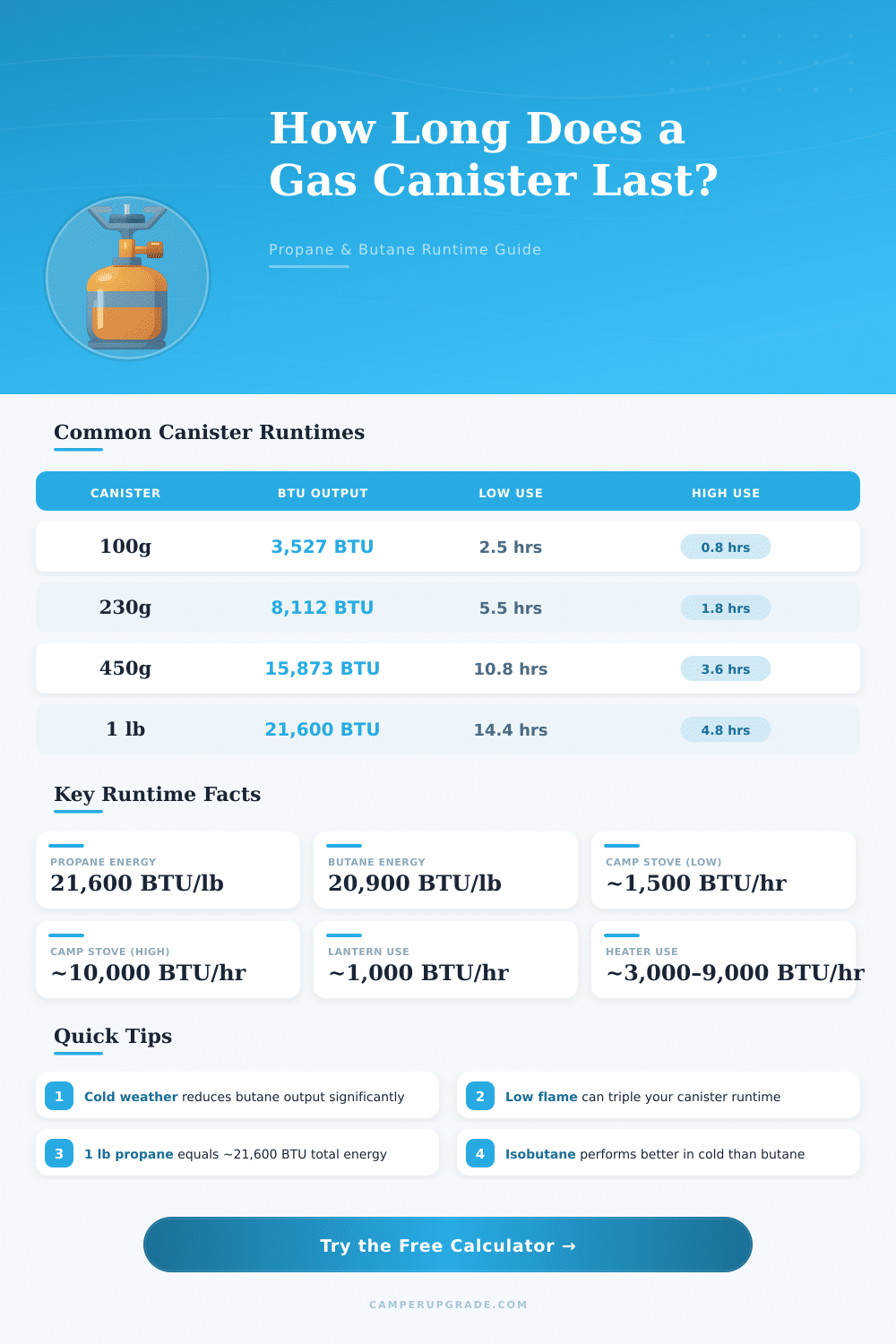
| Canister Size | Fuel Weight | Total BTU | Camp Stove Low (1,500) | Camp Stove High (10,000) | Heater Low (3,000) |
|---|---|---|---|---|---|
| 100g canister | 100g / 3.5 oz | 4,761 BTU | 3.2 hrs | 0.5 hrs | 1.6 hrs |
| 230g canister | 230g / 8.1 oz | 10,950 BTU | 7.3 hrs | 1.1 hrs | 3.6 hrs |
| 450g canister | 450g / 15.9 oz | 21,420 BTU | 14.3 hrs | 2.1 hrs | 7.1 hrs |
| 1 lb cylinder | 453g / 16 oz | 21,600 BTU | 14.4 hrs | 2.2 hrs | 7.2 hrs |
| 1 lb 14 oz cylinder | 851g / 30 oz | 40,616 BTU | 27.1 hrs | 4.1 hrs | 13.5 hrs |
| 20 lb tank | 9.07 kg / 20 lb | 432,000 BTU | 288 hrs | 43.2 hrs | 144 hrs |
| Appliance | BTU/hr (Low) | BTU/hr (High) | Typical Use |
|---|---|---|---|
| Backpacking stove | 1,500 | 10,000 | Boiling water, cooking |
| Camp lantern | 800 | 1,200 | Continuous lighting |
| Portable tabletop heater | 3,000 | 9,000 | Space heating (small area) |
| RV BBQ grill | 5,000 | 10,000 | Grilling, cooking |
| RV furnace | 8,000 | 35,000 | Cabin heating (intermittent) |
| RV water heater | 6,000 | 10,000 | Hot water on demand |
| RV range burner | 5,000 | 8,000 | Cooking per burner |
| Catalytic tent heater | 1,500 | 3,000 | Tent/small space warming |
| Canister | Metric Weight | Imperial Weight | Approx. Total BTU (Propane) | Best For |
|---|---|---|---|---|
| Mini / 100g | 100 g | 3.5 oz | ~4,762 BTU | Day hikes, solo trips |
| Standard / 230g | 230 g | 8.1 oz | ~10,950 BTU | Weekend backpacking |
| Large / 450g | 450 g | 15.9 oz | ~21,420 BTU | Multi-day trips, car camping |
| Disposable 1 lb | 453 g | 16 oz (1 lb) | ~21,600 BTU | Camp stoves, lanterns |
| Disposable 1 lb 14 oz | 851 g | 30 oz | ~40,616 BTU | Extended camping |
| Refillable 20 lb | 9.07 kg | 20 lb | ~432,000 BTU | RV, full-season use |
Propane plays a big role in the world of RVs. It long serves as reliable fuel for cookers, heaters, refrigerators and other devices. Tanks of Propane commonly show on almost every RV.
Even models without exterior tank usually hide them inside the body, protected and quietly.
Using Propane Safely in RVs
Various kinds of tanks for Propane exist. Rolls of type DOT, that RVs use, must have a device against overflow. Tanks following ASME standard keep growing in usage and do not require recertification.
On the other hand portable rolls according to DOT rules require recertification ten years after the date of production marked on the neck, and later every five years. They need transport standing up with the valve below and removal from the RV during refilling. Little travel trailers and fifth-wheel trailers usually have one tank, while big campers commonly carry two.
Refilling of Propane happens fairly easily. Some gas stations can serve tanks according to ASME and rolls of type DOT. Parks for RVs sometimes offer stations for Propane also.
Tractor Supply and U-Haul charge by the gallon, so that a half full tank can receive extra filling. When the tank is set to the vehicle, the whole RV must move to the right place for refilling. Costco commonly offers cheap Propane.
Flying J helps during journeys, although it can cost a bit more. Programs for change of tanks exist, but they sometimes show themselves unhelpful. A tank exchanged stores only around fifteen pounds of Propane agianst almost twenty dollars.
Cost of Propane adjusts by region. In some areas one can pay two dollars and fifty-five cents per gallon, while in other places it reaches only one dollar and forty-nine cents per gallon with delivery. Locally isolated areas can require even thirty dollars for a tank of twenty pounds.
Safety with Propane. To use devices with Propane without danger, it matters to regularly check tanks and devices, ensure proper airflow and no, how to react against gas smells or leaks. Carbon monoxide does rank among the main risks of Propane setups.
Detectors for leaks and alarms for LP are important additions. Little leaks beside a quickly closed screw of a connector or tube link are not uncommon. Tubes in coil form, controls and automatic connectors commonly cause such little leaks.
Putting soapy water on links helps the search for leaks.
Fire pits with Propane became popular for camping. They do not make smoke or ash. Almost everywhere one allows such Propane fires even during general bans of fires, if it fits the rules of the campground or ranger.
Some of those pits require controls for special use, that one sets to pressure different than in the standard system of an RV.
A heater on diesel can help the boiler of an RV and reduce the use of Propane during cool season. One method reduces the need of Propane from more than a hundred pounds to under twenty for a week, thanks to extra diesel heating. Propane boils at minus forty-four degrees Fahrenheit at sea level, because ofwhich it beats Butane as fuel in cold conditions.