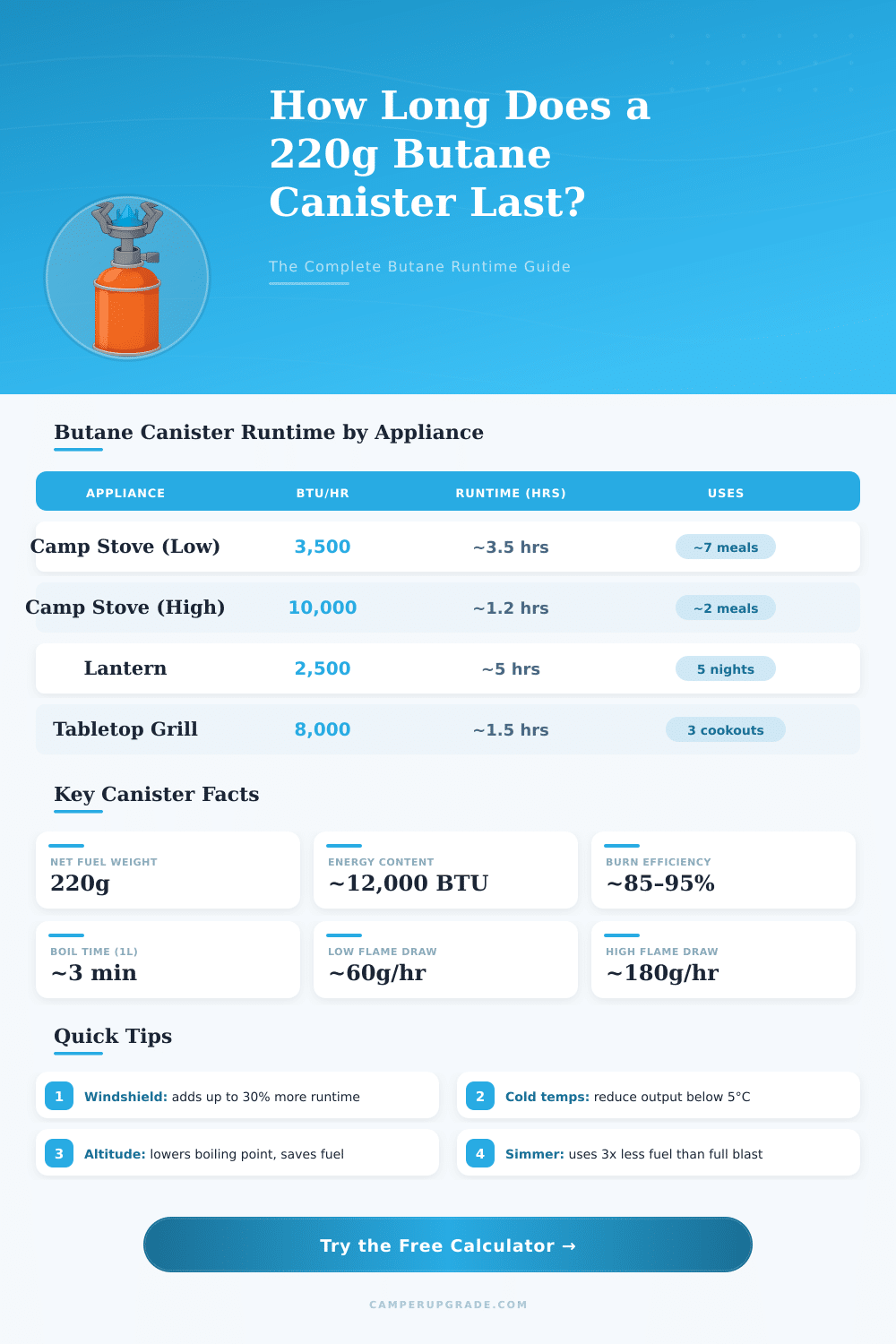
🔥 220g Butane Canister Runtime Calculator
Find out exactly how long your butane canister will last for any appliance or heat setting
| Appliance | Low Setting | Medium Setting | High Setting |
|---|---|---|---|
| Camp / Backpacking Stove | ~3.0 hrs | ~1.8 hrs | ~1.2 hrs |
| Gas Lantern | ~5.5 hrs | ~5.0 hrs | ~3.5 hrs |
| Tabletop Gas Grill | ~2.0 hrs | ~1.5 hrs | ~0.9 hrs |
| Portable Gas Heater | ~3.5 hrs | ~2.5 hrs | ~1.5 hrs |
| Camping Coffee Maker | ~4.5 hrs | ~3.0 hrs | ~2.0 hrs |
| Fondue / Hot Pot Burner | ~3.0 hrs | ~2.2 hrs | ~1.4 hrs |
| Butane Torch / Soldering | — | ~1.5 hrs | ~0.8 hrs |
| Output (Watts) | Output (BTU/hr) | Fuel Use (g/hr) | Runtime from 220g |
|---|---|---|---|
| 500W | 1,706 BTU/hr | ~38 g/hr | ~5.8 hrs |
| 1,000W | 3,412 BTU/hr | ~75 g/hr | ~2.9 hrs |
| 1,500W | 5,118 BTU/hr | ~113 g/hr | ~1.95 hrs |
| 2,000W | 6,824 BTU/hr | ~150 g/hr | ~1.47 hrs |
| 2,500W | 8,530 BTU/hr | ~188 g/hr | ~1.17 hrs |
| 3,000W | 10,236 BTU/hr | ~225 g/hr | ~0.98 hrs |
| 3,500W | 11,942 BTU/hr | ~263 g/hr | ~0.84 hrs |
| Canister Size | Fuel Weight | Energy (approx) | Runtime vs 220g |
|---|---|---|---|
| Small / Mini | 100g | ~4,550 kJ | 0.45x (45%) |
| Standard | 220g | ~10,010 kJ | 1.0x (baseline) |
| Medium | 250g | ~11,375 kJ | 1.14x |
| Large | 450g | ~20,475 kJ | 2.05x |
| XL / Jumbo | 500g | ~22,750 kJ | 2.27x |
Butane canister tins are practical fuel sources that provide energy for many kinds of portable devices. They work well for camping stoves, kitchen burners and outdoor cooking. The most used types have around 8 ounces, but you will find also various sizes between 5.6 and 8.8 ounces depending on the maker.
What sets those tins apart is their light weight and low price. So they appeal to fans of outdoor cooking and to people close to the budget. Among well-known producers mention GasOne, Coleman, Chef Master, Iwatani, Sterno and Bernzomatic.
How to Use and Store Butane Canisters Safely
Stores commonly sell them in big purchases, as 4-packages or 12-packages, and one can buy them at stores like Lowe’s or various websites.
Safety really matters when dealing with butane canister tins. Some models include a valve feeling temperature, that lowers the flame if it gets too warm or if the stove tips. Others have a system for accidnetal release.
GasOne adds a safe release tool. When you buy a matching stove, some brands advise to use tins with a push-in release valve for best results.
About good storage of butane canister tins one should not forget. They stay in cold, dry places, so that internal pressure does not grow. A good method is to store the stoves together with tins at home.
Keep only what you really will use, follow the instructions with your tins and follow local rules. There is good reason too avoid keeping them in sealed cars, especially when the heat rises. Most can handle up to around 120 degrees Fahrenheit, that deserves to mind.
Keeping four tins at hand seems normal; but storing forty, that is an entirely other matter.
One tin lasts for a whole day of camping cooking. If some cook often at home by means of a portable stove, for example veggie dishes, sausages, such foods (one tin usually lasts almost a week). Watch for deals dropping the price to about one dollar each tin, and then stockthem.
Cool weather does not mix well with butane. Under 32 degrees or colder, it does not burn well. So one mixes propane with butane in tins.
Different producers use various amounts. Here is the point: propane gives almost four times more vapor pressure than butane, so adding pure propane to a butane canister tin would be dangerous. The thin metal walls simply do not handle such force.
Butane itself is odorless, but the makers add sulfur during filling. That gives it a rotten egg smell, that helps to quickly notice leaks. Tip: burning butane indoors can create problems with carbon monoxide, so you need good airflow.