❄️ Dehydrated Food Freezer Life Calculator
Estimate how long your dehydrated food will last in the freezer by food type, packaging, and storage conditions
| Packaging Method | Shelf Life Multiplier | Oxygen Barrier | Notes |
|---|---|---|---|
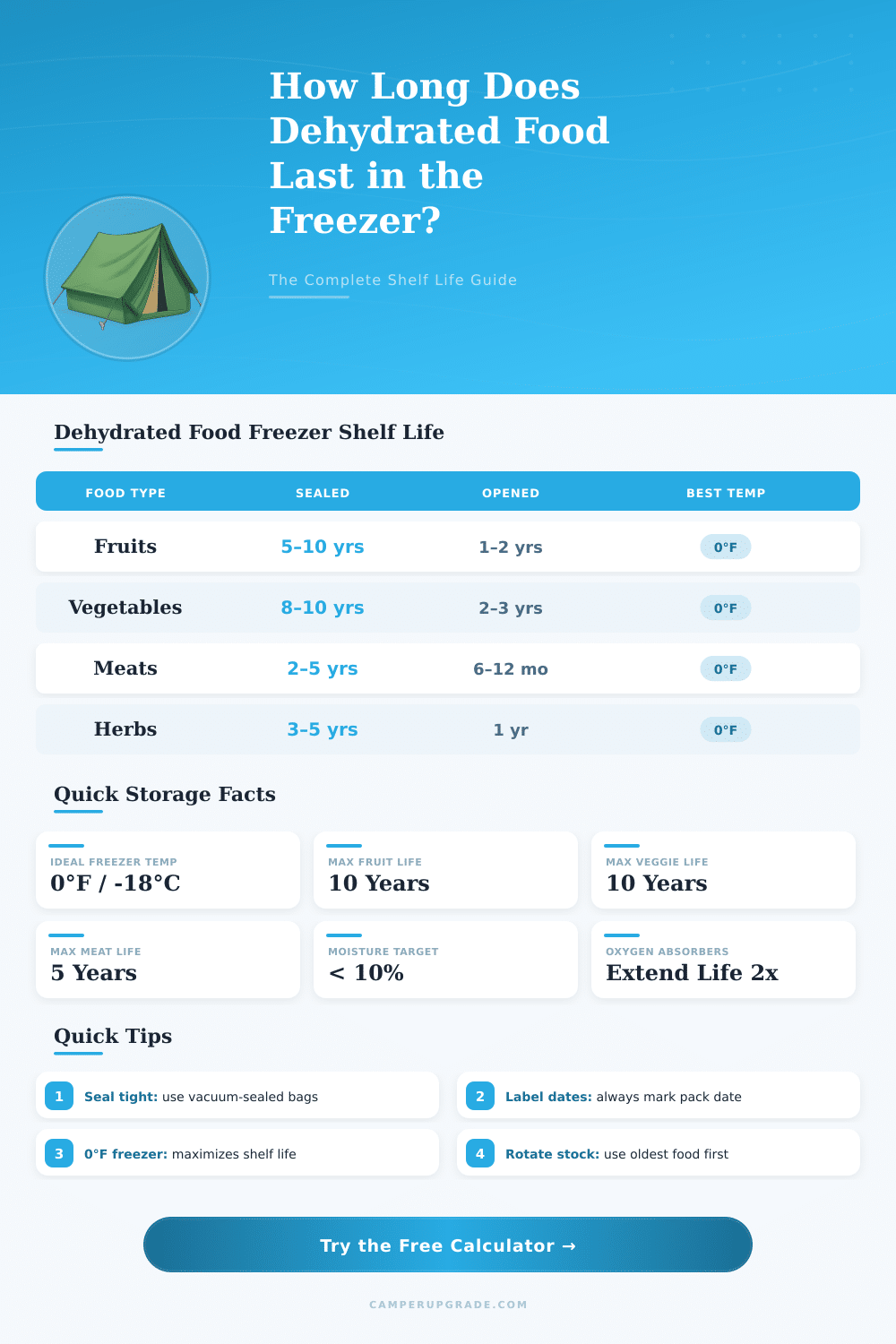
| Mylar Bag + O2 Absorber | 100% (Maximum) | Excellent | Best for long-term freezer storage |
| Vacuum-Sealed Bag | 90–100% | Very Good | Removes nearly all oxygen |
| Mason Jar (sealed) | 70–85% | Good | Rigid; no crush risk; slight air gap |
| Zip-Lock Bag | 40–60% | Poor | Air remains inside; freezer burn risk |
| Open / Loosely Covered | 10–25% | None | Not recommended; degrades rapidly |
| Temp (°F) | Temp (°C) | Shelf Life Factor | Example: Dried Fruit |
|---|---|---|---|
| 0°F | −18°C | 100% (Optimal) | Up to 10 years |
| 10°F | −12°C | 85% | Up to 8.5 years |
| 20°F | −7°C | 65% | Up to 6.5 years |
| 32°F | 0°C | 40% | Up to 4 years |
| 40°F | 4°C | 15% (Refrigerator) | Up to 18 months |
| 70°F | 21°C | 5% (Room Temp) | 6–12 months |
| Scenario | Food Type | Packaging | Est. Freezer Life |
|---|---|---|---|
| Bug-out bag prep | Mixed vegetables | Mylar + O2 | 8–10 years |
| Camping meal prep | Dehydrated meals | Vacuum-sealed | 2–3 years |
| Snack storage | Dried mango/berries | Zip-lock | 1–2 years |
| Hunting/RV jerky | Beef jerky | Vacuum-sealed | 2–5 years |
| Herb garden surplus | Dried herbs | Mason jar | 2–4 years |
| Emergency dairy | Powdered milk | Mylar + O2 | 3–5 years |
At the core, dehydration simply removes almost all water from foods. The main idea is remove the moisture this quickly that bacteria can not attach and decay. Interesting fact is, that most fruits and vegetables store around 80 to 95 percent of water.
Meat and cooked grains have about 70 percent. When the water goes, the other nutrients stay almost unchanged: proteins, fats, sugars, fibers, vitamins, minerals. That really matters for food value.
How Drying Food Keeps It Safe and Healthy
Folks commonly care, whether dry food loses its nutritious value. The truth? dehydrated food keeps almost the same nutritious profile as the fresh.
Slow drying process pulls the water, while it keeps those natural nutrients locked in their place. Even so, some elements miss, especially vitamins, C and riboflavin suffer the most. Water-soluble vitamins are most weak during dirying.
The good news: dehydration indeed saves more nutrients than many other preservation methods.
There is not only one way to dehydrate food. A home food dryer does that easy and efficient. Also oven drying works well, same as making of fruit leather in low temperatures.
It helps to cut everything in equal bits, so that the drying happen the same across the whole. Working with fruits, dip it in lemon juice mixed with water, to stop browning on its surface. In industry, big companies make tons of dehydrated food.
They apply spray drying, one turns the product in fine mist and blow it with warm air, to remove the moisture right away, leaving dry powder.
Why dehydrated food shine for tents and hiking? It saves wait, simply and clearly. Any water weight must go, so a day hiker needs only a small burner and one jar.
The cooking at tents is almost laughably simple (mix the dry food), add water, boil a bit of time, and eat. Fresh idea: grind the dried food in dust after drying, to mix it with cold water. Homemade dry food tastes much better than store versions, and it does not drain your purse.
The real advantage of dehydration is the most value for your money. It gives more food for less weight and the lowest price. Freezer-dried options maybe offer more calories each gram, but they cost widely.
Folks dehydrate everything possible, apples, pasta sauce, ground beef, beans, all leftover vegetables. Mixing bread crumbs in hamburger, one stops it from becoming brick during drying. Dehydrated food last forever and do not waste on you.
Even so, recall, that it should not be your everyday meal (your body needs water-rich foods), that are more easily to digest. Want to know, whether old dry food is still edible? Search for moisture first.
Later sniff it. If it smells fine and nothing looksweird or bad, it almost certainly is safe to eat.