🪵 Pine Firewood Drying Time Calculator
Estimate how long your pine firewood needs to season based on split size, climate & storage method
Hot & Dry
Temperate
Humid
Cold & Wet
Moisture
Moisture
Width
Gap
| Pine Species | Green Moisture | Density (dry) | Typical Dry Time | Notes |
|---|---|---|---|---|
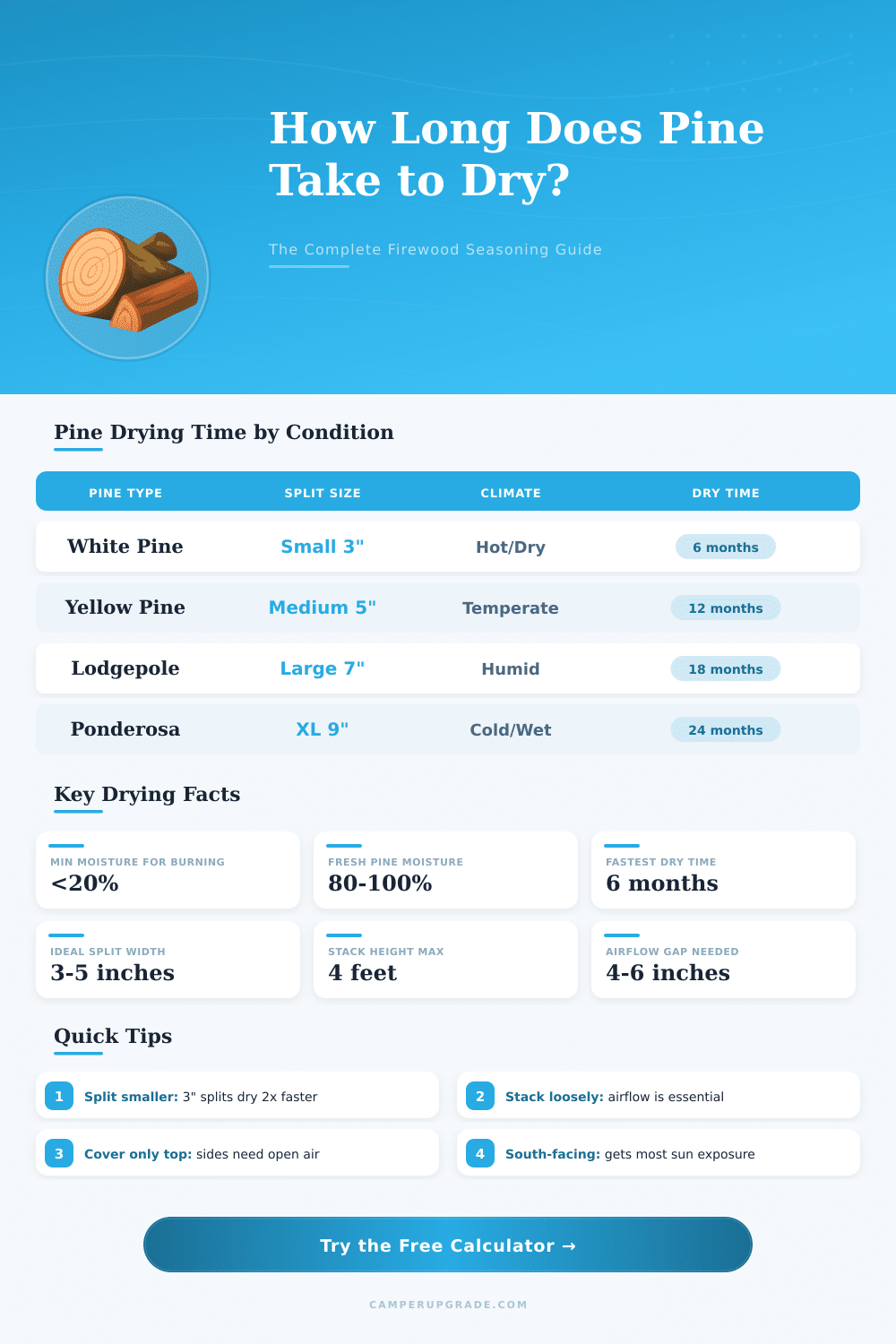
| White Pine (Eastern) | 80–100% | 22–24 lbs/ft³ | 6–12 months | Low density, dries fastest |
| Yellow Pine (Southern) | 90–110% | 34–37 lbs/ft³ | 12–18 months | High resin – slower drying |
| Lodgepole Pine | 80–95% | 26–29 lbs/ft³ | 9–15 months | Moderate density |
| Ponderosa Pine | 85–100% | 26–28 lbs/ft³ | 10–16 months | Common in western US |
| Scots Pine | 90–105% | 30–33 lbs/ft³ | 12–20 months | High resin content |
| Eastern White Pine | 75–90% | 22–24 lbs/ft³ | 6–10 months | Lightest common pine |
| Jack Pine | 80–100% | 28–31 lbs/ft³ | 10–16 months | Northern climate species |
| Radiata Pine | 85–100% | 26–29 lbs/ft³ | 10–15 months | Common in Southern Hemisphere |
| Split Width | Width (metric) | Dry Time Multiplier | Example (temperate, covered) |
|---|---|---|---|
| Small (2–4 in) | 5–10 cm | 0.6x (faster) | ~7 months |
| Medium (4–6 in) | 10–15 cm | 1.0x (baseline) | ~12 months |
| Large (6–8 in) | 15–20 cm | 1.4x (slower) | ~17 months |
| Extra Large (8–10 in) | 20–25 cm | 1.8x (much slower) | ~22 months |
| Unsplit Round (10+ in) | 25+ cm | 2.5x+ (very slow) | ~30+ months |
| Climate Type | Typical Region | Drying Factor | Extra Time vs. Baseline |
|---|---|---|---|
| Hot & Dry | SW USA, Mediterranean | 0.65x (fastest) | –35% time |
| Temperate | Midwest USA, UK | 1.0x (baseline) | Baseline |
| Humid | SE USA, Pacific NW | 1.4x (slower) | +40% time |
| Cold & Wet | NE USA, Canada, N.Europe | 1.8x (slowest) | +80% time |
| Storage Method | Airflow | Drying Factor | Notes |
|---|---|---|---|
| Open Stack (no cover) | Excellent | 0.9x (slightly faster) | Risk of rain rewetting |
| Covered Stack (top only) | Good | 1.0x (baseline) | Best balance – recommended |
| Shed / Indoor | Moderate | 0.85x (faster) | Consistent, less humidity swing |
| Ground Pile (no airflow) | Poor | 1.9x (much slower) | Risk of rot, avoid if possible |
Pine are the most common conifer trees globally. They grow tall with elegant shapes and needles that have a pleasant scent. They look surprising in nature and offer one of the most available kinds of Firewood.
Imagine a popping fire on a cool night, where the sweet smell of burning Pine fills the area. Here is the charm of Pine Firewood.
Using Pine for Firewood
There are big myths, that Pine never works for burning as wood for home. For many years folks heard, that burning Pine can destroy a whole house. In reality, that is almost all wrong.
Pine entirely can serve as Firewood. The main point to recall is, that Pine belongs to softwood, that simply is a conifer, while the hardwoods come from trees that drop leaves. Because they have different structures in the cells, here exists the main confuison.
Pine carries a lot of resin. While burning, it delivers flame, that brings creosote to the walls of the chimney. Basically, Pine generates tar and creosote, but it does not always burn quite strongly enough to clear that from the chimney.
Like this it builds up on the walls over time. Even so, if the chimney gets proper care and one mixes in a bit of hardwood, there should not be important troubles. Folks used almost only Pine for fifteen years, and there home with chimney stayed entirely in order.
Pine burns strongly and quickly. It flares alright and works well as starter wood. Because of its fast burning, it gives less energy than hardwood, so double the amount of Pine is needed for the same fire.
It works surprisingly for light. Also it works well for camping. White Pine wood gives a nice scent similar to vanilla during burning, what makes it ideal for morning use in a wood stove or for open campfires.
It is hard to dry Pine well. It requires nine to twelve months to mature, depending on the region. Half-prepared Pine mixes dry and green parts, and the thick bits maybe require several more weeks to finish drying.
Burning unprepared Pine indoors is not advised because of the buildup of creosote. But used outside, well dried Pine is entirely fine.
One thing to notice is, that Pine can pop and crack while burning. That risks casting sparks away from the fire. In many places, one sells Pine only in self-burning packages of Firewood, because it is that much common and costs less than hardwood.
Most folks, that prepare their own wood, find plenty of Pine and fir in the woods. In certain areas, big zones have dried Pine, killed by Pine beetles, what gives easily found Firewood. The American Forest Service delivers similar permits foronly-Pine cutting, that allows folks to enjoy a cord of dead and falling Pine.