🔥 Kamado Joe Charcoal Duration Calculator
Estimate how long your charcoal will last based on fill level, cook temperature, and charcoal type
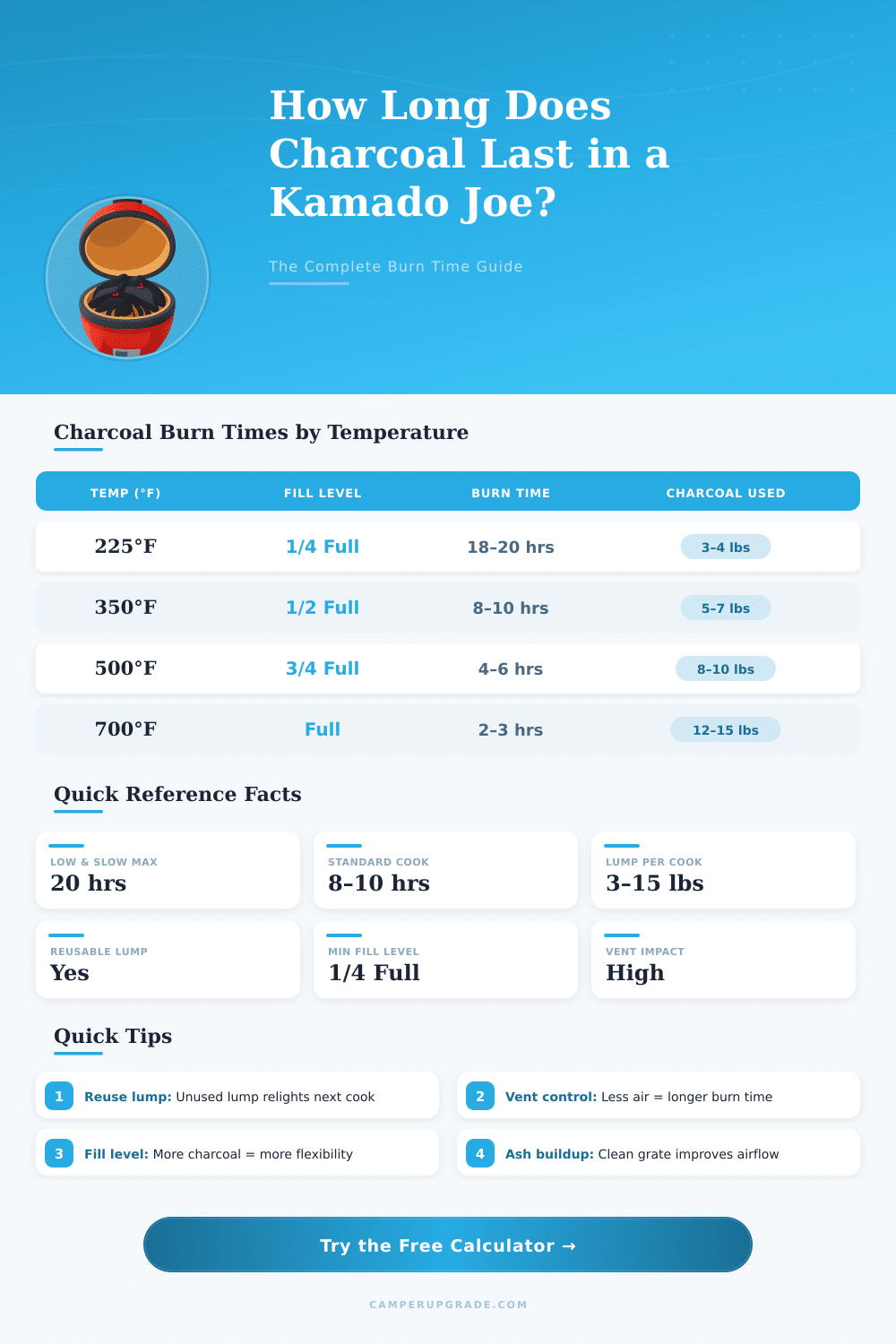
| Temperature | Fill Level | Approx. Burn Time | Charcoal Used (lbs) | Charcoal Used (kg) |
|---|---|---|---|---|
| 225°F (107°C) | 1/4 Full | 14–18 hrs | 3–4 lbs | 1.4–1.8 kg |
| 225°F (107°C) | 1/2 Full | 18–20 hrs | 4–6 lbs | 1.8–2.7 kg |
| 250°F (121°C) | 1/2 Full | 15–18 hrs | 5–7 lbs | 2.3–3.2 kg |
| 275°F (135°C) | 1/2 Full | 12–15 hrs | 5–8 lbs | 2.3–3.6 kg |
| 350°F (177°C) | 1/2 Full | 8–10 hrs | 5–7 lbs | 2.3–3.2 kg |
| 400°F (204°C) | 3/4 Full | 6–8 hrs | 7–10 lbs | 3.2–4.5 kg |
| 500°F (260°C) | 3/4 Full | 4–6 hrs | 8–12 lbs | 3.6–5.4 kg |
| 650°F (343°C) | Full | 2–4 hrs | 10–14 lbs | 4.5–6.4 kg |
| 700°F+ (371°C+) | Full | 1–3 hrs | 12–15 lbs | 5.4–6.8 kg |
| Model | Grill Diameter | Full Load (lbs) | Full Load (kg) | Max Temp |
|---|---|---|---|---|
| Joe Jr | 13.5 in (34 cm) | ~8 lbs | ~3.6 kg | 750°F (399°C) |
| Classic I | 18 in (46 cm) | ~12 lbs | ~5.4 kg | 750°F (399°C) |
| Classic II / III | 18 in (46 cm) | ~15 lbs | ~6.8 kg | 750°F (399°C) |
| Big Joe I / II / III | 24 in (61 cm) | ~25 lbs | ~11.3 kg | 750°F (399°C) |
| Vent Setting | Approx. Open % | Temp Range | Burn Time Impact |
|---|---|---|---|
| Nearly Closed | ~5% | 175–225°F | Maximum (longest burn) |
| 1/8 Open (Low) | ~12% | 225–300°F | +15–25% vs medium |
| 1/4 Open (Medium) | ~25% | 300–450°F | Baseline |
| 1/2 Open (High) | ~50% | 450–600°F | –20–35% vs medium |
| Wide Open | 100% | 600–750°F+ | –50–70% vs medium |
Unlike briquettes, unburned lump charcoal can be relit for your next cook. After a session, close all vents completely to snuff the fire. The remaining lump is fully reusable, saving you charcoal over time. Always shake ash from old lump before relighting.
Kamado Joe grills are highly insulated, which dramatically reduces charcoal consumption compared to open grills. At 225°F, a Classic III can run 18–20 hours on a full load. Keep the lid closed as much as possible — every opening adds 10–15 minutes of recovery time and increases charcoal usage by 5–10%.
When you heat wood or other natural materials with very little oxygen, you get Charcoal, lightweight, jet-black carbon residue. During that process you basically push out water and volatile substances, and what stays is almost pure carbon. Think of it as wood that was almost fully “cooked”: the whole moisture and chemical mess goes which explains why it looks like the blackened bits of a campfire.
Here is a fact that commonly surprises folks: Charcoal and fossil coal are absolutely not the same. Coal is a natural fossil fuel from underground, formed over millions of years by geological processes. Charcoal rather, is homemade and comes from wood through controlled heating.
What Charcoal Is and How It Works
One is a mineral, the other is not.
Truly interesting is that Charcoal burns much more effectively. By weight, it has roughly double the energy density of average wood. Also the burning happens more “cleanly”, so it reaches higher temperatures.
We talk about around 33 kilojoules per gram for Charcoal against roughly 17 for wood… Quite a big difference. Moreover, the porous structure of Charcoal means that it can absorb dirt, so it has use beyond just fuel.
When dealing with barbecue, you have some options. Briquettes are the “factory made” version, basic Charcoal packed with binders, for instance sawdust and wood chips. They are cheaper and usually burn more evenly.
Lump Charcoal is another option: it burns hotter than briquettes, but commonly does not last as long, and the heat can be less steady. The advantage is purer smoke from the grill without extra ingredients.
You will also find Charcoal made from various wood types. Some brands use extra-dense fruit tree wood form Thailand, that burns noticeably longer and hotter, while it produces minimal ash and smoke. No spitting, no irritation, only steady heat with subtle taste that will not overwhelm your meal.
Other brands are known for how quickly they light, for their lasting power and for the real smoky taste that they give to the food.
Airflow plays a huge role in how Charcoal works. A cheap grill with badly designed air vents can totally ruin your cook. A chimney starter with fire lighter cubes works well to light the Charcoal without lighter fluid.
Briquettes also work for campfire cooking, when open flames are outside the allowed limits. Cooking with wood fire requires more patience, because temperature control gets tricky until you build a solid bed of embers below.
The color of Charcoal is not truly black, it is deep dark gray that only looks black in weak light. About activated Charcoal toothpaste people commonly talk as a way too remove surface marks on teeth, but average toothpastes handle that totally well. It will not bleach yourteeth beyond removing surface stains, despite what the marketing suggests.