🏕 RV Boondocking Duration Calculator
Enter your RV's tank sizes, battery capacity & daily usage to find exactly how long you can stay off-grid.
| Activity | Gal / Person / Day | Liters / Person / Day | Conservation Tip |
|---|---|---|---|
| Regular shower (5 min) | 10–12 | 38–45 | Switch to navy shower |
| Navy shower (wet/soap/rinse) | 1–2 | 4–8 | Best water saver |
| Cooking & drinking | 1–2 | 4–8 | Use bottled drinking water |
| Dishes (handwash) | 1–3 | 4–11 | Use a basin, not running water |
| Toilet flushing | 1–2 | 4–8 | "If it's yellow, var it mellow" |
| Teeth brushing / handwashing | 0.5–1 | 2–4 | Turn off tap while brushing |
| Typical boondocker total | 5–8 | 19–30 | Goal for extended stays |
| Appliance / System | Watts | Hours / Day | Daily Ah (12V) |
|---|---|---|---|
| LED lighting (full rig) | 30–60 | 4–6 | 10–30 |
| Residential refrigerator | 100–150 | 24 (cycles) | 60–100 |
| 12V compressor fridge | 40–60 | 24 (cycles) | 30–50 |
| Water pump | 50–100 | 0.5–1 | 2–8 |
| Phone / laptop charging | 60–100 | 2–4 | 10–33 |
| TV / entertainment | 40–80 | 2–4 | 7–27 |
| Fan / ventilation | 20–50 | 6–12 | 10–50 |
| Roof AC (if inverter) | 1000–1500 | 2–4 | 170–500 |
| Panel Array | Daily Ah (4 sun hrs) | Daily Ah (5 sun hrs) | Daily Ah (6 sun hrs) |
|---|---|---|---|
| 100W | ~27 Ah | ~33 Ah | ~40 Ah |
| 200W | ~53 Ah | ~67 Ah | ~80 Ah |
| 400W | ~107 Ah | ~133 Ah | ~160 Ah |
| 600W | ~160 Ah | ~200 Ah | ~240 Ah |
| 800W | ~213 Ah | ~267 Ah | ~320 Ah |
| 1000W | ~267 Ah | ~333 Ah | ~400 Ah |
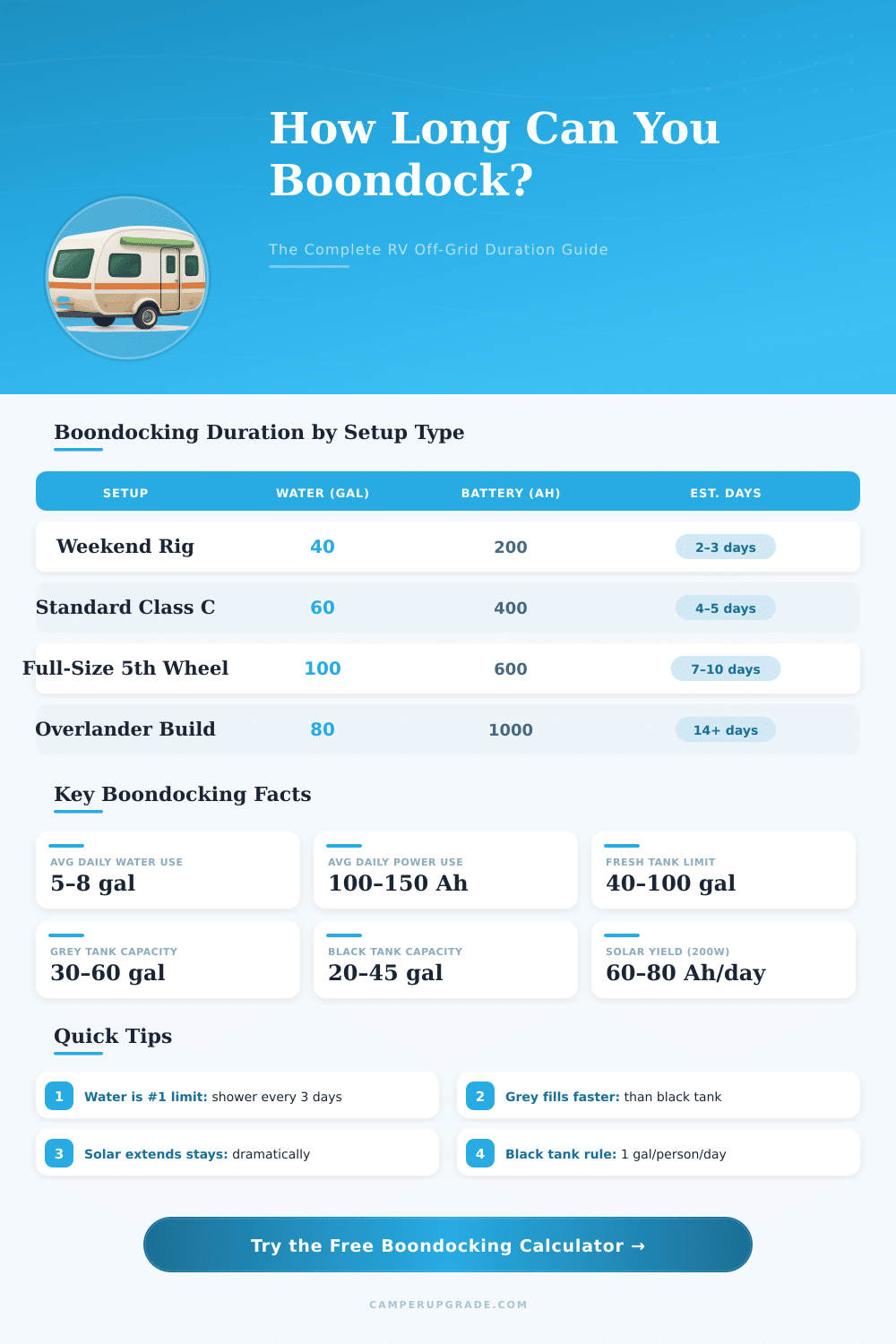
| RV Type | Fresh Tank | Battery Bank | Solar | Est. Duration (2 people) |
|---|---|---|---|---|
| Van / Class B | 30–40 gal | 200 Ah | 200W | 2–4 days |
| Class C (no solar) | 60 gal | 200 Ah (stock) | None | 3–5 days |
| Class C (upgraded) | 60 gal | 400 Ah LiFePO4 | 400W | 5–8 days |
| 5th Wheel couple | 80 gal | 400 Ah | 400W | 7–10 days |
| Full-size Class A | 100 gal | 600 Ah | 600W | 7–14 days |
| Overlander build | 80 gal | 1000 Ah LiFePO4 | 800W | 14–30 days |
Boondocking with an RV means to travel off-road and camp without any hookups for electricity, water or sewage. Sometimes people call it “dry camping” or even “free camping“. No official definition has full agreement, but the basic idea stays the same: parking or staying somewhere without any services.
So everything needed comes directly from the built-in systems of your RV for water, power and waste.
How to Boondock in an RV
There are a lot of ways for Boondocking. Some folks simply park in store parking lots for the night. Others prefer to go to public lands, like BLM grounds or national forests.
In such public areas everything becomes fairly easy. You simply drive down a side road until you find flat ground, and if there are no signs against camping, then everything is fine. Especially the privacy and vast open views is what brings calm to many RV users.
Boondocking helps to save a lot of money during long road trips. You do not need reservations, and you have freedom to go almost anywhere, which eases the planning of routes. That really matters.
Besides the money advantage, camping without comforts eases the pressure of too full RV parks and paid campgrounds… Something that states and local authorities actively support.
Before choosing a new place, it matters to check reviews more than one thinks. Look at what others say about soil thickness, upper branches and rough dirt roads. If your instinct says that your vehicle will not handle it, trust that and keep searching.
Shorter trailers handle tight ways better than long ones. Some things to think about: ground thickness, height, size and wait of your gear, amount of energy used, battery capacity, type of charging and size of water tank. Really, less big rigs simply work more effectively in such conditions.
Apps like Campendium and iOverlander serve as popular tools for finding Boondocking places and reading posts from others. Campendium focuses on RV camping, so the listed spots commonly work for bigger vehicles. Using both apps for cross-checking is a wise step.
There is also a paid membership called Boondockers Welcome, that costs around fifty dollars yearly. It gives access to more then two thousand places, where owners of private properties allow RV users to stay free for at least one night. Those hosts usually have wide driveways or good areas for parking.
Some of them invite travelers with an RV to camp together, share experiences and cut costs during the adventure.
The gray water tank commonly limits the time for how long you actually can stay. It most commonly fills up first, honestly. Then you must either dump it in a portable container or leave the campsite to find a station for waste.
Buying food in stores before leaving helps to prepare meals without quickly ending your supplies. You can also dump trash before arrival, so less waste sits around. A portable solar panel together with a small generator works as reliable backup for charging during the stay.
Testing everythingat home before is the only good way to guess how much time your batteries and water will last.