🔋 RV Battery Charging Time Calculator
Calculate exactly how long to charge your RV battery when plugged into shore power or a converter
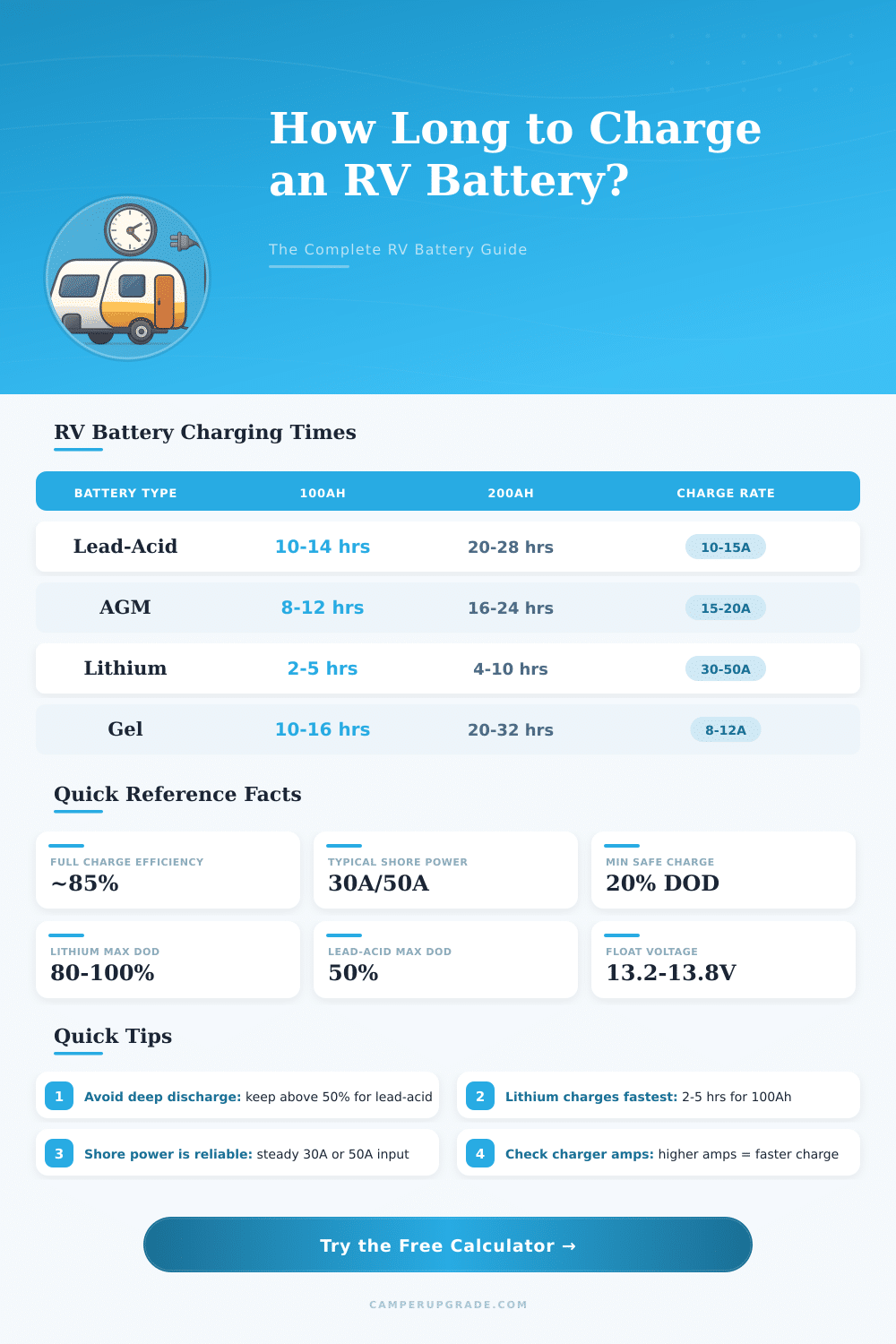
| Battery Type | 50Ah Full | 100Ah Full | 200Ah Full | Efficiency | Max DOD |
|---|---|---|---|---|---|
| Flooded Lead-Acid | 5–8 hrs | 10–14 hrs | 20–28 hrs | 70–80% | 50% |
| AGM | 4–6 hrs | 8–12 hrs | 16–24 hrs | 80–85% | 80% |
| Gel Cell | 5–8 hrs | 10–16 hrs | 20–32 hrs | 75–80% | 50% |
| Lithium LiFePO4 | 1–2.5 hrs | 2–5 hrs | 4–10 hrs | 95–99% | 80–100% |
| Lithium-Ion | 1.5–3 hrs | 3–6 hrs | 6–12 hrs | 90–95% | 80% |
| NiCad | 6–10 hrs | 12–20 hrs | 24–40 hrs | 70–75% | 60% |
| Shore Power | Converter Output | Charger Output | 100Ah Charge Time | 200Ah Charge Time |
|---|---|---|---|---|
| 30 Amp Service | 45–55A DC | 10–45A | 3–12 hrs | 6–24 hrs |
| 50 Amp Service | 55–80A DC | 20–80A | 1.5–6 hrs | 3–12 hrs |
| 15 Amp (120V) | 20–30A DC | 8–20A | 6–14 hrs | 12–28 hrs |
| Converter Only | 8–15A DC | 8–15A | 8–15 hrs | 16–30 hrs |
| Configuration | Total Capacity | Usable (Lead-Acid) | Usable (Lithium) | Est. Charge Time @ 20A |
|---|---|---|---|---|
| 1x 100Ah | 100 Ah | 50 Ah | 80–100 Ah | 5–8 hrs |
| 2x 6V 225Ah (Series) | 225 Ah | 112 Ah | N/A | 11–17 hrs |
| 2x 100Ah (Parallel) | 200 Ah | 100 Ah | 160–200 Ah | 10–16 hrs |
| 4x 6V 225Ah (2S2P) | 450 Ah | 225 Ah | N/A | 22–34 hrs |
| 2x 200Ah Lithium | 400 Ah | N/A | 320–400 Ah | 8–14 hrs |
Charge the batteries of RV during maintenance is one of those topics that seems easy, but can become complex quickly. The converter works as the main device for the circuit in almost all RVs. It receives 120V AC energy from a shore source or generators and converts it to 12V DC energy.
That DC energy then charges the batteries and feeds the electronics on board. Every RV is equipped with a converter charger, because the DC system depends on it, when the vehicle is connected to electricity. One finds those converters usually in storage boxes or occasionally built into the center of 12V distribution.
How to Charge RV Batteries
Check for warm spots beside the charging center when you connect, because here it probably sits.
For charging by means of shore energy, you must tie the RV to a 120V AC outlet in a campground. The built-in converter then changes that AC energy into DC form. Use a RV Battery monitor to help control the state of the circuit and prevent overcharging.
Disconnect, when the batteries are fully filled. The converter uses around five to ten amps from the energy, and any usual home outlet handles it well.
Now, the 30-amp or 50-amp hookups in campgrounds do not serve only for charging batteries. Those services with higher amps are needed for running air conditioning and other big devices. RVs do not depend on their batteries for such heavy loads.
Lithium batteries, especially LiFePO4 type, charge up to five times more quickly than lead-acid. A DC-to-DC charger, for instance from Renogy, can boost the voltage level of the alternator too that, what is needed for RV batteries, like 14.4 volts for lithium. There are three main ways to charge lithium batteries in an RV: solar, DC-to-DC charger, or converter charger by means of shore power or generator.
For AGM batteries, the first charge voltage should reach around 14.4 to 15.0 volts, then one passes to float charge at 13.5 to 13.8 volts. Flooded batteries, another common kind, are filled with liquid from diluted sulfuric acid. When the current reaches the RV Battery, the acid reacts with the lead plates and creates electrons.
The house battery powers devices like refrigerator, television and lights. The start battery helps start the engine by means of big flows. Many batteries can get damaged, if one leaves them empty under 50 percent.
Charge them again after reaching that 50 percent limit to extend there use.
Solar panels connect to a charge controller, that then ties to the house battery. The controller delivers a higher voltage level than the normal internal voltage of the battery, to push the current inside. A 160-watt portable folding panel can fill a group of 24-amp-hour battery on a nice solar day.
For storage, use a disconnect switch, that keeps the battery separate from drainage, when the RV standsidle. Disconnect the ground of the batteries after parking is an easy method to escape draining. Batteries should be fully charged before winter storage and stay filled during the whole season.