🔥 20 lb Propane Tank Runtime Calculator
Calculate exactly how long your propane tank will last for any appliance or use case
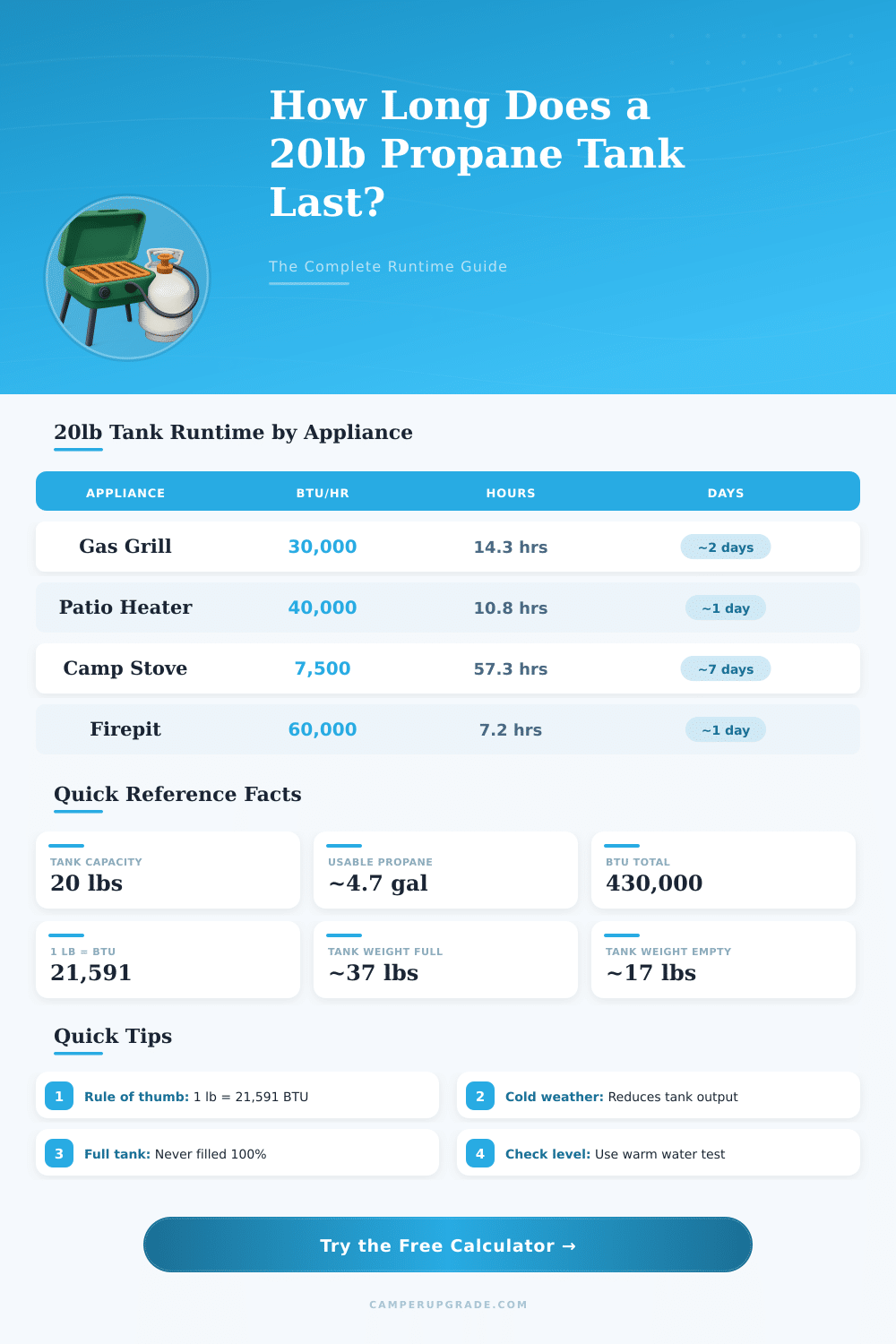
| Appliance | BTU/hr | Total Hours (Full) | At 1 hr/day | At 2 hrs/day | kW Rating |
|---|---|---|---|---|---|
| Gas Grill | 30,000 | 14.3 hrs | ~14 days | ~7 days | 8.8 kW |
| Patio Heater | 40,000 | 10.8 hrs | ~11 days | ~5 days | 11.7 kW |
| Camp Stove | 7,500 | 57.6 hrs | ~57 days | ~29 days | 2.2 kW |
| RV Furnace | 20,000 | 21.6 hrs | ~22 days | ~11 days | 5.9 kW |
| Propane Fire Pit | 60,000 | 7.2 hrs | ~7 days | ~4 days | 17.6 kW |
| RV Water Heater | 10,000 | 43.2 hrs | ~43 days | ~22 days | 2.9 kW |
| Propane Generator | 50,000 | 8.6 hrs | ~9 days | ~4 days | 14.7 kW |
| Camp Lantern | 1,500 | 288 hrs | ~288 days | ~144 days | 0.44 kW |
| RV Stove Burner | 9,000 | 48.0 hrs | ~48 days | ~24 days | 2.6 kW |
| Tank Size | Propane (lbs) | Gallons | Total BTU | kWh Equiv. | Common Use |
|---|---|---|---|---|---|
| 1 lb Cylinder | 1 lb | 0.24 gal | 21,591 | 6.3 kWh | Camping lanterns |
| 5 lb Tank | 5 lbs | 1.2 gal | 107,955 | 31.6 kWh | Small camp stoves |
| 11 lb Tank | 11 lbs | 2.6 gal | 237,501 | 69.6 kWh | Portable grills |
| 20 lb Tank | 20 lbs | 4.7 gal | 431,820 | 126.5 kWh | Gas grills, RV |
| 30 lb Tank | 30 lbs | 7.1 gal | 647,730 | 189.8 kWh | RV, heaters |
| 40 lb Tank | 40 lbs | 9.4 gal | 863,640 | 253.0 kWh | Large heaters |
| 100 lb Tank | 100 lbs | 23.6 gal | 2,159,100 | 632.6 kWh | Permanent install |
| Measurement | Imperial Value | Metric Value | Notes |
|---|---|---|---|
| 1 lb of propane | 21,591 BTU | 6.33 kWh | Energy content |
| 1 gallon of propane | 91,502 BTU | 26.8 kWh | Liquid propane |
| 1 lb propane = gallons | 0.236 gallons | 0.893 liters | Liquid volume |
| 20 lb tank total BTU | 431,820 BTU | 126.5 kWh | At 100% fill |
| Tank fill limit | 80% max | 80% max | Safety regulation |
| 20 lb tank empty weight | ~17 lbs | ~7.7 kg | Tare weight |
| 20 lb tank full weight | ~37 lbs | ~16.8 kg | Total weight |
Propane forms one of the key parts for any travel vehicle. It heats the oven, runs it, gives energy to the fridge and provides warm water for showering and washing. Without that gas several everyday tasks in such vehicle would become a real challenge.
Even those travel vehicles, that do not show visible tanks, usually hide them under the body of the vehicle.
Using Propane in Travel Vehicles
A great benefit of propane compared to electricity is, that it works everywhere. One can use it at a campsite or in the middle of nowhere. That makes it practical, whether it serves as a main energy source or simply as a backup.
Two main kinds of tanks for propane in travel vehicles exist: portable cylinders and fixed tanks. Towed travel vehicles widely use a different style than motorhomes. Cylinders by transport rules, that one uses in travel vehicles, must carry a device against overflow.
Fixed tanks, that stay flat tied to the travel vehicle, require, that one drive or drag it to a special place for filling. Tanks in motorhomes belong to ASME-type and do not require rechecking. Portable cylinders by those standards on the other hand require rechecking ten years after the date of production and later every five years.
One must carry them straight up with the valve below and remove them form the travel vehicle for refill.
Propane boils at forty-four degrees Fahrenheit at sea level. Butane boils at thirty degrees. Here is the reason, why propane is preferred as fuel for travel vehicles.
Filling the propane tank up is quite an easy task. Full-service campsites, special stores of propane, places like Tractor Supply, U-Haul and even some gas stations offer such services. Costco commonly offers cheap propane.
Flying J suits during travel, but it costs a bit more. The prices change a lot by region. In some areas one pays around one dollar and fifty cents per gallon, while in others it passes three dollars.
Swaps of tanks are practical, but they commonly deliver only fifteen pounds of propane, so one gets a better deal by means of direct refill by gallon.
Fridges in travel vehicles commonly work by means of an absorbing system, that burns propane instead of draining the battery. Some owners of such vehicles replace old absorbing models with twelve-volt versions because of worries about fire risk. Propane can also run generators and use portable heaters, that are popular during camping in times of bans on open fires, because they do not produce smoke ore ash.
Safety is very important with propane. It weighs more than air, so gas can collect below. Carbon monoxide from propane is especially dangerous.
Commonly one must check the tanks, tubes and links. Small leaks at quick connectors or startup parts are not rare. Installing detectors for safety and caring about their good state helps to escape dangers.
If the travel vehicle stays idle along time, just turn off the gas valve.