🥾 Hiking Time Calculator
Estimate your hike duration using Naismith's Rule & Tobler's Function — supports km & miles
| Distance (km) | Elevation Gain (m) | Est. Time (Avg Hiker) | Est. Time (Fit Hiker) |
|---|---|---|---|
| 5 km | 100 m | 1h 20min | 1h 05min |
| 5 km | 300 m | 1h 50min | 1h 25min |
| 10 km | 200 m | 2h 40min | 2h 05min |
| 10 km | 500 m | 3h 20min | 2h 40min |
| 15 km | 400 m | 4h 15min | 3h 20min |
| 20 km | 600 m | 5h 45min | 4h 30min |
| 25 km | 800 m | 7h 15min | 5h 45min |
| 30 km | 1000 m | 8h 50min | 6h 55min |
| Kilometers | Miles | Avg Walk Time | Pace (min/km) |
|---|---|---|---|
| 1 km | 0.62 mi | 12–15 min | 12–15 min |
| 3 km | 1.86 mi | 36–45 min | 12–15 min |
| 5 km | 3.11 mi | 1h – 1h 15min | 12–15 min |
| 10 km | 6.21 mi | 2h – 2h 30min | 12–15 min |
| 16 km | 9.94 mi | 3h 15min – 4h | 12–15 min |
| 21 km | 13.05 mi | 4h 15min – 5h 15min | 12–15 min |
| 30 km | 18.64 mi | 6h – 7h 30min | 12–15 min |
| 42 km | 26.10 mi | 8h 25min – 10h 30min | 12–15 min |
| Pack Weight | Speed Reduction | Pace Modifier | Notes |
|---|---|---|---|
| No pack | 0% | × 1.00 | Base speed |
| Under 5 kg | ~5% | × 0.95 | Light daypack |
| 5–10 kg | ~10% | × 0.90 | Full daypack |
| 10–15 kg | ~18% | × 0.82 | Overnight pack |
| 15+ kg | ~25% | × 0.75 | Multi-day expedition |
Count how many time a trek requires is one of the most practical causes to learn before moving on the feeling. There are several different modes to estimate the time for a rise and each from them works a bit differently.
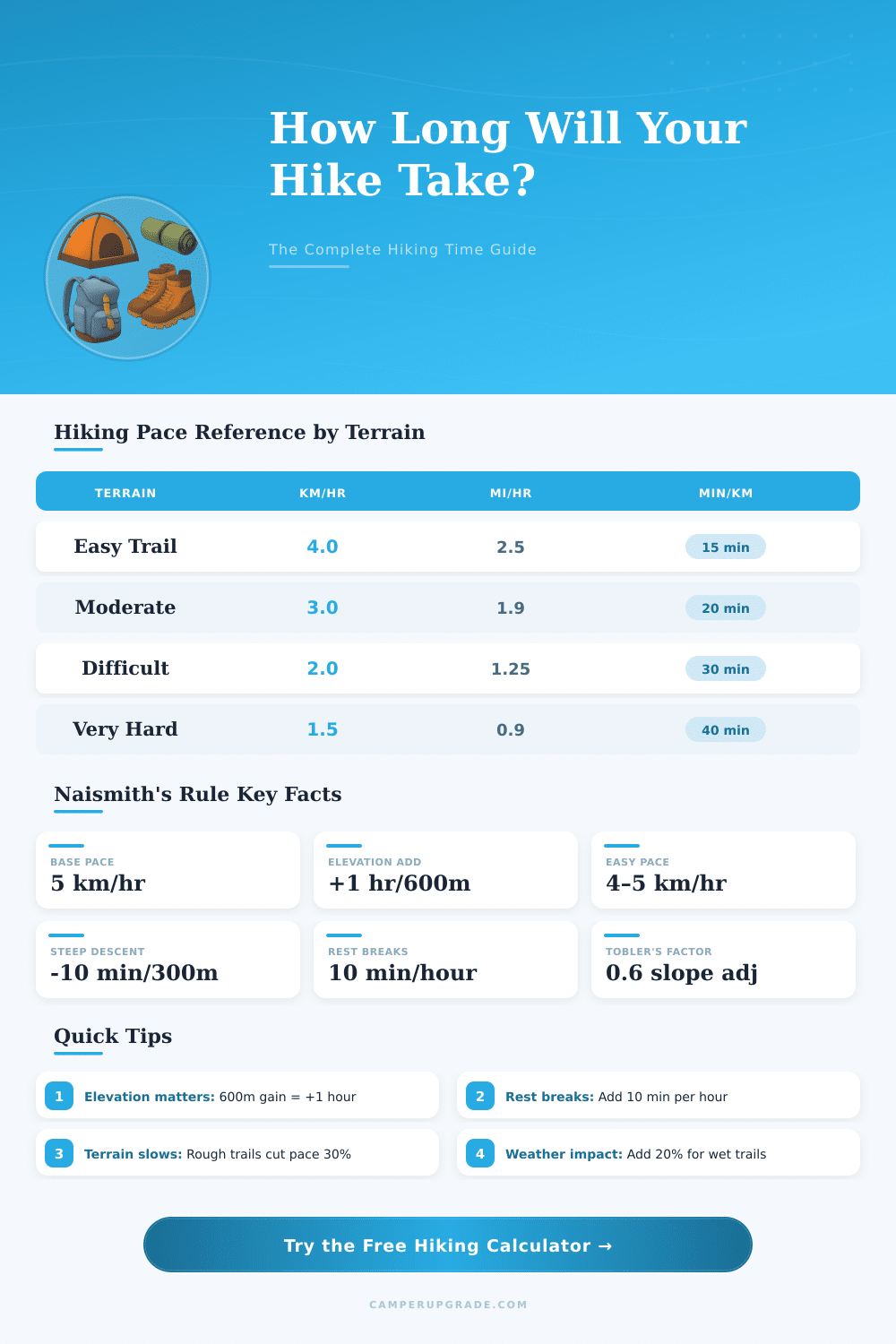
The most ancient of those methods is the Rule of Naismith. A Scottish hiker called William W. Naismith created it in 1892. The idea itself is very basic.
How to Work Out Hiking Time
It means to prepare a hiking trip by means of rating of the travel time, with extra time for the difficult hiking. The math is this: one shares the flat length in miles by three, later add the rise in feet divided by two thousand. For instance, a six-mile way with two thousand feet of height gain should involve around three hours, two for the distance and one for the hiking.
Another mode one calls Libran Time. It gives thirty minutes each mile, also thirty minutes for every thousand feet of rise, and one rounds to the most nearby five minutes. That method works well for mountain trails and rocky full paths.
There is also a free program called HikeClock, that mixes some rules, also the Rule of Naismith, Libran Time, the function of Tobler together with fixes of Langmuir and Tranter. It gives more real ranges of time for treks. Some calculators for hikes think also about the walking speed on flat ground, difficult rises, sloping steps and rough areas.
Such tools usually point fast and slow time, rounded to the nearest half hour.
Ratings of time really are useful four planning. One can use them for choosing ways that match with the open time and forces. Later they serve as base for figuring how many hours or days the whole path will need.
A common simple hint is two and half miles each hour in average ground, about two for difficult rise and almost three for going down. Some plan three miles each hour for fast hikes, two for middle and one for slow. The ground, pauses, fitness grade and tiredness all affect the result.
One way is add a half hour for every thousand feet of height gain up along the way, but for going down use only two miles each hour on nearly flat ground. The slope of the top and the age of the hiker also matter.
Some treks require a whole day. Full paths can last from ten to twelve hours. A well prepared hiker on a long daily way with light gear fits to go across from thirty to fifty kilometers in that much time.
Safe planning is wise; cutting the expected distance by around twenty to thirty percent for unknown ways helps to avoidbig surprises. Slowing down to enjoy the creatures along the path also deserves to mind.