☀️ Sunscreen Duration Calculator
Find out exactly how long your sunscreen lasts and when to reapply based on your activity, SPF, and skin type
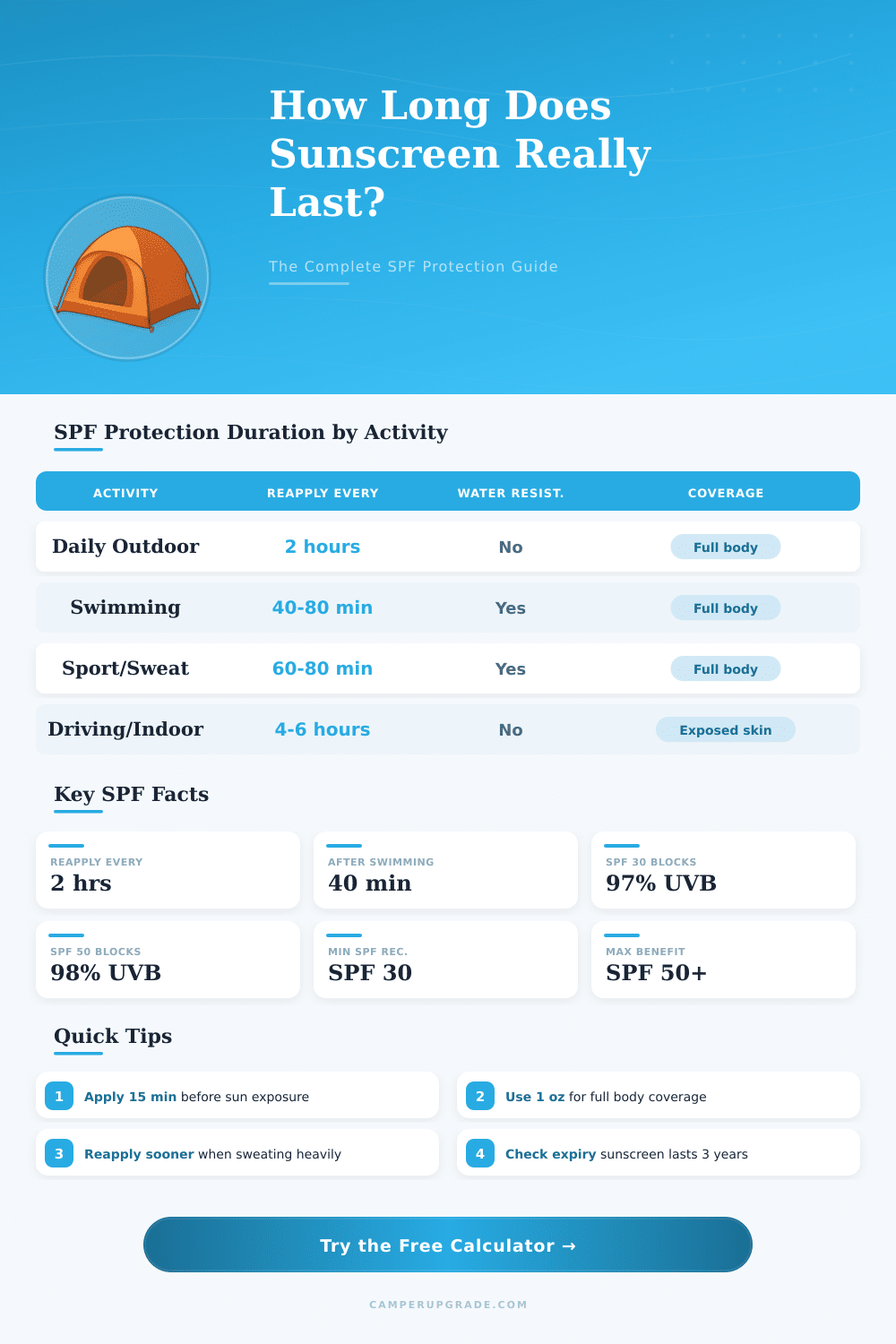
| Activity | Reapply Interval | After Water/Sweat | Notes |
|---|---|---|---|
| Minimal (indoors, driving) | Every 4-6 hours | N/A | UVA penetrates windows |
| Daily walking / light outdoor | Every 2 hours | After noticeable sweat | Standard recommendation |
| Moderate activity / light sweat | Every 90 minutes | Every 60-80 minutes | Use water resistant formula |
| Heavy activity / heavy sweat | Every 60 minutes | Every 40-60 minutes | SPF 50+ recommended |
| Swimming / water sports | Every 40-80 minutes | After every swim session | Immediately after toweling |
| Snow / skiing / high altitude | Every 60-90 minutes | After sweating | UV increases 4-5% per 1000 ft |
| SPF Level | UVB Blocked | UVB Reaches Skin | Base Protection Time |
|---|---|---|---|
| SPF 15 | 93.3% | 1 in 15 rays | Up to 2.5 hours (fair skin) |
| SPF 30 | 96.7% | 1 in 30 rays | Up to 3-4 hours (fair skin) |
| SPF 50 | 98.0% | 1 in 50 rays | Up to 4-5 hours (fair skin) |
| SPF 50+ | 98.0-98.7% | 1 in 50-75 rays | Up to 5 hours (fair skin) |
| SPF 100 | 99.0% | 1 in 100 rays | Up to 5-6 hours (fair skin) |
| Formula Type | Water Resistance | Duration Modifier | Best For |
|---|---|---|---|
| Regular lotion | None | Base duration | Daily, minimal activity |
| Water Resistant (40 min) | 40 min in water | +10% duration on skin | Light swimming, sports |
| Water Resistant (80 min) | 80 min in water | +20% duration on skin | Swimming, heavy sweat |
| Mineral / Zinc Oxide | Varies | +15% duration | Sensitive skin, all activities |
| Spray sunscreen | Varies | -10% (often under-applied) | Quick reapplication |
| Sunscreen stick | Often WR-80 | +5% duration | Face, lips, targeted areas |
| UV Index | Risk Level | Reapply Modifier | Recommended SPF |
|---|---|---|---|
| 0-2 (Low) | Minimal | Standard interval | SPF 15+ |
| 3-5 (Moderate) | Moderate | Standard interval | SPF 30+ |
| 6-7 (High) | High | Reduce by 15 min | SPF 30-50 |
| 8-10 (Very High) | Very High | Reduce by 30 min | SPF 50+ |
| 11+ (Extreme) | Extreme | Reduce by 45 min | SPF 50+ every hour |
Solar cream has several different names. Some call it sunblock, solar lotion or sunscreen. It is something that one puts on the skin to protect against sunburn and stop skin cancer.
It comes in many forms, for instance as creams, sprays gels and foams. There are a lot of choices, and picking the right one is not as simple as many believe.
How to Choose and Use Solar Cream
The amount of used solar cream and other protective items really matters. This product protects against sunburn, skin cancer, early skin aging and other dangers because of too much sun. Good solar cream should be broad-spectrum, so it filters both UVA-rays and UVB-rays.
Also water-resistance is a useful thing to look for. SPF of 30 or more is reliable, although 50 or more can be even more useful, because many folks do not put as much of it as needed.
SPF stands for Sun Protection Factor. It shows how much moer time one can stay in the sun to receive the same amount of UVB-damage than without any solar cream. For instance, SPF 10 shows that it takes ten times more time to reach the same level of damage.
Reapplying is an important cause. When one is outside more than two hours, one must reapply it. After swimming or sweating, one must replace it right away.
Water-resistant solar cream is not fully water-resistant. Many folks also use too little. Around one ounce is enough to cover the whole body.
Easily forgotten parts are the tops of ears, the neck, the tops of feat and places around clothing and sunglasses.
One picks solar creams based on the kind of skin. Lightweight gel solar cream works well for oily or mixed skin. Creams or thicker items with moisturizing ingredients work more for dry skin.
Always pick non-irritating items. Some sunscreen products use minerals, using things like zinc oxide. Zinc oxide is seen as a bit more useful for sun protection than titanium oxide.
Mineral sunscreen products sometimes feel powdery, but new versions spread easily with only few white traces.
Some sunscreen products are made as safe, without chemicals like oxybenzone and octinoxate, that were found causing harm. Australian solar creams often are thicker and heavy, usually made to be water-resistant. Korean and Japanese sunscreen products mostly are more light, because they do not plan for swimming.
European sunscreen products deserve attention, because they can follow more strict rules than some American. Daily putting solar creams on the face and on bare parts of skin inwarm days forms a good habit.