🏠 Rubber Roof Lifespan Calculator
Estimate how long your EPDM, TPO, or PVC rubber roof will last based on type, thickness, climate & maintenance
| Climate Zone | UV Exposure | Thermal Cycling | Life Adjustment | Notes |
|---|---|---|---|---|
| Cold / Northern | Low–Moderate | High (freeze-thaw) | –2 to +1 yrs | Membrane brittleness risk |
| Temperate | Moderate | Moderate | Baseline | Optimal conditions |
| Hot / Arid | Very High | Moderate–High | –3 to –5 yrs | UV degrades EPDM faster |
| Coastal / Humid | Moderate–High | Low | –1 to –3 yrs | Moisture & salt attack seams |
| Tropical / High UV | Extreme | Low | –4 to –6 yrs | Coating critical here |
| Maintenance Level | Cleaning | Inspection | Coating | Years Added / Lost |
|---|---|---|---|---|
| Poor | Never | Never | No | –5 to –8 yrs |
| Fair | Every 2–3 yrs | Annually | No | –2 to –3 yrs |
| Good | Annually | Annually | Occasionally | Baseline |
| Excellent | Twice yearly | Twice yearly | Every 5 yrs | +5 to +10 yrs |
| Roof Size (sq ft) | Roof Size (m²) | Typical Replace Cycle | Inspection Interval |
|---|---|---|---|
| Under 500 sq ft | Under 46 m² | 15–25 years | Annually |
| 500–1,500 sq ft | 46–139 m² | 15–25 years | Annually |
| 1,500–5,000 sq ft | 139–465 m² | 20–30 years | Every 6 months |
| Over 5,000 sq ft | Over 465 m² | 25–40 years | Every 6 months |
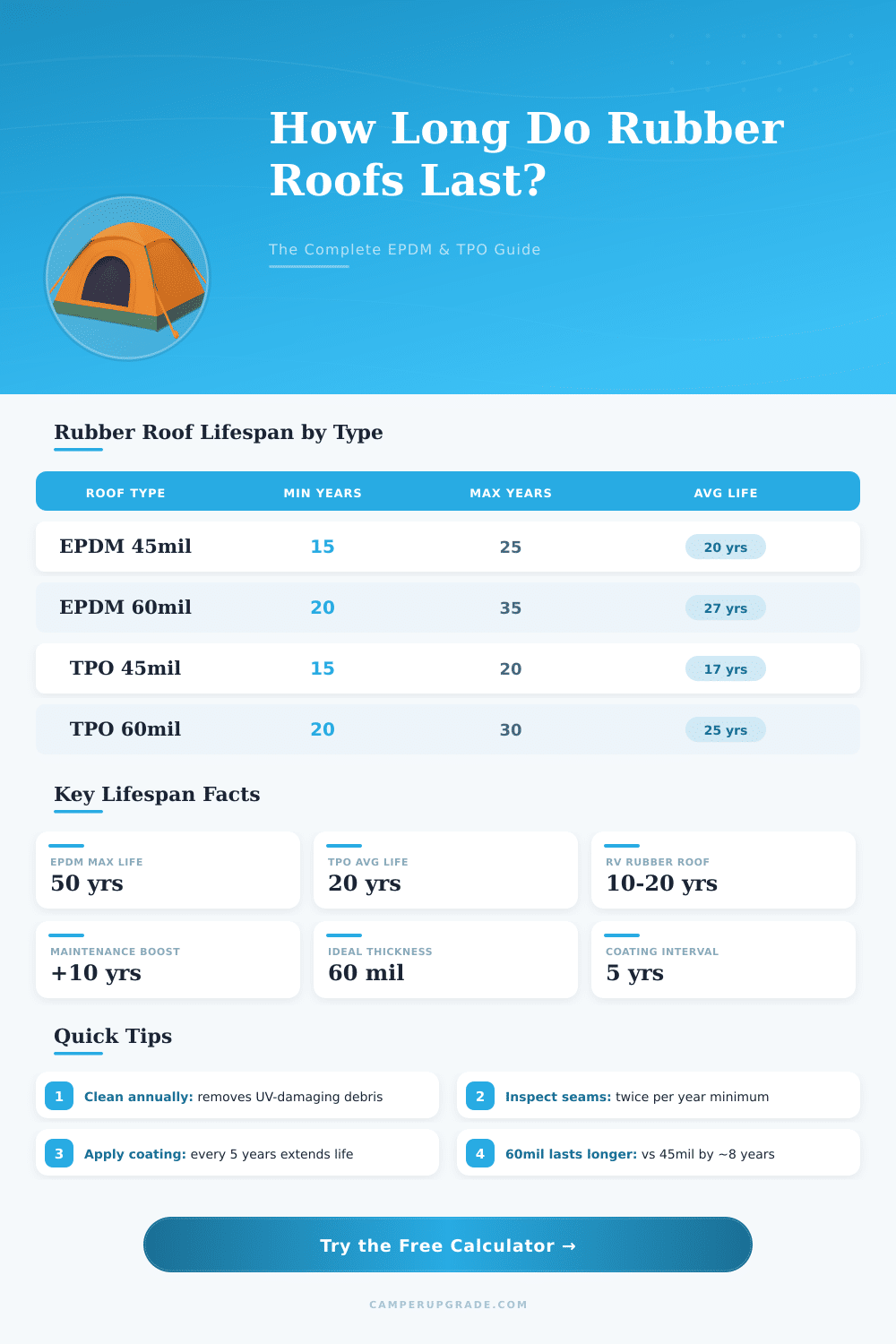
| RV (85–250 sq ft) | 8–23 m² | 10–20 years | Annually |
| Warning Sign | Severity | Typical Action | Urgency |
|---|---|---|---|
| Seam lifting or peeling | Moderate–High | Re-seam or patch | Within 1 month |
| Surface cracking / crazing | High | Full replacement | Immediate |
| Ponding water >48 hrs | Moderate | Slope correction | This season |
| Shrinkage / pulling | High | Replacement | Immediate |
| Blistering / bubbling | Moderate | Inspect & patch | Within 3 months |
| Interior staining/leaks | Critical | Emergency repair | Same day |
Travel vehicles often choose Rubber Roofs as the main solution today, because more than two million of them use such coverings. Such roofs stand out by means of their durability, low need of care and good price. Rubber easily repairs quickly installs and even cheaply replaces, so almost all managed travel vehicles on the market have this covering.
Rubber Roofs from EPDM rank between the most advanced options. It ensures waterproof and easily cared surface. EPDM-rubber stands out by means of great flexibility and high resistance, so that it well adapts to tight forms of roofs and can join for more complete usages.
Rubber Roofs for Travel Vehicles: Types and Care
It already shows, that it serves years without leaks. Also PVC Rubber Roofs count as a choice, and one considers them the strongest for travel vehicles, with the biggest pull strength and durability against cuts or holes. TPO offers another great option, because it is strong, resists water and well handles UV-light together with heat, although the joining parts dry during yaers and ultimately require update.
Rubber Roofs even so not always well defend against scratches or UV-damages. Here is a truly weak aspect. Regular cleaning of the roof each year or every second with proper rubber cleaner, together with soft protectors, stops the material from breaking because of UV-damage.
When the travel vehicle does not get used, parking under covering is a wise step. Every owner of such vehicle should check the roof at least twice yearly, ideally in spring and fall. The roof forms the first barrier against harsh natural forces.
If the roof starts to fit badly, it can rub against everything that touches it. That signals well, that a fix will bee required before problems expand. A fix requires a lot of work.
Plastic sheets protect the sides of the travel vehicle during the whole action. Products like Dicor for EPDM Rubber Roofs or Roof-Gard are popular, because they strengthen defence against UV-rays. Liquid rubber covers, that resist water, UV-attack and easily apply, are available for long-term guard.
Actually, an entirely new roof is rarely needed. Usually, rubber covering of a travel vehicle one renews by means of coating with silicone liquid, that closes leaks and creates fresh layer. One can do it yourself or professionally done.
If it applies correctly, such systems are guaranteed for 12 years and can serve 20 or more, which is not a new thing. Professional repair kits come in various lengths with all needed parts for safe placing.
Products with crude oil matter to avoid on Rubber Roofs, because they can cancel the guarantee and injure the material. Always check, what kind of rubber covering is on the travel vehicle, and ensure, that any glue ormembrane answers to that precise model.