🏠 EPDM Roof Lifespan Calculator
Estimate how long your EPDM rubber roof will last based on membrane thickness, climate, installation type, and maintenance habits.
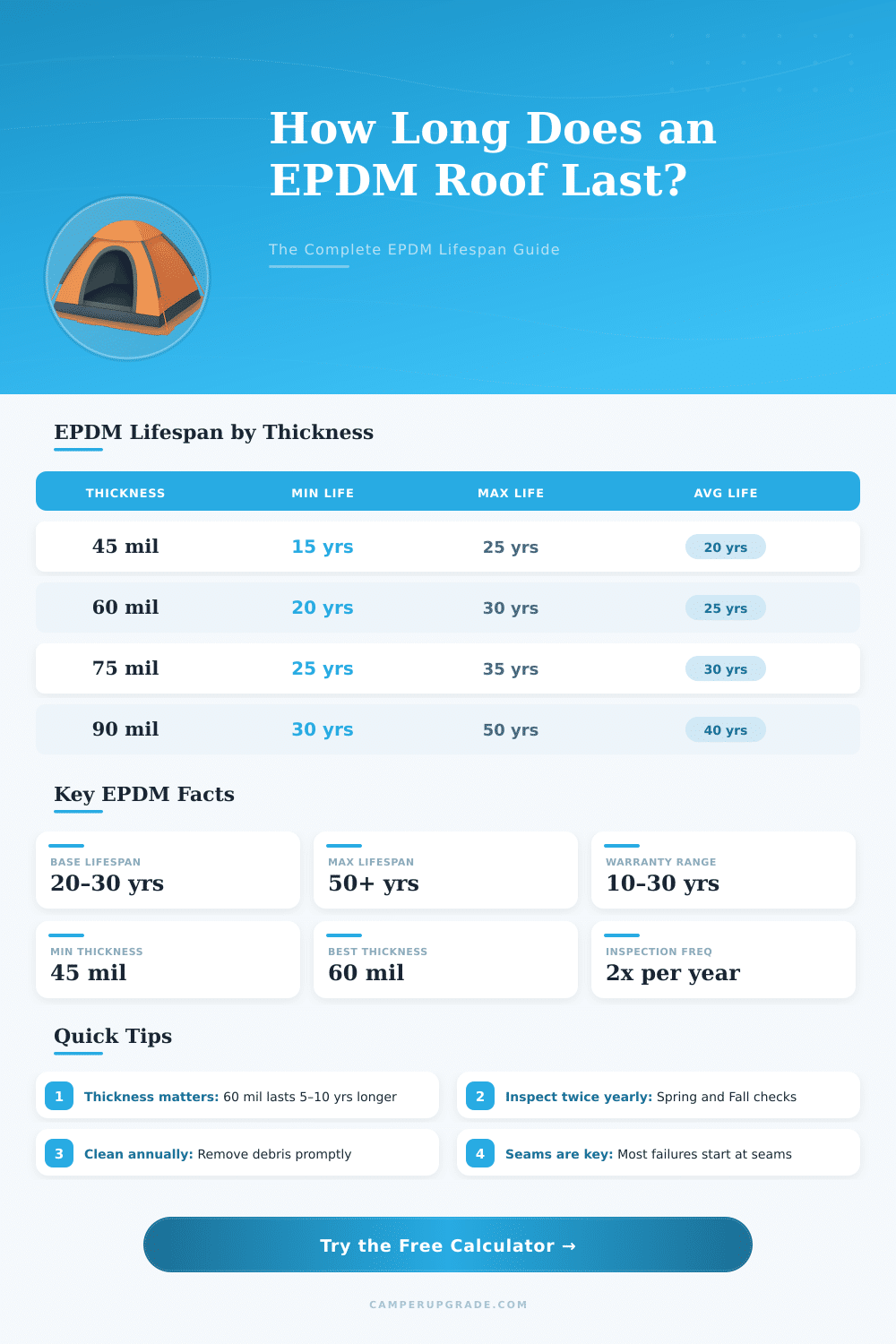
| Thickness | Mild Climate | Moderate Climate | Harsh Climate | Tropical |
|---|---|---|---|---|
| 45 mil | 20–25 yrs | 15–20 yrs | 12–18 yrs | 14–20 yrs |
| 60 mil | 25–30 yrs | 20–28 yrs | 18–25 yrs | 20–27 yrs |
| 75 mil | 30–40 yrs | 25–35 yrs | 22–30 yrs | 25–35 yrs |
| 90 mil | 40–50+ yrs | 30–45 yrs | 27–40 yrs | 30–45 yrs |
| Installation Method | Lifespan Modifier | Best For | Notes |
|---|---|---|---|
| Fully Adhered | +3 to +5 years | Residential, low slope | No billowing, best wind resistance |
| Mechanically Attached | Baseline | Commercial, large roofs | Faster install, some flex movement |
| Ballasted | –2 to +2 years | Flat commercial roofs | Depends on ballast quality and load |
| DIY Self-Adhesive | –3 to –6 years | Small sheds, patches | Seam failure risk higher without pro install |
| Maintenance Level | Inspection Frequency | Lifespan Effect | Key Tasks |
|---|---|---|---|
| Excellent | Twice per year | +5 to +8 years | Clean, inspect seams, reseal flashings |
| Good | Once per year | +2 to +4 years | Annual inspection, clear debris |
| Fair | Every 2–3 years | Baseline | Occasional visual check |
| Poor | Rarely | –3 to –6 years | Missed minor repairs become major |
| Neglected | Never | –6 to –10 years | Seam failures, ponding damage |
| Thickness | Metric (mm) | Typical Warranty | Best Application |
|---|---|---|---|
| 45 mil | 1.14 mm | 10–15 years | Sheds, RV roofs, small projects |
| 60 mil | 1.52 mm | 15–20 years | Residential homes, standard commercial |
| 75 mil | 1.90 mm | 20–25 years | Heavy duty commercial, high traffic |
| 90 mil | 2.29 mm | 25–30 years | Premium residential, green roofs, ponds |
EPDM is made up of strong rubber for roofing skins. It is the short form of ethylene-propylene-diene-terpolymer, and one uses it mainly for low slopes in United States and globally. Many folks simply call it rubber roof what has sense, because well, that describes it in essence.
Between the advantages of EPDM is its good resistance against harsh weathers. In very cold conditions, it stays flexible, even down to minus forty degrees Fahrenheit. Also it belongs to the most stable heat addressed skins by size.
EPDM Rubber Roofs: What They Are and How to Care for Them
Thanks to 465-percent stretching and high resistance to tearing, it well protects against strong corrosion. Its rubber flexibility allows that it moves together with the building, without breaking the skin. It lasts heat, cold, rain, snow and salt.
Black EPDM sheets come even up to 50 feet wide and 100 feet long. However such big size is not needed for the most many works. The material comes in 45-thousandth thickness, what matches almost the thickness of a cent.
Pressing by means of special technique means seamless sheets.
One finds both black and white types. Black EPDM skins help to lower costs for heating, what is useful in regions with long winter seasons. White versions, on the other hand, reduce costs for cooling.
Like this the colour chooses itself according to the local climate. EPDM Roof answers especially well for north buildings.
One can install it many ways. The skin joins to regular insulation or set firmly to structural attic under metallic panels. Insulation fills the spaces between metallic roofing parts and later gets covered by means of extra board.
Both elements bind firmly ore join to the metal roof. For shine and stamp around poles and edges, EPDM accessories use strips and sticks.
About care it is fairly easy. Little holes or cracks commonly get fixed soon. Even so EPDM hardly resists oil-based fuels, many oils and nonpolar solvents.
If one uses wrong cleaner, that can create serious troubles. The skin becomes sticky and starts tearing, when some apply oil product on it.
EPDM rubber roofing skin is made to serve 20 years or even more. It normally comes with 10 to 12-year guarantee, according to the maker. Makers claim that such rubber roofing skins do not need extra protective coverings.
Plain EPDM usually lasts more well during years than strengthened type. Some strengthened roofs seem rough after only 15 years, while plain ones yet look well at 25 years old. EPDM does not match with underlayment or shields against ice andwater, so one must check that during install.