💧 RV Water Filter Life Calculator
Find out exactly when to replace your RV water filter based on your usage and water conditions
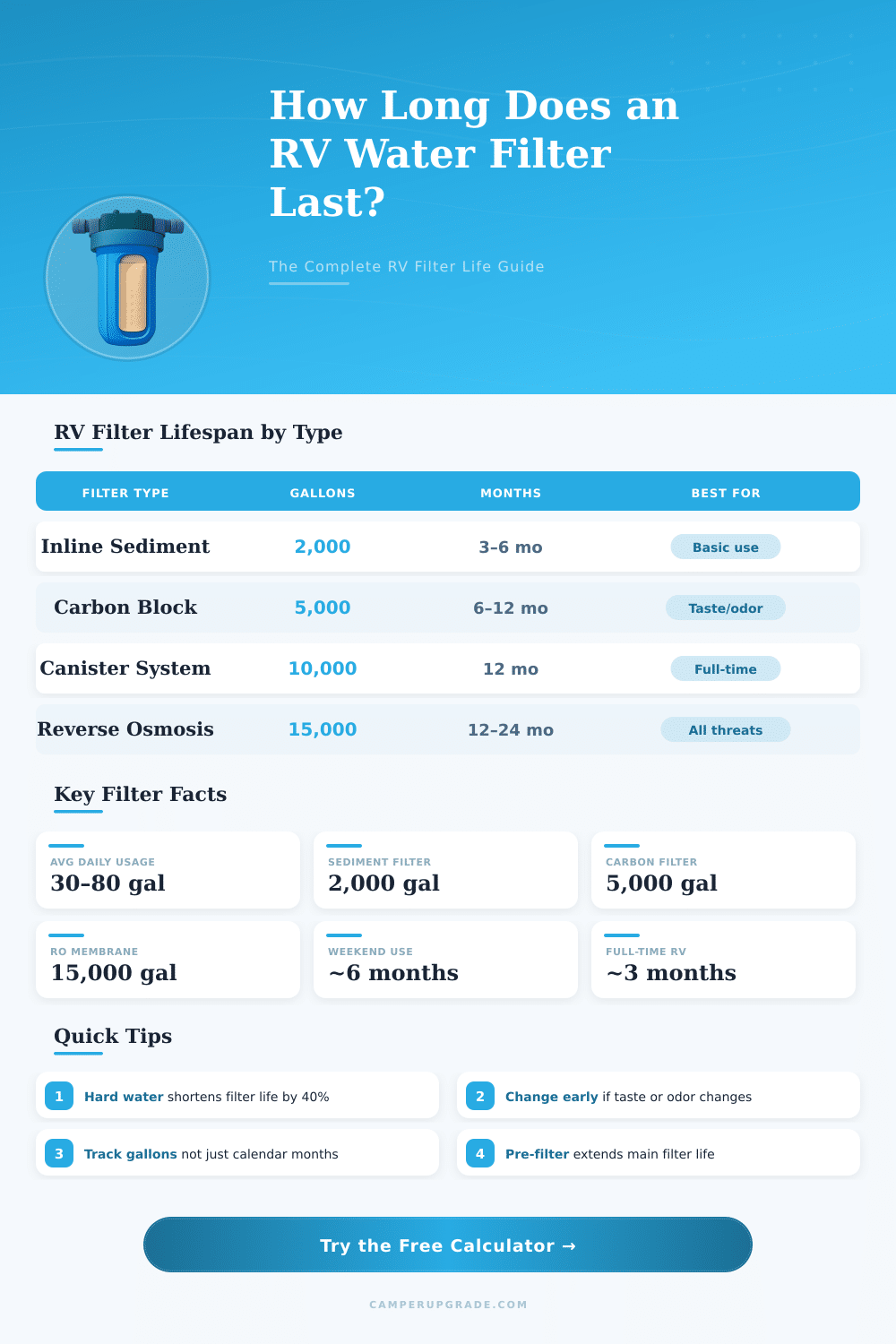
| Filter Type | Max Capacity (gal) | Weekend Use | Full-Time Use | Max Months |
|---|---|---|---|---|
| Inline Sediment | 2,000 | 8–12 months | 2–3 months | 12 |
| Carbon Block | 5,000 | 12–24 months | 4–6 months | 12 |
| Single Canister | 10,000 | 2+ years | 8–12 months | 12 |
| Dual Canister | 15,000 | 3+ years | 12–18 months | 18 |
| Reverse Osmosis | 15,000 | 3+ years | 12–24 months | 24 |
| UV Filter | 3,000 | 10–14 months | 3–4 months | 12 |
| Ceramic Filter | 12,000 | 2+ years | 10–14 months | 24 |
| Whole-RV Inline | 2,500 | 8–14 months | 2–3 months | 12 |
| Water Quality | Life Multiplier | Notes | Recommended Action |
|---|---|---|---|
| Soft / Municipal | 1.2x (longer) | Low TDS, treated water | Standard replacement |
| Normal / Average | 1.0x (baseline) | Average sediment load | Follow manufacturer guide |
| Moderate Hardness | 0.8x (shorter) | 50–150 ppm hardness | Check quarterly |
| Hard Water | 0.6x (much shorter) | 150+ ppm, heavy sediment | Add pre-filter, check monthly |
| Well Water | 0.5x (shortest) | Unknown contaminants | Test water, add pre-filter |
| Usage Type | Gal/Person/Day | Liters/Person/Day | Typical Activities |
|---|---|---|---|
| Minimal / Dry Camping | 5–10 | 19–38 | Drinking, basic cooking |
| Conservative | 10–20 | 38–76 | Add quick showers |
| Average RV Use | 20–40 | 76–151 | Normal showers, dishes |
| Comfortable Use | 40–60 | 151–227 | Long showers, full cooking |
| Heavy / Home-Like | 60–100 | 227–379 | Like a stick-and-brick home |
RV Water Filter is quite important for each person that travels by means of a motorhome, travel trailer or camper. The quality of water can range a lot from one campground to the next, so having a good filter setup helps to keep drinking water pure and safe.
A popular choice is the Camco 40043 TastePure inline Water Filter. You connect it to the outside tap, and it helps to reduce bad taste, smells, chlorine and sediment in the drinking water. It even comes with a flexible hose connector.
How to Choose an RV Water Filter
The blue Camco filters are very common, but they filter only at 10 microns which is quite a big pore in the world of filtering.
For better filtering, some setups use a pre-filter at 1 micron, and then a carbon filter at 0.5 microns. In a three-stage system the first two stages remove sediment, and the last stage filters out things like lead, heavy metals and cysts. Such sediment filters can clog quickly, and that shows how much stuff actually floats around in campground water.
The filters from Clearsource use a three-stage system with a coconut shell carbon block filter, that removes and reduces bacteria from the drinking water. The Clearsource Extreme system is designed for outside RV connections. Another option is the iSpring CW31-PF: a three-stage system with lead-free brass fittings, that was tested for removal of PFAS.
There are also NSF-certified choices from brands like Blue Technology, that offer portable, improved and outside inline filter systems.
Some RV users choose reverse osmosis systems. The APEC RO-CTOP-C is a reliable countertop RO filter for RVs. The tankless iSpring 500 system works well under the sink.
Even so, some reckon that RO is an excessive solution, unless the water source is known to be polluted.
The best Camco filters combine a outer sediment layer for sediment with a core of activated coal. Carbon filters can actually be cleaned up to 100 times using a plastic scrub pad, when the flow noticeably drops.
Most RV Water Filter units must be replaced every three to six months, depending on the water quality. Some last closer too three months. It does not really matter where the filter sits, whether at the water stand or at the camper, as long as it filters the water before it enters the RV.
Some vehicles come with a built-in filter under the sink or in the wet compartment, but many owners prefer to add an outside filter to avoid leaks and broken fittings, that caused complaints. Using an inline filter between the RV and the watersource is always a good first step. A brass screen filter can catch big bits before the water even enters the system.