🚗 RV Pad Material Calculator
Calculate exactly how much gravel, crushed stone, or base material you need for your RV pad or campsite project.
lbs / cu yd
lbs / cu yd
lbs / cu yd
lbs / cu yd
lbs / cu yd
lbs / cu yd
lbs / cu yd
lbs / cu yd
| Depth | Depth (cm) | Sq Ft / Cu Yd | Sq M / Cu M | Cu Ft / Cu Yd |
|---|---|---|---|---|
| 1 inch | 2.54 cm | 324 sq ft | ~30.1 m² | 27 cu ft |
| 2 inches | 5.08 cm | 162 sq ft | ~15.1 m² | 27 cu ft |
| 3 inches | 7.62 cm | 108 sq ft | ~10.0 m² | 27 cu ft |
| 4 inches | 10.16 cm | 81 sq ft | ~7.5 m² | 27 cu ft |
| 6 inches | 15.24 cm | 54 sq ft | ~5.0 m² | 27 cu ft |
| 8 inches | 20.32 cm | 40.5 sq ft | ~3.8 m² | 27 cu ft |
| Bag Size | Volume / Bag | Bags / Cu Yd | Coverage @ 3in | Approx Weight |
|---|---|---|---|---|
| 0.5 cu ft bag | 0.5 cu ft | 54 bags | ~2 sq ft | ~50 lbs |
| 0.75 cu ft bag | 0.75 cu ft | 36 bags | ~3 sq ft | ~75 lbs |
| 1 cu ft bag | 1.0 cu ft | 27 bags | ~4 sq ft | ~100 lbs |
| 2 cu ft bag | 2.0 cu ft | 13.5 bags | ~8 sq ft | ~200 lbs |
| 3 cu ft bag | 3.0 cu ft | 9 bags | ~12 sq ft | ~300 lbs |
| Bulk 1 ton | ~0.67 cu yd | — | ~72 sq ft | 2,000 lbs |
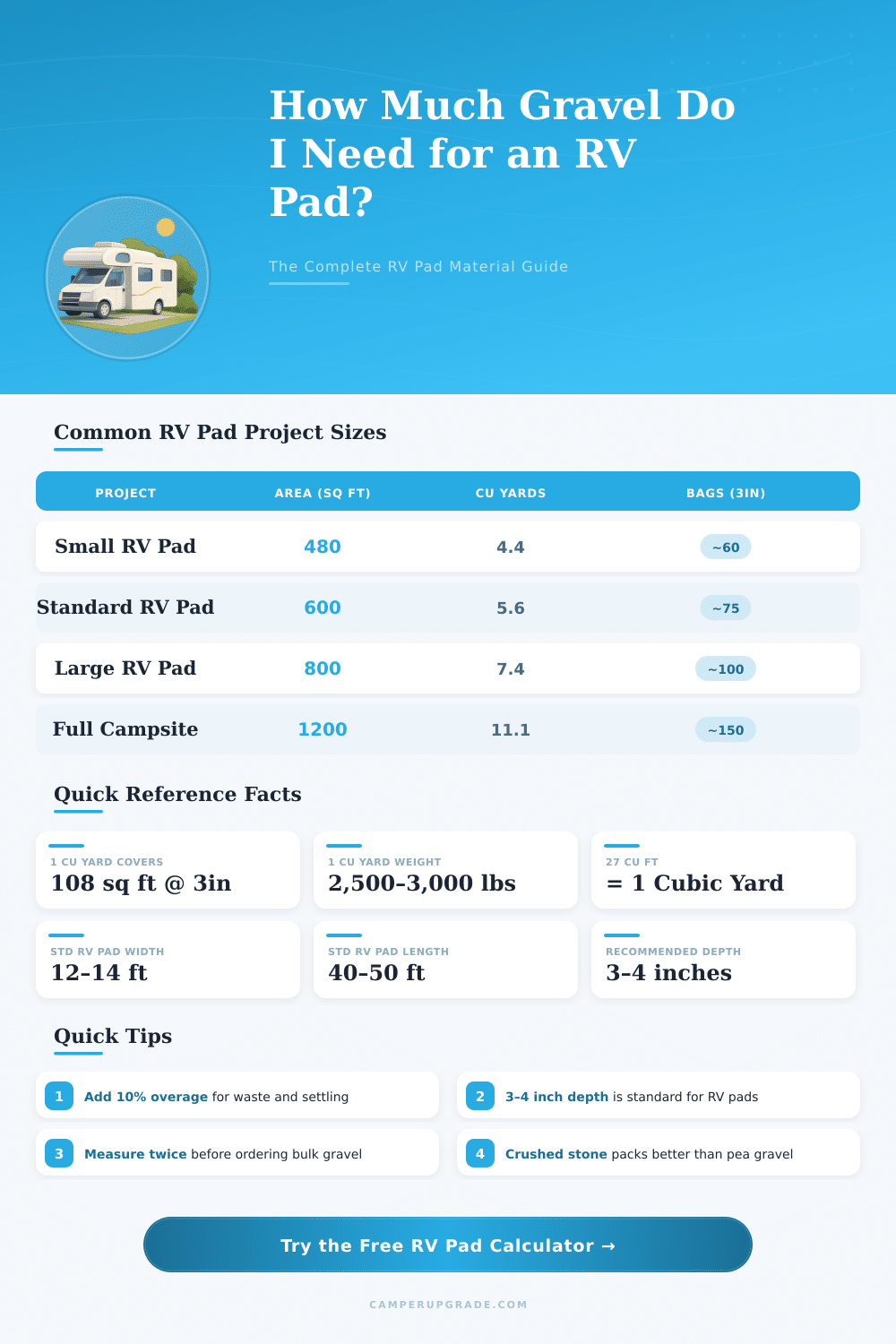
| Project Name | Dimensions | Area (sq ft) | Cu Yds @ 3in | 2cu ft Bags |
|---|---|---|---|---|
| Small RV Pad | 12 x 40 ft | 480 sq ft | 4.4 yds | ~60 bags |
| Standard RV Pad | 12 x 50 ft | 600 sq ft | 5.6 yds | ~75 bags |
| Large RV Pad | 14 x 50 ft | 700 sq ft | 6.5 yds | ~88 bags |
| Tandem/Double Site | 14 x 60 ft | 840 sq ft | 7.8 yds | ~105 bags |
| Square Campsite | 20 x 20 ft | 400 sq ft | 3.7 yds | ~50 bags |
| Awning Zone | 8 x 20 ft | 160 sq ft | 1.5 yds | ~20 bags |
| Fire Pit Circle | D = 10 ft | 78.5 sq ft | 0.73 yds | ~10 bags |
| Group Campsite | 20 x 40 ft | 800 sq ft | 7.4 yds | ~100 bags |
RV Pad is simply an area where one can park an RV. In a campground, such a pad always should be flat and without obstacles. When folks talk about building an RV Pad at the side of their home, they most commonly mean a place for storing the RV away from the driveway or outside rental space that costs a lot.
A solid parking base is more important than many believe. It provides the RV stable support, especially during winter when it stands there for months. One must avoid bare soil, because it quickly becomes dirt.
Simple RV Pad Types and Costs
Placing something over the ground removes dust and problems with dirt.
Crushed stones are commonly chosen. No need to spend much money on concrete or asphalt, if crushed stones work. With good bottom it drains water well and easily levels.
The kind of crushed stones, usually called “crusher run”, are made up of bits of three-quarter inch down to powder size. One can make it from various stones, even from old concrete. It serves as basic material for paths and parkings.
Stable RV Pads are built using three-quarter-inch limestone, granite or basic stuff like crushed stones and flexible base.
A good method was to lay weed-blocking fence and crushed rocks in the side garden. One made a path using ten-by-ten-by-two square feet of stones to reach the door. The whole expense reached around two hundred dollars and the pad lasted eight years without problems.
Cracked asphalt forms another option. One pad of fifteen by forty-five feet installed using ground asphalt. It costs less than regular asphalt.
After three years the RV and trailers did not sink or damage anything. The expense for mining, leveling, work and materials came to fourteen hundred dollars.
Concrete forms the most strong type of RV Pad and needs little care. After pouring and setting it stays usable for years. For strength, rebar does help.
Bigger rocks in the mix give more strength. Pavers look nice, but move over thyme.
Crushed stone grids offer a friendly do-it-yourself solution, that allows one to create their own parking pad without trouble, high price or heavy machines for concrete. Products like grid gates hold the base on grass or crushed stone. Right base truly changes everything.
Rental of an RV Pad in a campground ranges by season. Summer months can cost around thirteen hundred dollars per month, dropping to nine hundred fifty during off-season. Nightly and weekly options are available, but many choose monthly andstay some months long.